Get Full Government Meeting Transcripts, Videos, & Alerts Forever!
Get email alerts on the Public Safety topic
No spam. Unsubscribe anytime.
Committee hears technical corrections to HB 4002 including fentanyl statute changes, pharmacy authority and automatic-expungement fixes
Summary
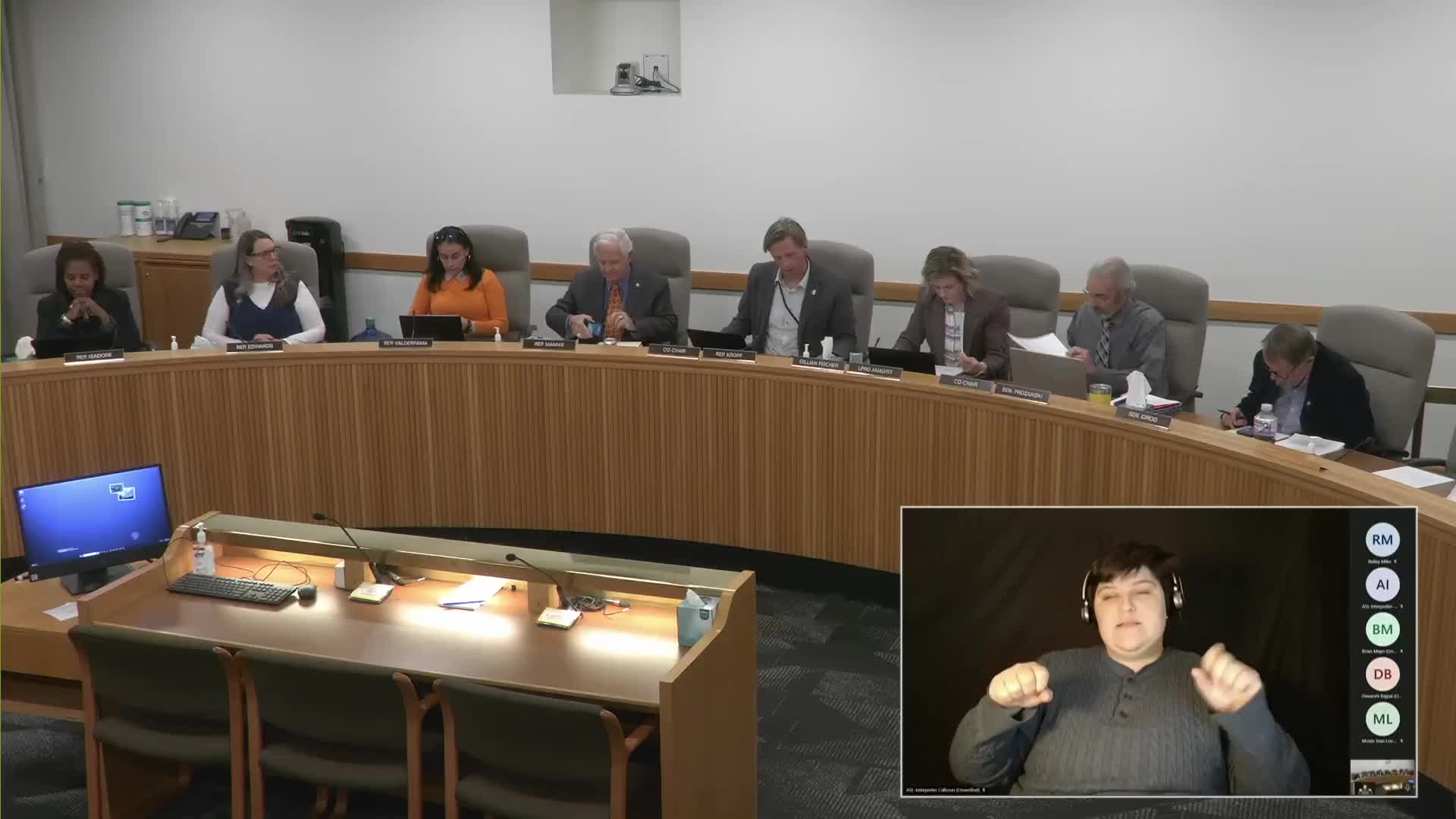
Senators and representatives on the Joint Committee on Addiction and Community Safety Response heard public testimony Feb. 5 on Senate Bill 236, an omnibus technical-corrections bill tied to House Bill 4,002 (2024) that sponsors and agency witnesses said would separate fentanyl offenses into distinct statutes, adjust pharmacy authority and prescription processes for medications for opioid use disorder (MOUD), expand a jail-based MOUD grant to some correctional facilities, and correct automatic-expungement provisions that are not currently functioning as intended.
Senators and representatives on the Joint Committee on Addiction and Community Safety Response heard public testimony Feb. 5 on Senate Bill 236, an omnibus technical-corrections bill tied to House Bill 4,002 (2024) that sponsors and agency witnesses said would separate fentanyl offenses into distinct statutes, adjust pharmacy authority and prescription processes for medications for opioid use disorder (MOUD), expand a jail-based MOUD grant to some correctional facilities, and correct automatic-expungement provisions that are not currently functioning as intended.
The bill matters because the changes are intended to make the 2024 law operable without changing criminal penalties, improve access to MOUD through pharmacies and correctional facilities, and allow automated set-asides of eligible convictions once state information systems and procedures can support that automation.
Rob Bovette, an adjunct professor at Lewis & Clark Law School who testified for the bill, told the committee sections 1–16 “basically break out fentanyl into separate statutes” so fentanyl fits into Oregon’s existing controlled-substances statute structure. Bovette said the drafting goal is not to change offense levels or outcomes but to enable better data tracking and independence from shifting federal schedules. He described sections 18–23 as fixes to make pharmacist authority for MOUD prescriptions and dispensing work in compliance with federal and state law.
Brian Mayo, executive director of the Oregon State Pharmacy Association, testified in strong support and described specific proposed amendments. He said the changes would remove early-refill language, add authority for pharmacists to administer MOUDs and clarify that prescription drug lockers should be treated as extensions of the retail outlet that operates them. “These refinements will allow for smoother implementation of the bill while maintaining patient safety and regulatory compliance,” Mayo said.
Section 17 would expand the jail-based grant program created under House Bill 4,002 to allow some county community corrections centers to receive funding for medication-assisted treatment. Bovette told the committee that section 17 mirrors language in a separate bill (House Bill 3,009) and that the provision could be pulled into a standalone measure if the committee prefers; he said his preference was to keep the change in SB 236. He also said he had heard “nobody in opposition” to expanding the grant to community corrections centers.
Aaron Knott, director of government relations and communications for the Oregon Judicial Department, told the committee the most technically fraught part of HB 4,002 is the automatic set-aside (automatic expungement) framework in sections 54–56, which “as a technical matter ... just didn’t work.” Knott described multiple distinct record-creation paths (deflection, citation, arrest, conditional discharge, probation) and the challenge of reconciling data across courts, law enforcement, probation offices and other systems so an automated process can reliably identify and set aside eligible records. He said partners have already been coordinating to align data fields and that the department will return with draft technical amendments. “We will be returning to you with technical amendments in the very near future that are designed to make this process work better,” Knott said.
Committee members asked clarifying questions about who would administer the automatic set-aside process and whether granting expanded pharmacist authority would apply to direct observed dosing requirements for some MOUDs; Mayo and Knott answered that the intent is to preserve patient safety and compliance with federal requirements while removing unintended regulatory barriers. Committee staff and witnesses also discussed the Criminal Justice Commission’s role; Bovette said he wants the bill to expressly give CJC authority to set grant-formula structure for the deflection grant programs it administers.
There was no committee vote on SB 236 during the hearing; the committee closed the public hearing and moved on to a separate bill. Sponsors and agency witnesses left the committee with next steps: prepare targeted technical amendments to sections identified during testimony (including the automatic-expungement provisions) and to work with stakeholders — including the Oregon State Pharmacy Association and the Criminal Justice Commission — on language the committee can adopt in a future meeting.
Evidence spans from the hearing include the committee’s opening of the public hearing on SB 236 and the committee’s subsequent closing of that hearing to open testimony on a separate bill.