Get Full Government Meeting Transcripts, Videos, & Alerts Forever!
Get email alerts on the Court Technology And Access topic
No spam. Unsubscribe anytime.
Judicial Department details online court tools, e-filing growth and remote-hearing tech
Summary
Oregon Judicial Department officials described e-filing, Guide and File, facilitators and remote-hearing systems for civil cases and said digital services handled nearly 2 million filings in 2024 and sent about 196,000 automated text reminders to litigants and jurors.
The Judicial Department told the Public Safety Subcommittee on Feb. 4 that Oregon’s court technology and online services have expanded and now carry a large share of filings and case communications.
"E-filing has really transformed Oregon's court system," Jessica Roeser, Assistant Deputy State Court Administrator for Operations at the Oregon Judicial Department, told the committee. "In 2024, we had almost 2,000,000 filings that were submitted through e-file." She also said that 81% of civil filing fees were paid online through File and Serve in 2024 and that the department sent about 196,000 automated text messages to litigants and jurors last year—roughly 16,000 per month.
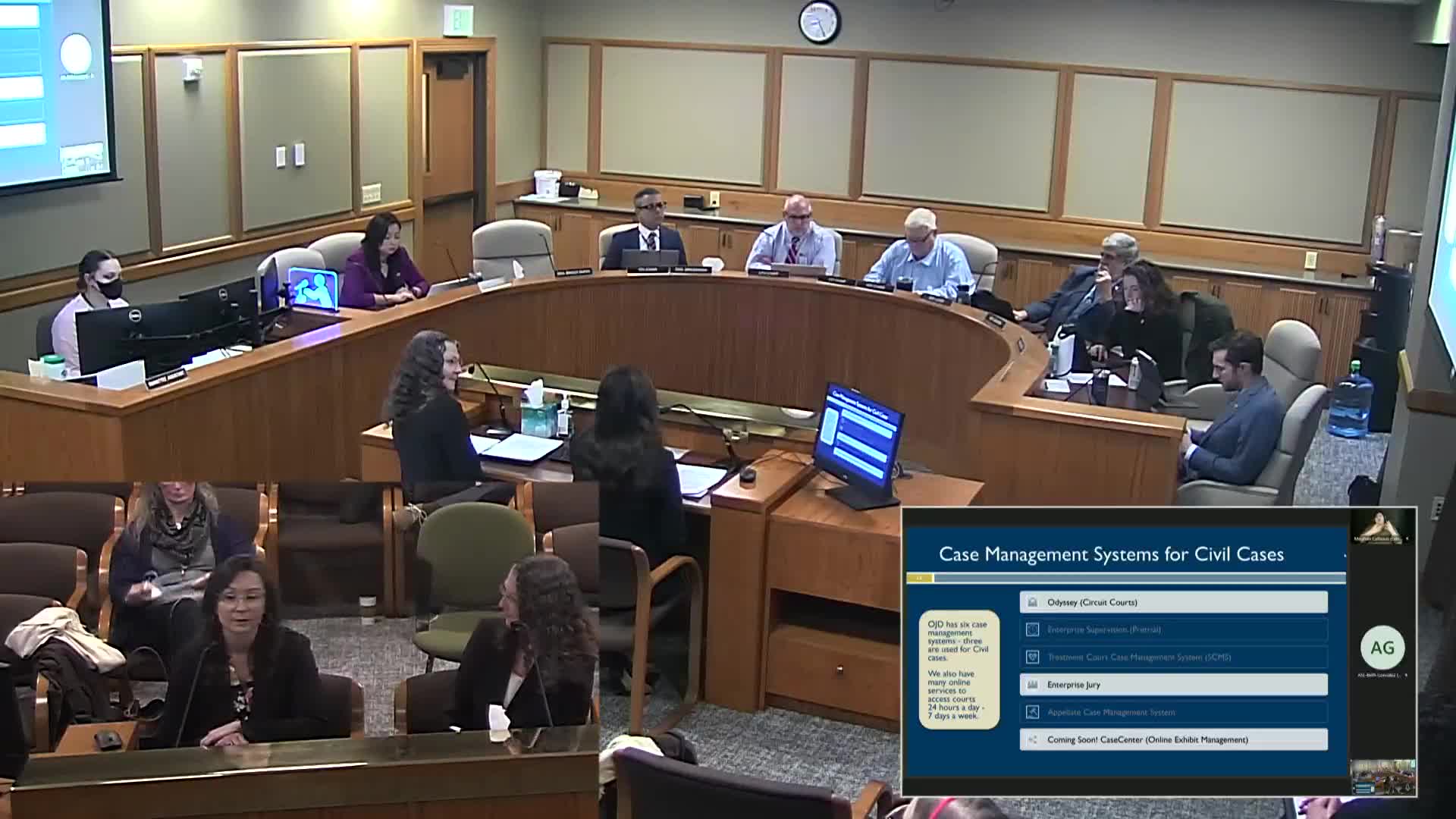
Roeser outlined the department’s primary civil case management systems: Odyssey for circuit courts, Enterprise Jury for jury management, and a forthcoming Case Center to manage exhibits and streamline evidence submission. She described Guide and File as a question-and-answer form system that lets self-represented litigants prepare and file specific forms for free.
Demographic data shared by the department showed Guide and File users are 59% female, most are aged 25–44, about 70% have some college education or higher, and nearly one in four users reported household income under $25,000 a year. Roeser said the tool is intended to bridge access gaps for people who cannot afford counsel.
On remote hearings, department officials said WebEx is the uniform video-conference tool used across districts; Polycom is used for phone conferencing. Courts may decide docket-by-docket whether to use phone or video remote hearings. The department is tracking online hearings but officials said historical tracking is incomplete and a new business process would improve accuracy.
Roeser described facilitation services and online booking: court facilitators can be booked for phone, video or in-person appointments to help litigants identify forms and check documents for completeness; facilitators do not provide legal advice. Committee members asked whether facilitators are mandatory reporters for child abuse; Roeser said she would follow up with an answer.
Why it matters: the department said digitization reduces paperwork, increases access to information and can reduce missed hearings. Legislators asked for additional breakouts of Guide and File usage by case type and for average wait times for facilitator appointments.
Officials said they would provide follow-up details to the committee where data are incomplete.