Get Full Government Meeting Transcripts, Videos, & Alerts Forever!
Get email alerts on the Idd Access Cooccurring topic
No spam. Unsubscribe anytime.
Lawmakers press OHA on gaps for people with intellectual and developmental disabilities and co-occurring behavioral health needs
Summary
Legislators raised examples of people with intellectual and developmental disabilities (IDD) being denied behavioral health care; OHA said it is expanding provider training, embedding expectations in RFPs and using cross-agency placements to address gaps.
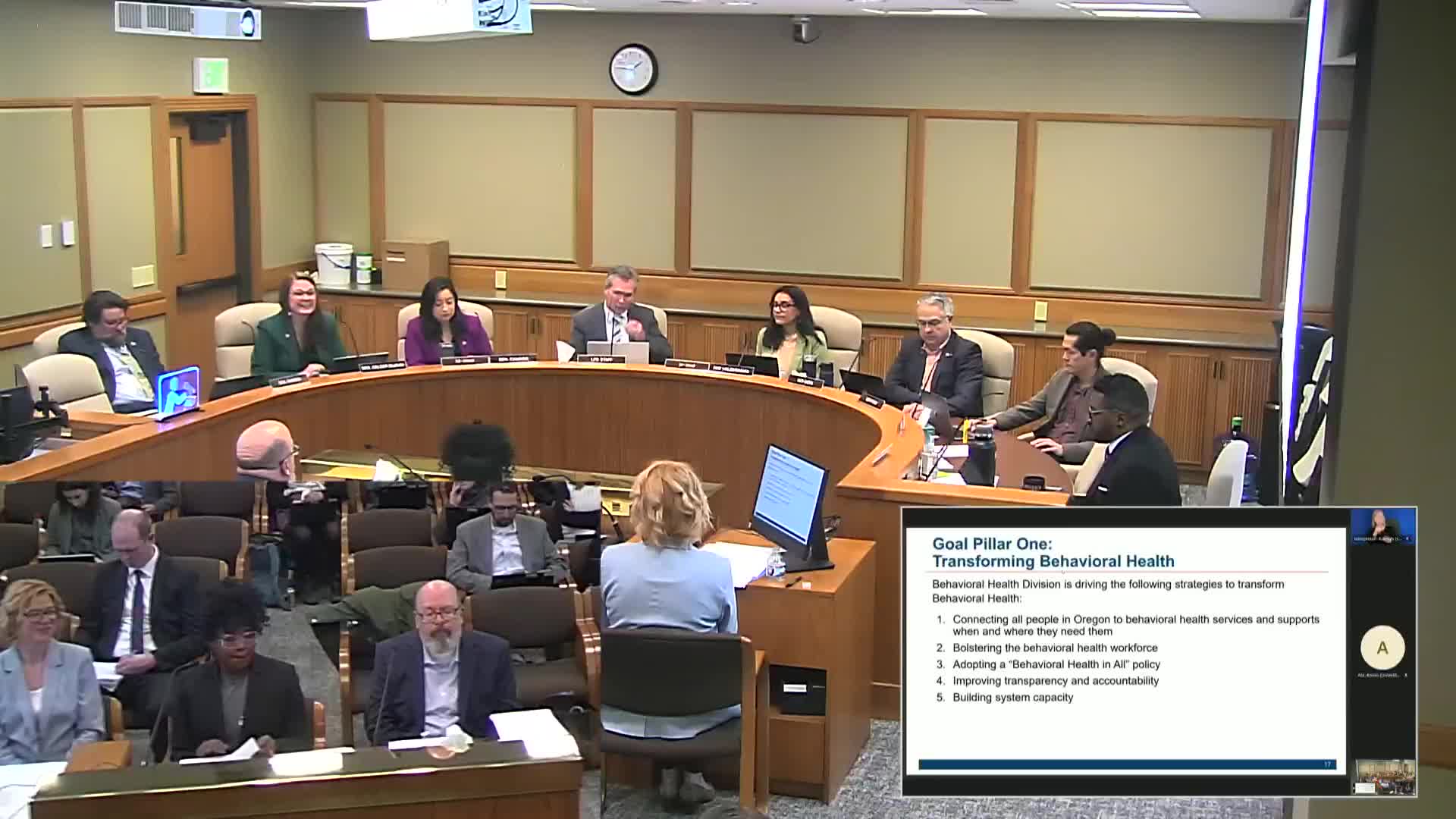
During the Feb. 4 informational meeting, senators and representatives pressed OHA officials about people with intellectual and developmental disabilities (IDD) who are turned away from behavioral health services when they need assessments or treatment for co-occurring mental health conditions.
Senator Gelser Bluen described cases where families were told facilities do not serve people with IDD or were told to institutionalize someone to access psychiatry. She asked what concrete steps are underway to stop that exclusion and improve access.
Krista Jones, deputy director for service delivery, and Ebony Clark, behavioral health director, said OHA is pursuing several steps: increasing provider competence via trainings (including an ECHO training for providers working with adults with co-occurring needs), embedding competence expectations in RFPs for residential and young-adult transition programs, partnering with ODDS on cross-agency placements, and convening summits to bring IDD and behavioral health systems together. Clark also said OHA is finalizing metrics specific to transforming behavioral health that will include goals tied to cross-system issues.
John Collins said programs that frequently serve people with co-occurring IDD and behavioral health needs are expected to develop multidisciplinary teams and specialized expertise; he added that baseline skills (empathy, connection, high-level psychosocial assessment) can help providers identify immediate needs and refer to appropriate specialty services.
OHA told the committee it would follow up in writing with contact names and resources for families seeking help and would provide additional materials on billing and administrative issues that can create gaps in service. Presenters acknowledged there is more work to do and said training, contract expectations and cross-agency coordination are active priorities.