Get Full Government Meeting Transcripts, Videos, & Alerts Forever!
Get email alerts on the It Modernization topic
No spam. Unsubscribe anytime.
OLCC seeks extra $8 million for distilled spirits supply chain IT lift, cites vendor work and point-of-sale costs
Summary
The Oregon Liquor and Cannabis Commission told the Transportation and Economic Development Subcommittee that additional spending authority is needed to finish a large IT modernization project for the distilled spirits supply chain, citing higher vendor costs since planning and unbudgeted point-of-sale hardware for stores.
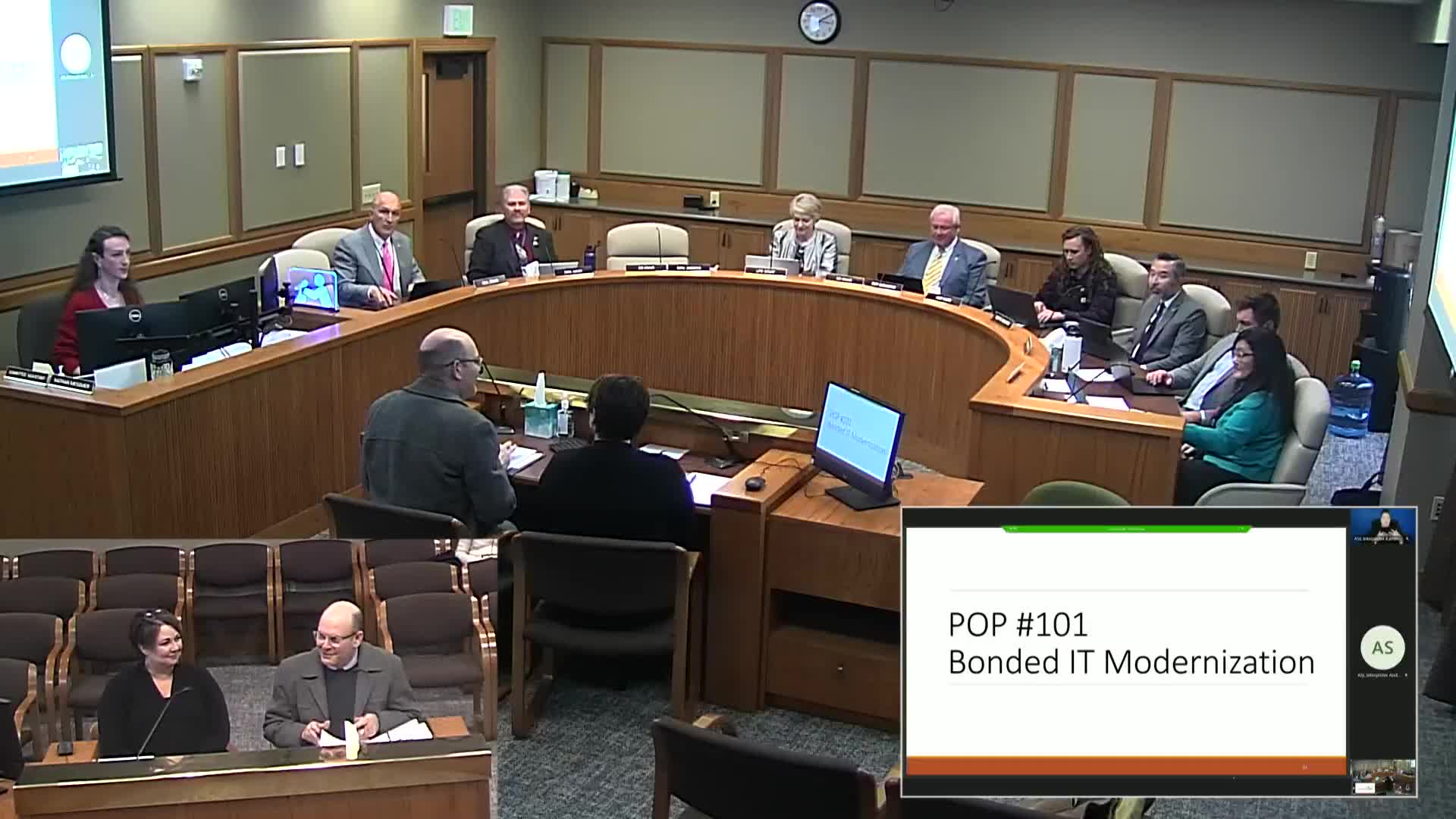
The Oregon Liquor and Cannabis Commission (OLCC) asked the Transportation and Economic Development Subcommittee on Feb. 4 to add roughly $8 million to a previously authorized bonding package for the distilled spirits supply chain (DSSC) portion of the agency's IT modernization. OLCC Director Craig Prins said the agency completed an RFI in 2019, issued an RFP in late 2023, and has selected a project vendor, Accenture, but is still negotiating some contract terms.
Prins said the agency’s initial bonding in the 2021–23 biennium covered most of the work but that “from the RFI to now, there was about a $3,000,000 increase in the estimated costs for the distilled spirit supply chain,” and that the requested $8 million includes point-of-sale hardware for retail stores that OLCC staff believe was not covered by the original bond. He added $1.4 million in projected debt-service and issuance costs tied to issuing the bonds.
Why it matters: OLCC said the project is large relative to the size of the agency and that the additional authority funds procurement and unanticipated implementation costs. The committee is reviewing the agency’s slide presentation and fiscal package in a multi-day hearing tied to House Bill 5019.
Details and timeline
Prins described the modernization as a multi-phase, Stage Gate project that includes a warehouse management system, enterprise resource planning functions and point-of-sale upgrades. He said the first phase of contracting for DSSC is complete and that OLCC expects a go-live in the first quarter of 2026 for DSSC, using the current Milwaukee warehouse as a test environment before moving the system to the new Canby warehouse when it is ready. "The best IT project is the one no one hears about," Prins said, noting cannabis and alcohol licensing portions of the agency’s CAMP (Cannabis Alcohol Management Program) work are already live.
Vendor selection and ongoing support
Prins and committee members discussed Accenture’s role. Representative Wynne asked the director to describe consultant selection; Prins replied that the state procurement process selected the vendor in partnership with the Department of Administrative Services (DAS) and the state's enterprise IT service (DAS EIS). Prins said he “purposely stay[s] out of that” and relies on IT staff for procurement work. Committee members raised cost and scope concerns about large consulting firms; Prins acknowledged Accenture is providing implementation services and ongoing support tiers and said OLCC is seeking ways to reduce long-term support costs if allowed by contract.
OLCC identified three support tiers: basic user support (tier 1), troubleshooting (tier 2) and code-level changes (tier 3). The agency requested $12 million for ongoing maintenance and support in the 2025–27 biennium and said it is exploring whether some call-center and support work could be cost-effectively provided by other means in the future.
Quotes and attributions
"From the RFI to now, there was about a $3,000,000 increase in the estimated costs for the distilled spirit supply chain," OLCC Director Craig Prins said. He also said Accenture "has done this type of modernization in some other states." Representative Wynne asked about consultant selection and costs.
Next steps
The committee opened the information hearing on House Bill 5019 and continued questioning. OLCC said it would provide additional details and follow-up on procurement, contract terms and potential cost-saving options for vendor-provided support.