Get Full Government Meeting Transcripts, Videos, & Alerts Forever!
Get email alerts on the Early Literacy topic
No spam. Unsubscribe anytime.
Education subcommittee reviews governor's early-literacy investments for birth-to-5 and early grades
Summary
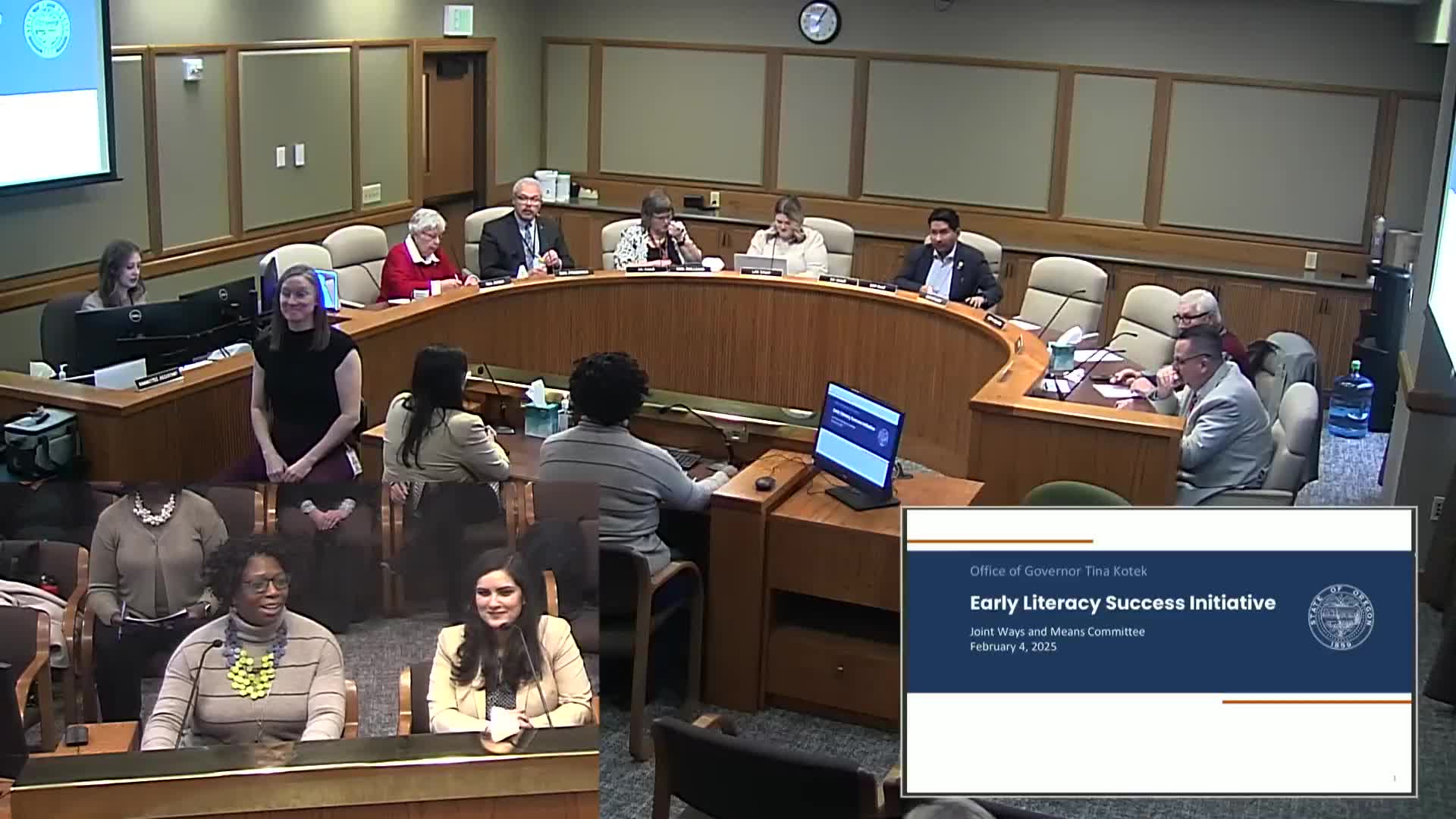
The Education Subcommittee on Feb. 4 heard presentations from the governor’s office, the Department of Early Learning and Care and the Oregon Department of Education on the Early Literacy Success initiative, a statewide effort that spans birth through early elementary grades and is included in the governor’s recommended budget.
The Education Subcommittee on Feb. 4 heard presentations from the governor’s office, the Department of Early Learning and Care and the Oregon Department of Education on the Early Literacy Success initiative, a statewide effort that spans birth through early elementary grades and is included in the governor’s recommended budget.
The presentations described how 2024 investments have been distributed to regional hubs, community grantees and tribal nations, outlined proposed 2025–27 funding priorities and identified metrics and reporting steps officials say will be used to track implementation and outcomes. "Early literacy is a predictor of many positive outcomes we want to see for kids in our communities," said Jona Timbs, Education Initiatives Director in the governor's office.
Why it matters: State officials said the initiative seeks to reduce early-literacy disparities, strengthen family engagement and build a workforce pipeline so children enter kindergarten better prepared. The work ties to earlier legislation and to a larger state effort to revise guidance and align pre-K through grade 3 supports.
Officials described what was funded in 2024 and near-term proposals. Alyssa Chatterjee, director of the Department of Early Learning and Care (DELC), said the first biennium’s $9.4 million for birth-through-5 literacy was split into two $4.7 million allocations: the kindergarten partnership innovation funds distributed through 16 regional early learning hubs and a birth-5 Early Childhood Equity Fund. The equity grants included a sole-source, noncompetitive option for Oregon’s nine federally recognized tribes, with individual tribal awards capped at $200,000 in the initial round.
Chatterjee provided preliminary implementation numbers for the 2024 distributions: about 1,200 families participated in early-literacy activities funded through equity grants; grantees reported more than 1,000 culturally relevant resources developed and distributed; hubs and partners distributed roughly 48,000 early-literacy resources with about 13,000 families receiving materials; and hubs reported several thousand participants in family-engagement activities and hundreds of educators receiving training. "Providers want more professional development specifically in early literacy," Chatterjee said, summarizing input from more than 400 community engagement participants.
Dr. Charlene Williams, director of the Oregon Department of Education (ODE), described the three grant streams ODE manages: $2 million in tribal set-aside grants, community grants (RFA posted September 2024; 35 applicants; roughly 28 passed initial screening) and $90 million in school-district grants. Williams said the K–5 district grants were distributed by a formula based on weighted K–5 average daily membership, with a statutory floor for small districts. She said roughly 248 districts and charter schools were approved and that by June 30, 2024 all year‑one funds had been distributed.
Williams outlined how districts are using funds: curriculum adoption, professional development and coaching, hiring literacy specialists or interventionists, extended-learning programs and high-dosage tutoring. She told the subcommittee that the district grants have generated a statewide inventory of early-literacy instructional materials now available on ODE’s website, and that ODE is integrating grant monitoring and reporting into its broader aligned-programs oversight. "The Oregon early literacy framework is our North Star," Williams said.
Funding proposals and allocations described by officials included the governor’s recommended 2025–27 request and agency-level proposals: DELC cited roughly $22 million for birth-through-5 plan implementation, $2.2 million for Dolly Parton’s Imagination Library expansion and $266,000 to update early-learning and kindergarten guidelines; DELC also sketched a 2025–27 breakdown that would include about $3.6 million for tribal noncompetitive awards, $1.3 million for workforce-development work such as revising guidelines and $15.9 million for direct program services. ODE said it recommended $100 million for statewide literacy in the next biennium and noted an anticipated additional federal comprehensive-literacy award of about $57 million over five years that would align with state-funded efforts.
Accountability, evaluation and concerns: Presenters described a mix of leading and lagging indicators to show progress. DELC officials said initial metrics emphasized service delivery (books distributed, PD offered, community sessions held) and that future work will use an "early learning transition check-in" to capture family-level, qualitative data as children enter kindergarten. ODE said districts must report annually on participation and growth for tutoring and extended learning, professional development and budgets; those reports and longitudinal targets will inform biennial reviews.
Committee members pressed officials on several implementation risks and unknowns: workforce turnover and low pay among early‑childhood educators, how quickly teacher-preparation standards and in-service training can equip teachers to use the "science of reading," and whether grants create ongoing salary obligations for districts. Representative Wright asked what kindergarten teachers should expect from children who participated in the program; Chatterjee said the goal is greater exposure to reading and stronger adult‑child relationships that support social‑emotional development. Senator Frederick emphasized diagnosis over testing and said home access to books is a priority; he added, "Praise Dolly Parton," in reference to support for the Imagination Library.
Officials acknowledged open questions and committed follow-up: they said they will provide additional details on the district matching requirement spelled out in statute, clarify how schools are prioritized for targeted supports, expand assessment repertoires for multilingual learners and continue government-to-government consultation with tribes. Williams said ODE would provide further detail on distribution and targeting and that ODE and DELC teams meet regularly to align the continuum from birth through grade 3.
Next steps: The subcommittee carried over the scheduled accelerated-learning presentation to a future meeting and officials said they will return with additional materials, a finalized 2025–27 funding plan and further implementation guidance. DELC and ODE staff said they plan ongoing evaluation work and a continuous quality-improvement approach, and ODE anticipates a full program evaluation for the tribal grants and a statewide convening to share lessons learned.
Context note: The briefing drew on work that began after 2023 legislative action on early literacy and on the governor’s budget proposals and is intended to connect early‑childhood providers, tribal nations, school districts and family engagement programs. Agency officials stressed that the initiative’s success depends on continuing workforce investment, aligned K–12 practices and sustained funding over multiple biennia.