Get Full Government Meeting Transcripts, Videos, & Alerts Forever!
Get email alerts on the Behavioral Health Division topic
No spam. Unsubscribe anytime.
OHA officials outline behavioral health overhaul, dashboards and goals at Feb. 4 subcommittee meeting
Summary
Oregon Health Authority officials described the Behavioral Health Division's structure, strategic goals and public dashboards, and said the division will center outcomes, community engagement and transparency as it implements HB 5025 (OHA budget bill).
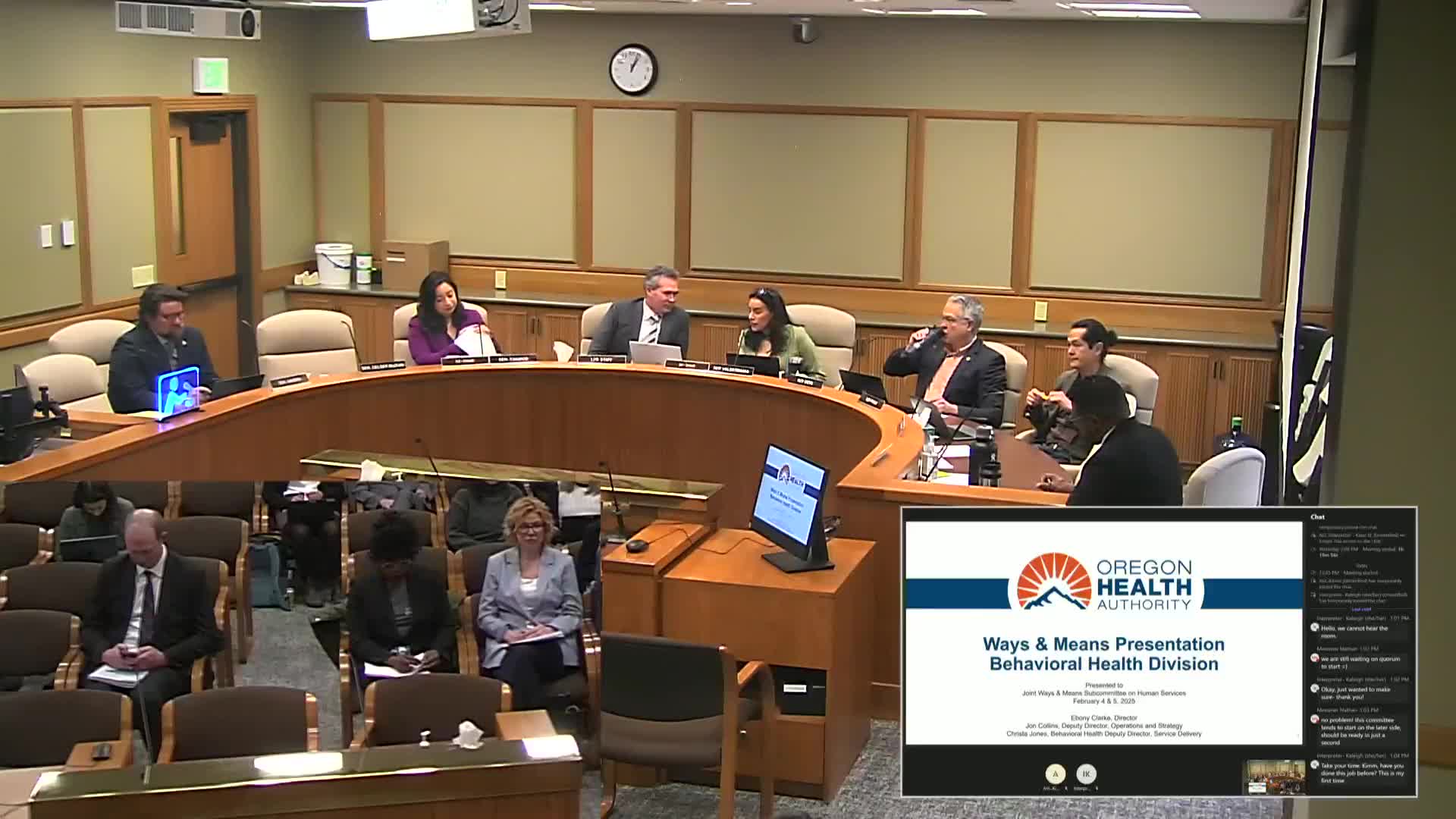
Oregon Health Authority (OHA) behavioral health leaders briefed the Joint Interim Subcommittee on Human Services on Feb. 4 on the agency's Behavioral Health Division, its structure, and the data tools the agency will use to track investments and outcomes.
The presentation, given by Ebony Clark, behavioral health director for the Oregon Health Authority, John Collins, deputy director for the Behavioral Health Division, and Krista Jones, deputy director for service delivery for behavioral health, framed the division's work around prevention, early intervention, treatment and ongoing supports and tied that work to the OHA strategic plan and HB 5025, the agency's main budget bill.
OHA officials said the Behavioral Health Division was created in 2023 to provide a focused infrastructure for mental health, substance use disorder and related services. The division’s core functions include maintaining workforce and infrastructure, expanding access to services, engaging community partners, and setting policy and regulatory standards. Clark emphasized the need to consider “the whole person” and social determinants of health when designing services.
Collins described the division's internal and external partnerships, noting close work with Medicaid, the Oregon State Hospital, public health, OHA’s Health Policy and Analytics unit, coordinated care organizations (CCOs), local mental health authorities, and federally recognized tribes. He said the division does not directly deliver services but relies on contracts and grants with community providers and partners.
The presenters highlighted OHA public dashboards that show Measure 110-funded behavioral health resource network activities and residential treatment investments, and said those tools will be central to measuring progress.
Officials said total funding for behavioral health has grown substantially across recent biennia and that mental health service dollars now include both treatment and medication spending. Clark and Collins said the division is shifting contracting and oversight to focus on outcomes rather than administrative processes, reducing administrative burden where possible, and aligning contracts to the agency's strategic outcomes.
The presenters said more detailed budget and allocation information will be covered in a second session. They offered to provide committee members with additional materials, including a staffing/org chart with names, a breakdown of contracts with community mental health programs, administrative-cost information per contract, and links to public dashboards.
The session concluded with OHA saying it will return the next day for a deeper budget review.