Get Full Government Meeting Transcripts, Videos, & Alerts Forever!
Get email alerts on the Educator Licensing topic
No spam. Unsubscribe anytime.
Teacher Standards and Practices Commission reports rising complaints, data system RFP and teacher-supply concerns
Summary
Melissa Gough, interim executive director of the Teacher Standards and Practices Commission, told the Education Subcommittee that TSPC is facing a large increase in misconduct complaints, is implementing an educator data system RFP, and is tracking declines in in-state teacher completers even as out-of-state applicants rise.
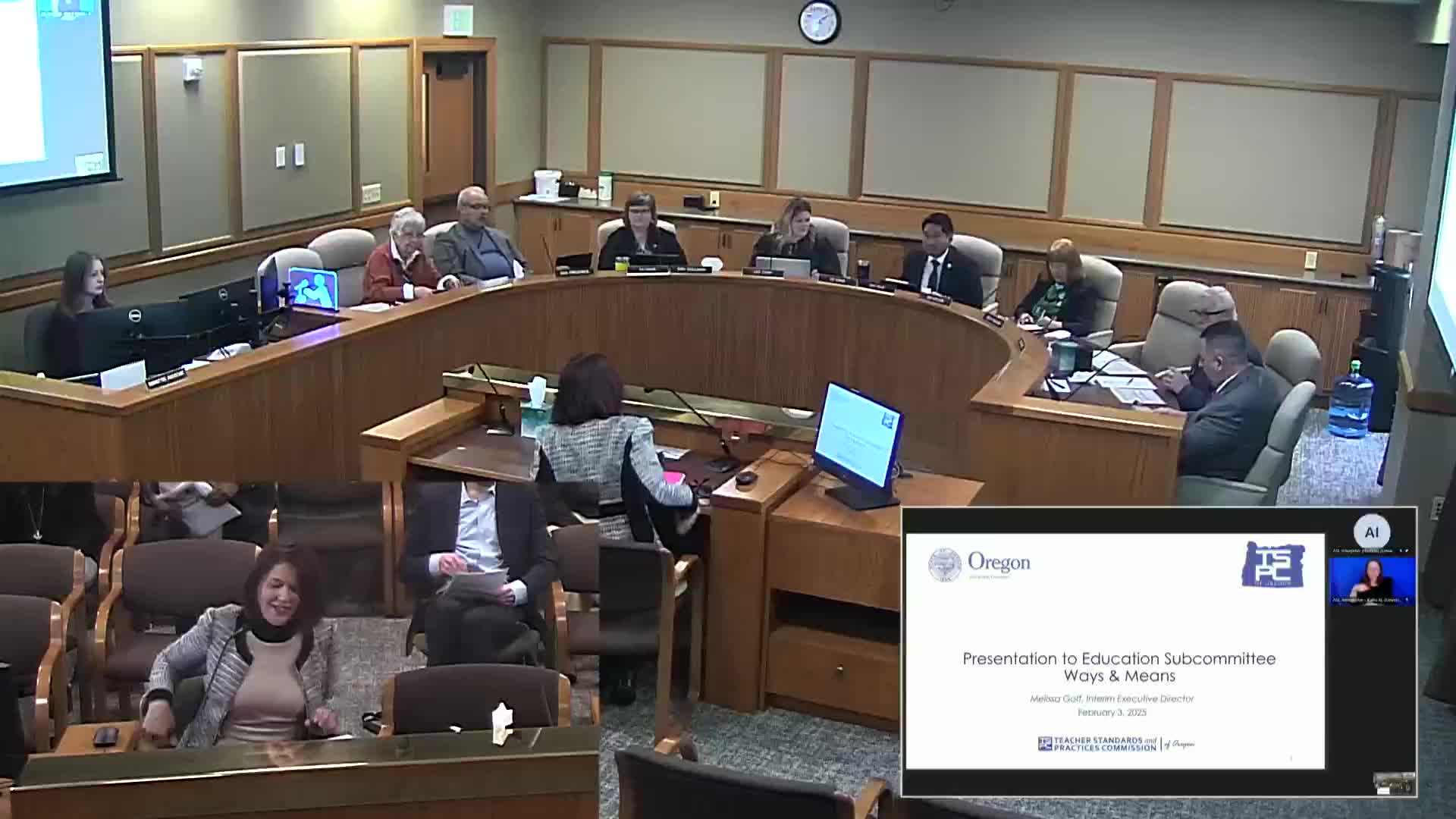
Melissa Gough, interim executive director for the Teacher Standards and Practices Commission, briefed the Education Subcommittee on Feb. 3 about TSPC’s licensing, educator-preparation oversight and professional-practices responsibilities, and the agency’s efforts to improve timeliness and transparency.
Gough said protecting student safety is TSPC’s primary concern while also reducing turnaround times for educators who are investigated but not found to have engaged in misconduct. She said the agency’s complaints and investigations caseload nearly doubled in the past year; staff reported over 500 active complaints and roughly 470 new complaints received this year. Gough said investigators’ caseloads are expected to be about 100 per investigator entering the next biennium if staffing levels remain as currently projected.
On administrative improvements, Gough said TSPC is midstream in procuring a new educator data system (RFP forthcoming) that will allow the agency to pull disaggregated data now unavailable, including data by race related to licensing and misconduct. She said the agency has added temporary licensing and investigative staff during the interim and is working to shorten licensing response times, including an appointment-scheduling option for applicants.
Gough also described workforce and preparation trends. TSPC reported 14 active educator-preparation programs statewide but said new teacher completers from Oregon programs have declined in recent years; that trend raises concern about program sustainability and the potential loss of in-state investment if teacher candidates pursue out-of-state programs. When asked later in the hearing about the share of applicants from out of state, Gough said—anecdotally and with the caveat that current data systems limit precise counts—about 50 percent of current applicants appear to be from out of state.
Gough highlighted policy priorities including multiple-measures pathways to licensure (to complement testing), an ESOL standards review group, and work to strengthen accountability and representation. She flagged Senate Bill 275 as a prior driver of work presented to the committee and noted Senate Bill 804 as a possible tool to authorize civil penalties that could offset investigative costs.
Representative Anna Plank asked for additional information about caseload staffing needs and thresholds; the agency said it will provide more specifics in follow-up materials. Representative David Wright asked about out-of-state teachers and was told the current data system cannot easily produce exact counts.
The presentation was informational; no formal votes or disciplinary actions were taken at the hearing.