Get Full Government Meeting Transcripts, Videos, & Alerts Forever!
Get email alerts on the Early Childhood topic
No spam. Unsubscribe anytime.
Oregon’s new Department of Early Learning and Care outlines programs, access gaps and outreach to connect families
Summary
Director Alyssa Chatterjee told the Education Subcommittee the Department of Early Learning and Care, created July 1, 2023, oversees preschool, infant-toddler, licensing and subsidies and is focusing on increasing access—particularly for infants and toddlers—and reducing barriers for families on subsidy wait lists.
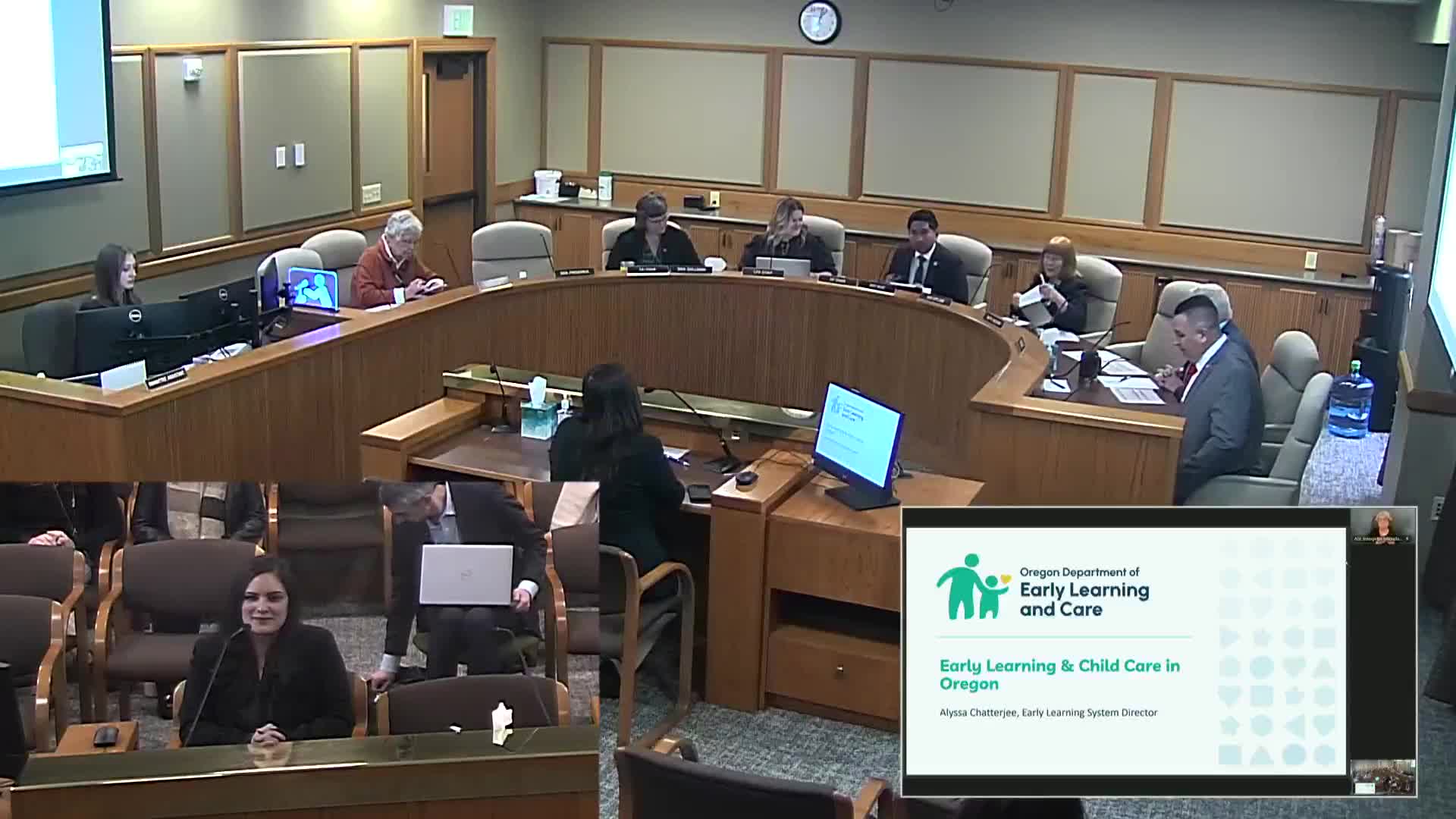
Alyssa Chatterjee, director of the Department of Early Learning and Care, told the Oregon Legislative Education Subcommittee on Feb. 3 that DELC was created on July 1, 2023, to centralize early childhood programs and increase access to care from prenatal through kindergarten and, in some cases, school age.
Chatterjee said DELC administers preschool, Early Head Start and infant-toddler programs, provides professional learning for the early childhood workforce, runs childcare licensing and health-and-safety monitoring, and operates the state’s subsidized childcare programs, including Employment-Related Day Care (ERDC).
The department inherited programs from multiple agencies, Chatterjee said. Programs moved from the Department of Education and the Department of Human Services into DELC, while eligibility determination for ERDC remains with DHS. The Oregon Health Authority still administers most home-visiting programs, and other partners include Oregon Housing and Community Services, Business Oregon (Child Care Infrastructure Fund), and the Higher Education Coordinating Commission for child-care grants.
Chatterjee described the department’s licensing structure and public-access goals. DELC inspects licensed child-care programs, issues and renews licenses, conducts background checks required by the federal Child Care and Development Fund, investigates complaints with DHS, and provides technical assistance. She said there are four main license types, including registered family homes, certified family homes (larger family homes that may include a second staff person), and two center licenses—one for programs serving children from birth and one created by the legislature in 2021 for school-age centers (House Bill 3073).
Chatterjee said DELC funds more than 320 grantees, supports about a 24,000-person early childhood workforce, and that those programs together offer roughly 32,000 public slots. She highlighted differences in access by age: most counties meet higher coverage for preschool-age subsidized slots, with five counties at or above 80 percent saturation, but access to infant and toddler subsidized slots remains low in many counties, with “the majority of counties having access for less than 10%” of infants and toddlers.
On ERDC and the subsidy wait list, Chatterjee said there are over 9,000 families on the list. DELC staff are focusing on the roughly 25 percent of families who are approved for ERDC but not yet connected to a provider; she said about 75 percent of those unconnected families are receiving TANF services. To reach families, DELC is partnering with DHS to use TANF family coaches for outreach and is working with Find Child Care Oregon and 211 information services for direct contacts when parents permit sharing their contact information.
Committee members raised related questions. Representative Pam McLean asked about the ERDC backlog and communications between families and providers; Chatterjee said the department is pursuing direct outreach through DHS and community partners. Representative David Wright asked about employer-sponsored child care; Chatterjee pointed to several employer-led models and cited insurance costs and local building or zoning rules as ongoing barriers.
Chatterjee closed by pointing committee members to DELC’s strategic plan, Growing Oregon Together, and the department’s diversity, equity and inclusion plan, which she said guide efforts to center tribal sovereignty, expand infant-and-toddler strategies and support the workforce.
The presentation was informational; no committee actions or votes were taken on DELC programs during the Feb. 3 meeting.