Get Full Government Meeting Transcripts, Videos, & Alerts Forever!
Get email alerts on the Forest Products Tax topic
No spam. Unsubscribe anytime.
House Revenue committee hears testimony on bill to extend components of forest products harvest tax
Summary
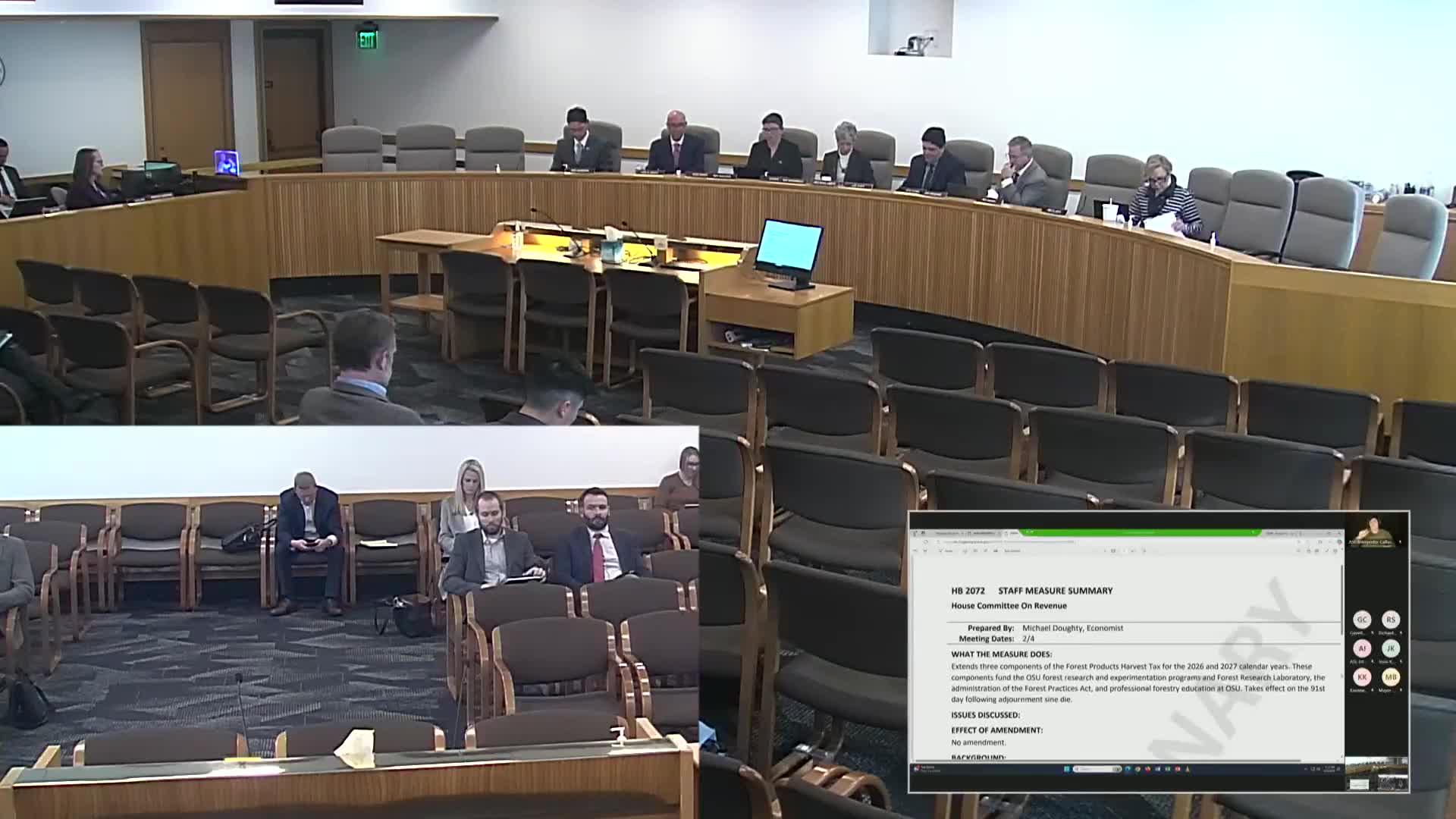
Chair Nathanson opened a public hearing on House Bill 2,072, which would extend three components of the forest products harvest tax for 2026–27, the funding source for Oregon State University research, Department of Forestry programs and professional forestry education.
Chair Nathanson opened a public hearing on House Bill 2,072, which would extend three components of the forest products harvest tax for calendar years 2026 and 2027. The bill focuses on the components that fund Oregon State University’s Forest Research Laboratory, the Administration of the Forest Practices Act at the Oregon Department of Forestry (ODF), and professional forestry education at Oregon State University.
The bill matters because the three components subject to the two‑year sunset provide dedicated funding to university research and forestry administration that supporters say leverages additional public and private funds. The Legislative Revenue Office (LRO) told the committee the review process for these taxes is set by statute to occur in odd‑numbered years and that the bill would take effect 91 days after adjournment or signing.
Kathleen Kavanaugh, representing Oregon State University’s College of Forestry, told the committee the harvest‑tax funds support critical research, teaching and stakeholder engagement. Kavanaugh said the harvest tax “accounts for a little over 17% of our total budget in the college,” and described external advisory committees that help guide how the funds are used. Michael Eliason, testifying for the Oregon Forest Industries Council, said the harvest tax has long been supported by many landowners and that its calculations depend on ODF ending balances, projected departmental needs and projected harvest levels.
Josie Kerna, speaking for the League of Women Voters of Oregon, opposed renewing the harvest tax in its current form and urged replacement with a value‑based severance tax. Kerna said the harvest tax is “not easy to administer and raises no revenue for either the counties or the general fund,” and noted the current rate is “just $6 per thousand board feet,” which she illustrated as roughly $30 on a typical logging truckload. LRO staff outlined the distinction between a volume‑based tax (per thousand board feet) and a value‑based tax (a percentage of sales), and reviewed the statutory history that led to the current structure.
Committee members asked for clarifications about historical harvest volumes and why the LRO report uses particular year ranges; the LRO noted declines in federal‑land harvests account for part of the long‑term change. The committee closed the public hearing without taking a vote on the bill.
The record includes testimony both supporting continuation of the existing funding streams for research and administration and recommendations from advocates that Oregon move to a value‑based severance tax that would generate more revenue for timber counties and general funds.
The committee closed the hearing on HB 2,072 with no motion to adopt or amend the measure recorded during the session. The LRO report and submitted materials remain available on the committee record for further review.