Get Full Government Meeting Transcripts, Videos, & Alerts Forever!
Get email alerts on the Oregon State Police Emergency Response topic
No spam. Unsubscribe anytime.
Oregon State Police outlines statewide emergency communications, dispatch redundancy and response resources
Summary
Superintendent Casey Cotting and Deputy Superintendent Josh Brooks told the committee how OSP organizes statewide dispatch, an agency operations center, equipment prepositioning and coordination with local partners during events such as tsunami warnings and wildfires.
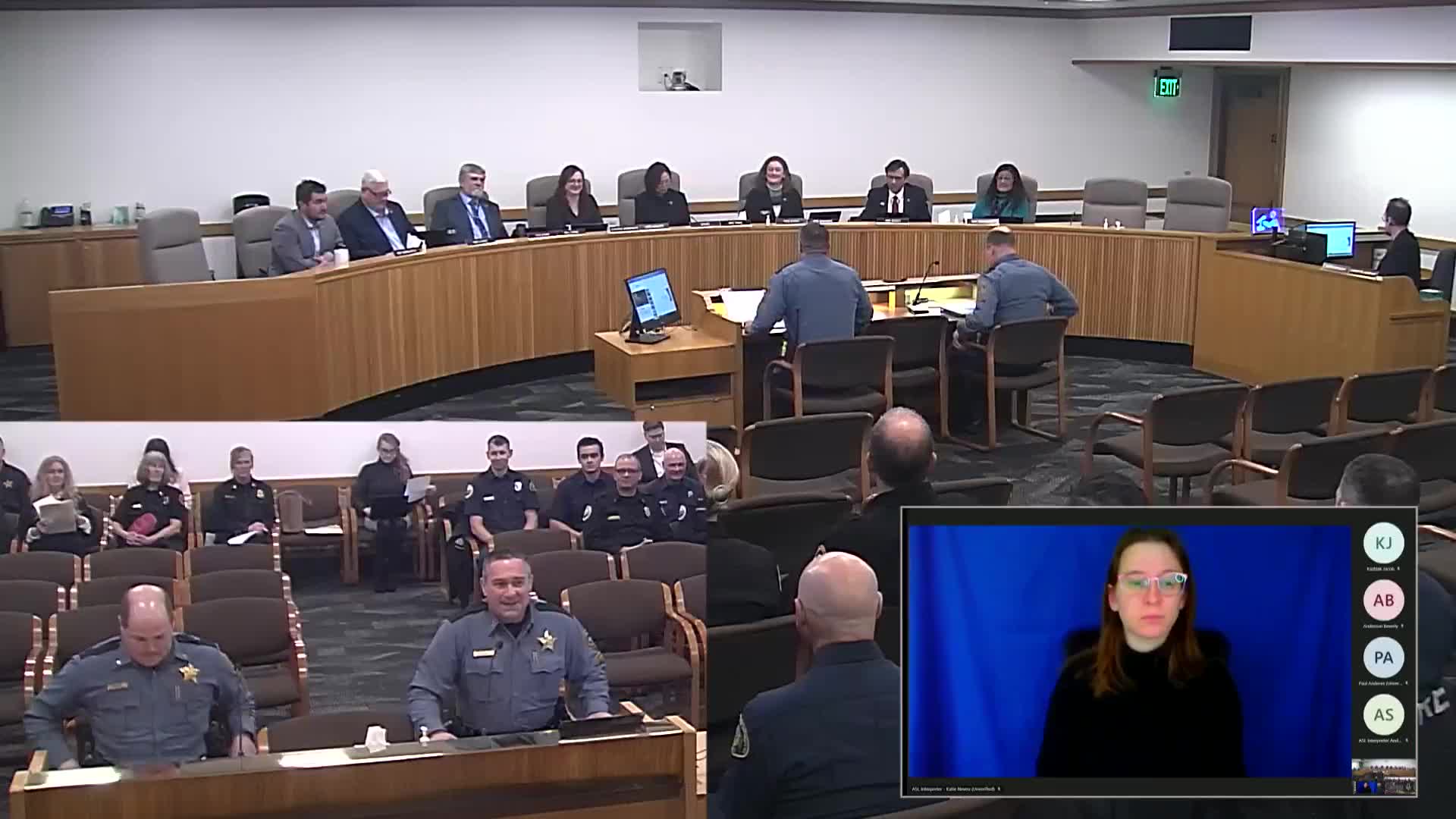
Casey Cotting, superintendent of the Oregon State Police, told the House Committee on Emergency Management, General Government, and Veterans on Feb. 4 that OSP’s role in state emergency response focuses on safeguarding life, property and natural resources while coordinating with local and federal partners.
“Our mission is to serve all people with a priority of safeguarding life, property, and natural resources by building upon a diverse professional and trustworthy workforce,” Cotting said during the informational briefing. She described OSP’s structure, specialty units and how the agency fits into the state emergency framework as Emergency Support Function 13, working with the Oregon Office of Emergency Management and local first responders.
Deputy Superintendent Josh Brooks described OSP’s communications and command capabilities: two regional dispatch centers (Salem and Central Point) that operate 24/7, an Agency Operations Center (AOC) housed at General Headquarters with redundant dispatch consoles and radio base stations, satellite phones and Starlink internet for resilience, and prepositioned watercraft, aircraft, off-road and armored vehicles. Brooks said the AOC and regional centers regularly practice failover exercises to maintain continuity.
Cotting and Brooks walked the committee through recent activations to illustrate those capabilities: during a Dec. 5 tsunami warning, OSP stood up an AOC call within minutes to gather command staff, view live coastal feeds and coordinate resource shifting and public notifications. Cotting said OSP’s Fish and Wildlife division keeps chainsaw and other tools for rapid response and noted the agency maintains a three-day go bag policy so members can be redeployed quickly across the state.
OSP officials told the committee the agency is authorized for approximately 766 sworn positions and 627 professional staff for a total of 1,393 authorized positions, and that patrol staffing is the most visible presence with 478 authorized FTE in patrol. Brooks said OSP dispatch centers act as secondary public-safety answering points (PSAPs) that coordinate with the state’s 41 primary PSAPs rather than receiving 911 calls directly.
On wildfires, Cotting said OSP assists with evacuations, road closures, post-incident investigations and mobile morgue support through the state medical examiner’s office. She described the agency’s emergency operations plan and continuity of operations plan (COOP), and said both are updated regularly to support a whole-of-community response.
Committee members asked how OSP coordinates with the Oregon Military Department on counterdrug investigations and how OSP equips sworn members in the field. Cotting replied that OSP uses military aviation and analytical capabilities where useful and confirmed that sworn OSP members are issued individual first-aid kits (IFAKs) and plate carriers.
Ending
Officials closed by asking the committee for continued support for investments that improve response resilience; committee members thanked Cotting and Brooks and asked for follow-up materials on staffing trends and resource needs.