Lifetime Citizen Portal Access — AI Briefings, Alerts & Unlimited Follows
Adjutant general briefs committee on Oregon National Guard deployments, equipment gaps and retention request
Loading...
Summary
Adjutant General Brig. Gen. Alan Groenewald updated the House Committee on the Oregon National Guard’s 2024 operations, deployments, wildfire responses and a request for state-funded reenlistment bonuses; members raised equipment and supply-chain problems for units deployed to Egypt.
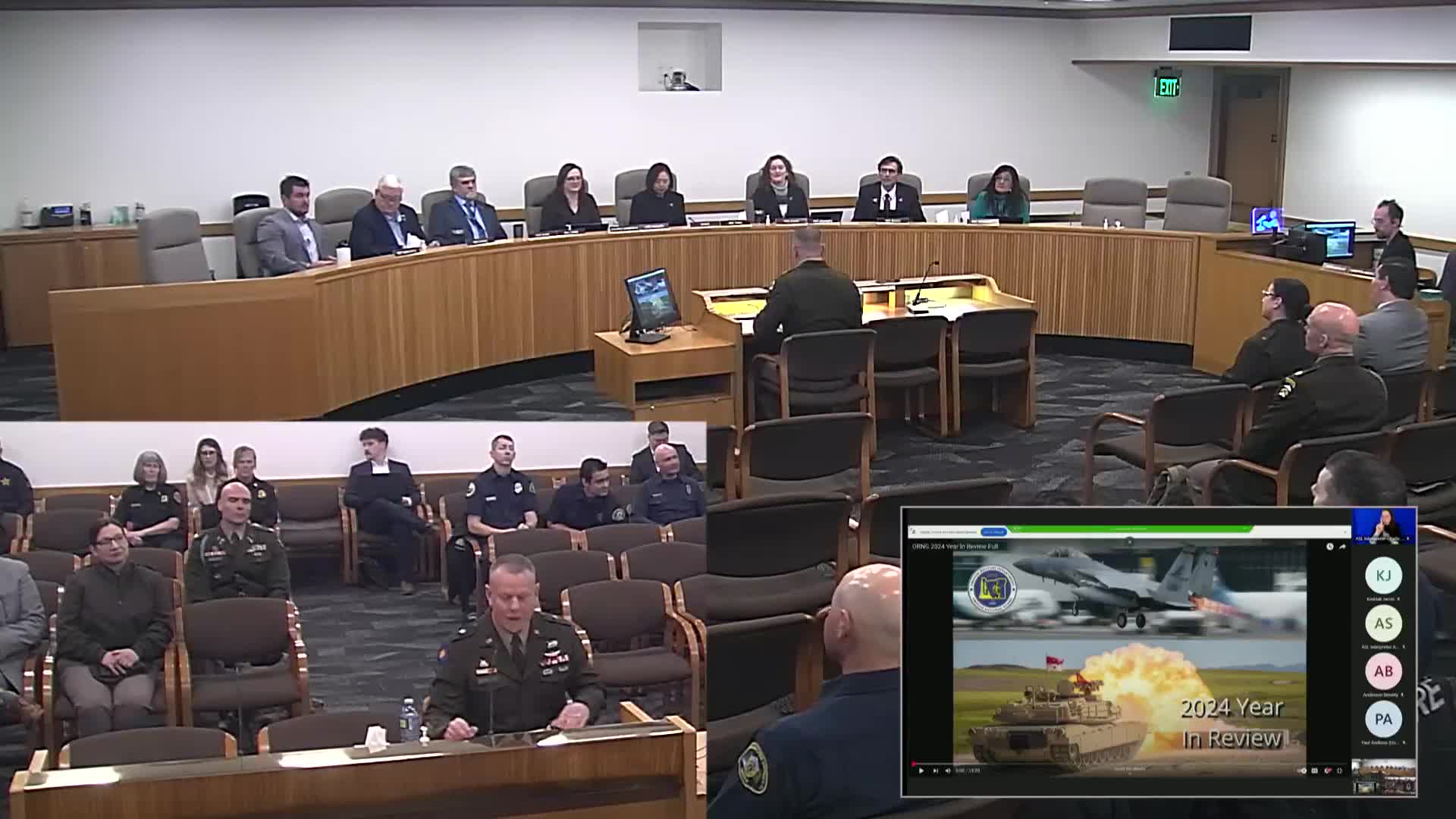
Brigadier General Alan Groenewald, Adjutant General of the Oregon National Guard, told the House Committee on Emergency Management, General Government, and Veterans on Feb. 4 that the Guard balanced significant overseas deployments with heavy domestic response work in 2024 while seeking state support to bolster retention.
In a prepared presentation and accompanying year-in-review video, Groenewald summarized training and federal missions — including 40th Infantry Brigade Combat Team rotations at the Joint Readiness Training Center and ongoing service in Kosovo and the CENTCOM area of operations — and domestic responses such as more than 60 days of wildfire support. "Through every mission, our Guard members demonstrated that they're connected to their communities, competent in their roles, and committed to excellence," Groenewald said.
The briefing outlined force posture and readiness: about 1,200 soldiers and airmen were expected to be deployed by May, drawn from roughly 4,800 Army soldiers and 2,000 airmen statewide. Groenewald said the Army National Guard was operating at roughly 80% strength with retention below 70%, while the Air National Guard was about 90% strength. He identified recruiting and retention as top priorities and asked the committee to support the governor's proposed budget request that would begin a reenlistment bonus program for Oregon Guard members.
Committee members pressed Groenewald on supply and equipment problems raised by a committee participant who reported soldiers deployed to Egypt had missing or delayed individual first-aid kits (IFAKs) and incorrectly sized or out-of-date body armor. Groenewald said the unit expected to receive new IFAK pouches at the mobilization station and that medical inserts were delayed in Egyptian customs. On body armor, Groenewald said some fit and issue failures appeared to be local supply-chain or unit-level problems in the chain of command; he said the Oregon Military Department's central issue facility had adequate IOTVs (improved outer tactical vests) to reissue as needed.
The Adjutant General and Sean McCormick, chief of state affairs for the Oregon Military Department, provided budget context: McCormick said the department's prior biennial state general fund figure was about $42.2 million and that the slide figure shown during the briefing reflected an annualized amount including state resources, debt service and match for cooperative agreements. Groenewald told the committee he planned to press for state-funded retention bonuses modeled on programs in other states; he cited Minnesota's roughly $13 million state retention program as an example and said he would welcome a reenlistment bonus large enough to improve reenlistment rates, though he did not provide a specific dollar figure for Oregon's proposal.
The presentation also highlighted the Guard's counterdrug program, which reopened in 2024 and, according to Groenewald's slides, supported law enforcement seizures of more than 1,000,000 pills, 4,700 pounds of fentanyl and 2,200 pounds of methamphetamine; the presentation stated an estimated seizure value exceeding $3,000,000,000. Groenewald described the Guard's domestic contributions during wildfires — more than 200 service members activated under a governor's emergency declaration on July 12, 2024, for nearly 60 days — and search-and-rescue missions, including a hoist rescue of a stranded hiker transferred to a Medford hospital.
Committee members asked for more precise data on current deployed personnel and on the proposed bonus program's scope and cost. Groenewald provided percentage goals (3% annual growth in Army strength for five years) and said the department would return with more specific budget numbers. He also emphasized the Guard's economic impact slide shown to the committee: the department said a state investment of $39 million corresponded to about $680 million in direct investment in Oregon and more than $1.3 billion in statewide economic activity per biennium.
The committee did not take formal action; Groenewald closed by asking for the legislature's support for recruitment and retention initiatives and for spreading awareness of Guard service opportunities.
Ending
The informational hearing continued to the Oregon State Police presentation after the Guard's briefing. Committee members flagged follow-up questions about exact equipment inventories, causes of fit and issue failures, and the specific dollar amount and eligibility rules for any state-funded reenlistment bonus; the committee requested those details in future briefings.