Get Full Government Meeting Transcripts, Videos, & Alerts Forever!
Get email alerts on the Pharmacy Benefit Managers topic
No spam. Unsubscribe anytime.
Oregon hearing on PBM reform draws pharmacists, insurers and state regulators to Capitol
Summary
Salient testimony at a House committee hearing Tuesday put the struggles of Oregon pharmacies at the center of a long, technical debate over how the state should regulate pharmacy benefit managers (PBMs).
Salient testimony at a House committee hearing Tuesday put the struggles of Oregon pharmacies at the center of a long, technical debate over how the state should regulate pharmacy benefit managers (PBMs).
The House Committee on Behavioral Health and Health Care opened a public hearing on House Bill 3,212 on Feb. 4 in Salem. Committee members heard a 20‑minute overview from the Department of Consumer and Business Services, followed by testimony from pharmacists, national trade groups, PBMs, insurers and community advocates.
The bill’s sponsors and pharmacy groups told lawmakers HB 3,212 would require PBMs that operate in Oregon to stop “spread pricing,” adopt cost‑plus or NADAC‑based ingredient reimbursement with a separate professional dispensing fee tied to the Medicaid fee‑for‑service survey, bar network steering to PBM‑owned pharmacies, and prohibit certain contract terms they say force pharmacies to fill loss‑making prescriptions. "We need you to finally, as you've said in the past, stop that bleeding," said Nikki Terziaff, executive director of the Oregon State Pharmacy Association. "Our Oregon pharmacies are dying so that their patients won't."
State regulators briefed the committee on how Oregon arrived at the current framework. Jesse O’Brien, policy manager at the Division of Financial Regulation, said HB 4,149 from the 2024 short session moved Oregon from a PBM registration model to a licensure model, giving the agency new powers to require reporting, request contracts and exams, and to enforce penalties. "The Division of Financial Regulation is the state's regulator of PBMs," O’Brien told the committee, explaining the department’s authority and the implementation work now under way.
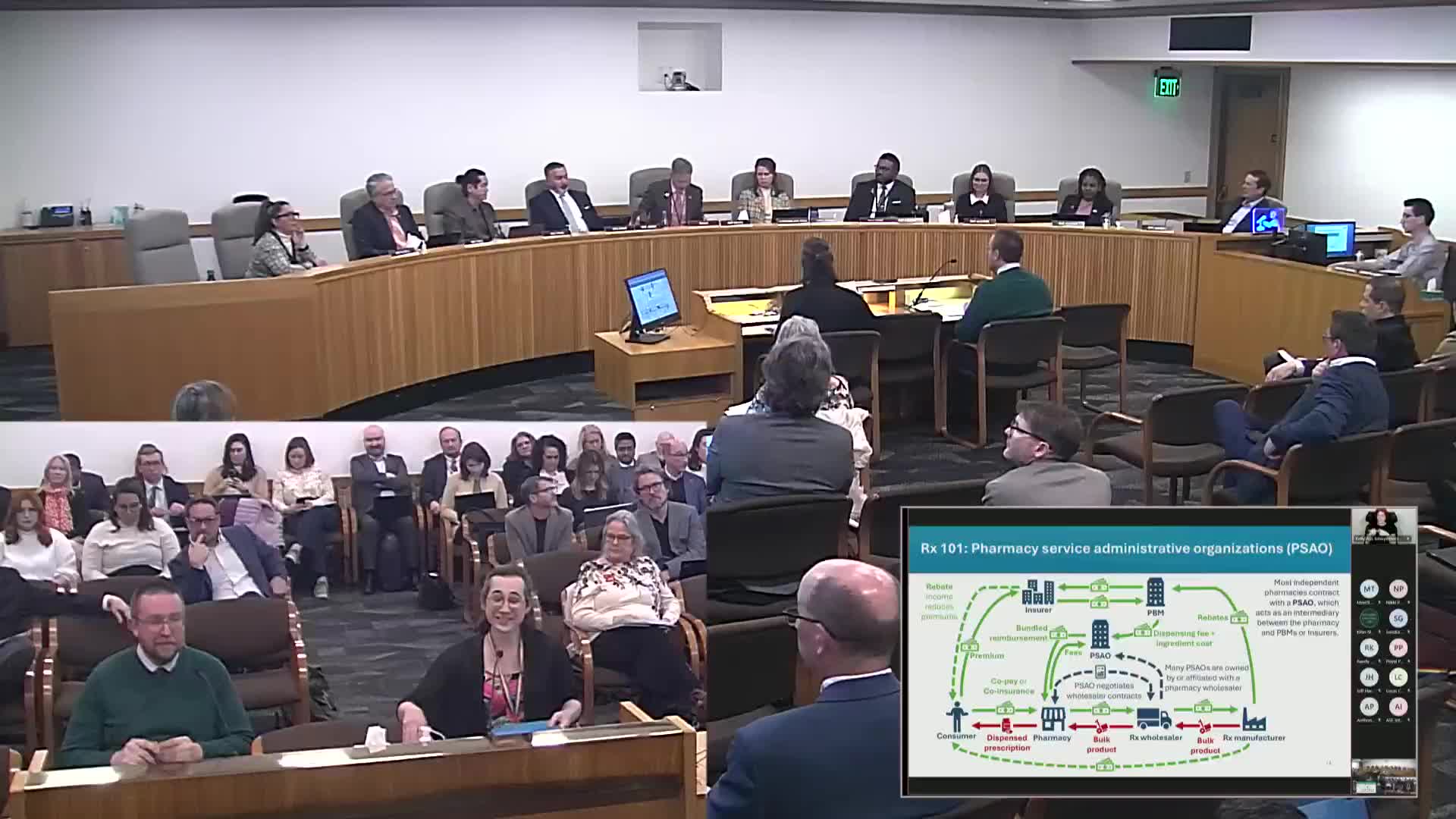
Noomi Raefold Griffith, senior policy adviser at the Division of Financial Regulation, walked members through PBM mechanics, reimbursement formulas and market structure. "This is a really complex area of business and of law," Griffith said. She explained how ingredient cost and a professional dispensing fee together form the allowed payment to pharmacies, that generic ingredient payments are commonly set by maximum allowable cost (MAC) lists or proprietary benchmarks, and that rebates flow from manufacturers to plans (and PBMs) in large, aggregated payments. Griffith noted DCBS began collecting 2023 rebate data as part of SB 192 implementation and reported PBMs received nearly $300 million in reported rebate revenue for that year; the division presented that most of the reported rebate dollars were reported as passed on to plans while a small share was retained by PBMs.
Pharmacists and trade associations described widespread business pressure on community pharmacies. The Oregon State Pharmacy Association (OSPA) and national groups urged the committee to ban spread pricing and patient steering and to adopt a NADAC (National Average Drug Acquisition Cost)‑plus dispensing fee standard. "We're not asking for a profit," said Amanda Meeker, president of OSPA. "We're asking for nothing. $0." Pharmacy witnesses provided local examples, including pharmacies that reported filling prescriptions at a financial loss and owners who said they had closed or been forced to sell.
Pharmacy advocates and consultants cited data and audits. Brian Mayo, executive director of OSPA, cited a Secretary of State audit noting Oregon regulation of PBMs has been "limited and fragmented," and said the Oregon Board of Pharmacy reported 57 community pharmacy closures since 2023. Witnesses cited a Federal Trade Commission report and a U.S. House Oversight report that examined PBM market conduct and vertical integration.
Insurers and PBMs opposed parts of the draft bill and warned it could raise overall health care costs or run afoul of federal law. Regina Mendez Harper, a pharmacist with Prime Therapeutics, testified in opposition to the bill as filed and said industry stakeholders had reached compromises in interim work groups that were not reflected in HB 3,212. "This bill, as drafted, doesn't represent the hard work that we engaged in over the summer and fall," she told the committee.
Plan representatives said mandated NADAC‑plus pricing and a higher dispensing fee would shift costs onto plan sponsors and members. Mary Ann Cooper, director of government relations for Cambia Health Solutions (Regence Blue Cross Blue Shield of Oregon), said modeling showed low‑cost generics used by many members could move from a few dollars at the counter to amounts that trigger copays or higher cost sharing under high‑deductible plans. "Increasing the cost of most of these drugs through enhanced dispensing fees and modifications to ingredient reimbursement is only going to exacerbate this trend," Cooper said, noting specialty drugs already drive most pharmacy spend.
Committee members pressed witnesses on ERISA (federal preemption) questions throughout the hearing. Noomi Griffith and DCBS staff repeatedly warned the line between permissible state regulation and ERISA‑preempted plan administration is legally unsettled. Griffith said court precedent, including Rutledge v. PCMA and ongoing cases such as Mulready v. PCMA, limited state authority in some lines of business and made universal coverage of all plan types uncertain: "If you hear somebody present to you and they say, I can tell you for certain that this thing is or is not preempted by ERISA, they have an agenda," she told the panel.
Lawmakers and witnesses also debated the practical effects of banning spread pricing, adopting NADAC and requiring state‑set dispensing fees. Insurers said banning spread pricing would remove a contracting option many employers use to assign cost‑management risk to PBMs; cities, school districts and other public employers warned a higher dispensing fee would add millions to their budgets. Scott Winkles of the League of Oregon Cities told the committee his pool had experienced double‑digit increases in health costs and could not easily absorb a new recurring pharmacy cost without cuts to services.
No formal action or votes took place during the hearing. The committee heard from more than three dozen witnesses and carried the bill‑setover work into additional hearings; Chair Noss told members the committee expects further negotiations and amendment work before any final vote.
The hearing record for HB 3,212 includes technical proposals (NADAC ingredient benchmark, mandated minimum dispensing fee tied to OHA fee surveys, limits on MAC appeals, bans on mail‑order mandates and patient steering, disclosures and anti‑retaliation protections) and legal constraints (ERISA preemption risk). The committee said it plans to continue work, including additional hearings and cross‑stakeholder negotiation.
Washington‑area and national reports on PBM conduct and Oregon regulatory filings were entered into the hearing record; DCBS asked stakeholders to provide additional data to help the agency implement licensure and reporting provisions adopted by the 2024 session.
The committee kept the record open and indicated it would carry related PBM bills to follow‑up work sessions and future hearings. No vote on HB 3,212 was taken Feb. 4.
Ending
The committee recessed after a day of extended testimony and signaled it would reconvene for additional hearings and a Medicaid financing session later in the week. Lawmakers asked insurers, PBMs and pharmacists to continue negotiations over specific language for reimbursement, pass‑throughs and network adequacy so the committee could consider technical amendments.