Get Full Government Meeting Transcripts, Videos, & Alerts Forever!
Get email alerts on the Police Technology Procurement topic
No spam. Unsubscribe anytime.
Springfield finance committee backs recommendation for $7.2 million, five-year Axon package for police cameras, TASERs and software
Summary
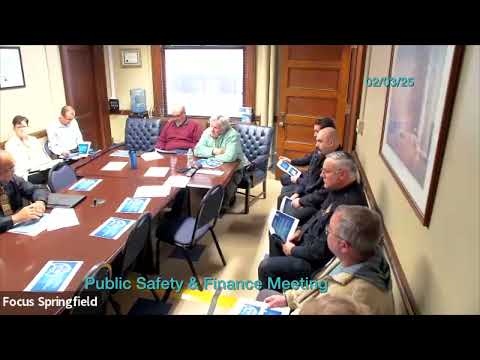
The Finance Committee discussed a proposed five-year, $7.2 million contract package from Axon to replace the Springfield Police Department's body-worn cameras, upgrade TASERs to TASER 10, and adopt an integrated software suite. Committee members signaled support and moved a positive recommendation to the full council.
The Finance Committee of the Springfield City Council on an informational meeting reviewed a proposed five-year, $7.2 million technology package from Axon that would replace the Springfield Police Department's body-worn cameras, outfit up to 350 officers with cameras and TASERs, and supply an integrated records and professional-standards software suite.
Superintendent Lawrence Acres said the package addresses long-standing technology gaps in the department and summarized the headline cost: "The elephant in the room is $7,200,000 over five years," he said, adding the proposal grew from a committee review that began about eight months ago.
Committee members and city finance staff said the purchase aims to replace the department's aging equipment, reduce siloed software systems and help the city remain compliant with its Department of Justice settlement agreement.
Acres told the committee the current vendor, Gtech, has produced systems the department finds incompatible with other tools and requires frequent repairs; the review compared Gtech with Motorola and Axon. "Axon met all three needs for the new body-worn cameras, TASERs and the software that we would be needing," Acres said, describing Axon as offering an integrated bundle that includes camera hardware, TASER hardware and a cloud/software suite for records and professional standards tracking.
Finance staff described the funding plan presented to the committee. Kathy Bono of the city's finance team said the proposed financing would combine a $2.5 million bond authorization, $1.5 million from free cash, roughly $2.1 million carried in the Springfield Police Department general fund (level-funded from an existing $423,390-per-year line for TASER software and cloud storage), approximately $187,000 from PAYGO, about $550,000 from police accounts such as donations and narcotics enforcement accounts, and a $400,000 mitigation grant application to reach the $7.2 million total. "If you do certify this $1,500,000, it will bring our free cash down to $4,800,000. But I think it's a good use of our free cash," Bono said.
Police presenters detailed equipment and software changes. Lieutenant Anthony Cicero described the TASER 10 as a single-probe, point-of-aim device that increases standoff distance and reduces what the department called the problematic "drive stun" deployment. "TASER 10 ... gives you a greater standoff distance to increase that reactionary gap and have a safer deployment," Cicero said. He and other presenters said the TASER 10 also integrates with the proposed camera system so that drawing a TASER or firearm can automatically trigger camera recording.
The package would expand camera coverage and TASER allocation. Department presenters said the plan would increase body-worn cameras from about 100 devices to roughly 350 and provide TASERs so more uniformed officers would be assigned a device rather than signing out shared units. Staff also said the suite would provide integrated tools for the professional standards unit, early-intervention monitoring and reporting required under the DOJ settlement agreement.
Finance and police staff estimated savings and compared vendors. Presenters said Axon's five-year total price of $7.2 million would be lower than alternatives they reviewed: a TTEC option presented at about $8.3 million and a Motorola option at roughly $9.0 million, with Axon yielding an estimated $1.8 million savings over five years compared with Motorola, as presented by the department.
Committee members voiced broad support. Councilor Kathy Walsh said she had "total confidence in Superintendent Acres" and urged unanimous support. Councilor Davila called it "a very good, efficient use of money" and said the package should reduce litigation exposure. Attorney Bonacanti, speaking for the city legal team, said the technology upgrade would assist the city's work to reach DOJ compliance and shorten the time to exit the consent process: "DOJ has raised this issue about technology as a concern of theirs ... once you were in compliance, then the clock starts running on two years, and then the DOJ would then leave the city."
On a procedural motion at the meeting's close, the Finance Committee moved to make a positive recommendation to the full City Council for the bond authorization, free cash certification and approval to enter the five-year contract. The committee vote produced a positive recommendation; the finance staff emphasized the three separate council orders that will be required on the council floor: the $2.5 million bond authorization, the $1.5 million free-cash certification and the contract approval because the proposed contract exceeds three years.
Next steps: the committee said it will bring the three orders to the City Council meeting on February 10 for a full council vote. City staff and the superintendent offered to make themselves available to answer additional questions before that meeting.