Get Full Government Meeting Transcripts, Videos, & Alerts Forever!
Get email alerts on the Housing And Homelessness topic
No spam. Unsubscribe anytime.
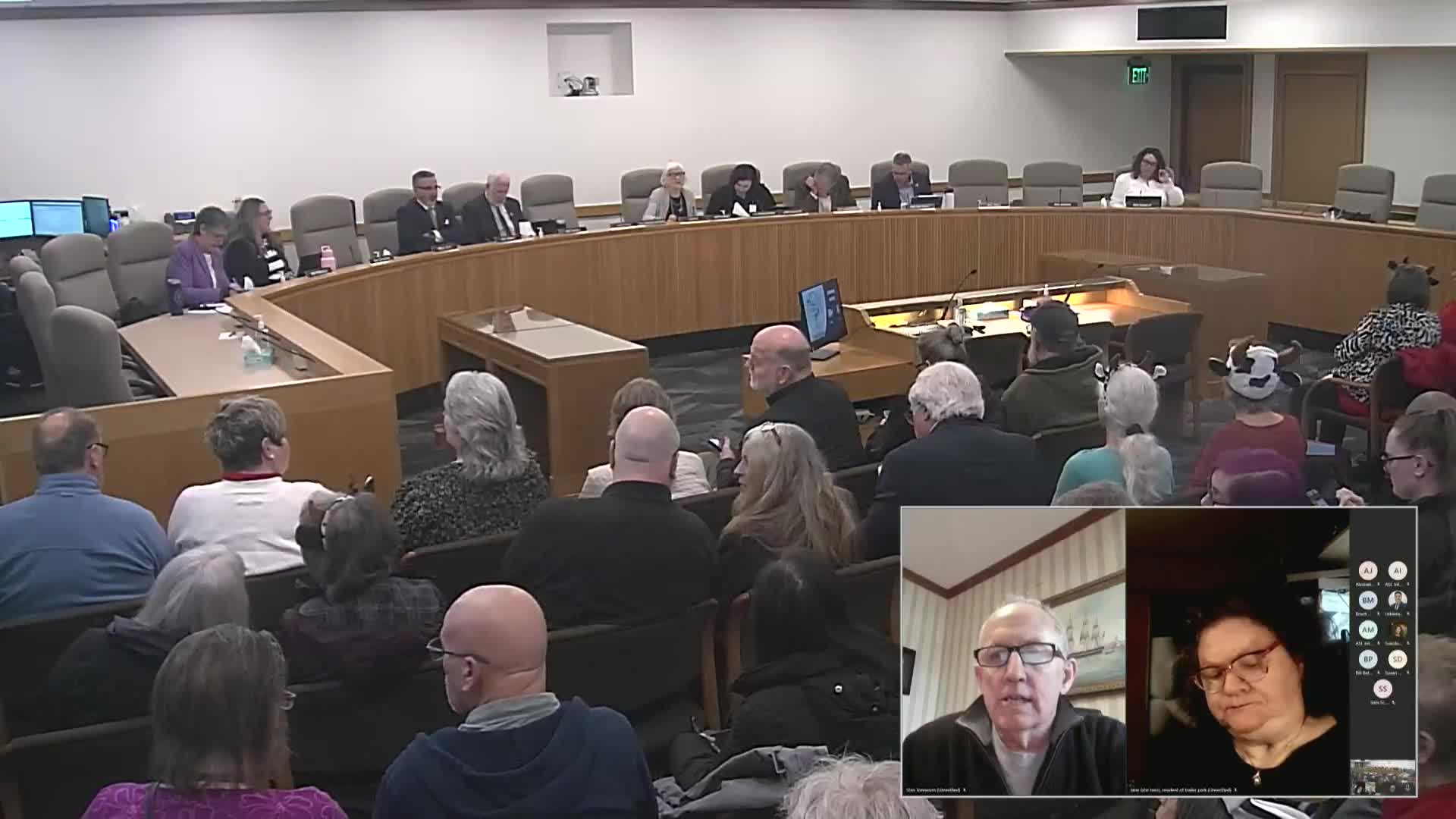
Oregon committee hears hours of testimony on House Bill 3054 to curb rent spikes in manufactured-home parks
Summary
Representative Tina Kotek Marsh (chairing the House Committee on Housing and Homelessness) opened a Feb. 3 informational hearing and public hearing on House Bill 3054, which would change how rents and certain sale conditions are set in manufactured-home parks across Oregon.
Representative Tina Kotek Marsh (chairing the House Committee on Housing and Homelessness) opened a Feb. 3 informational hearing and public hearing on House Bill 3054, which would change how rents and certain sale conditions are set in manufactured-home parks across Oregon.
The bill would (1) cap rent increases for facility tenancies at the consumer price index (CPI), (2) restrict vacancy decontrol (limit how much a new buyer can be charged after a sale), (3) prohibit landlords from requiring aesthetic upgrades as a condition of sale, and (4) bar mandatory landlord-ordered interior inspections as a condition of sale. No committee vote was taken at the hearing.
Why it matters: About 1,000 manufactured-home parks in Oregon house roughly 60,000–62,000 spaces and many residents are seniors or households on fixed incomes who depend on stable lot rents. Supporters say unchecked post-sale rent resets and recent large increases have put homeowners at risk of losing both housing and equity; opponents say the bill’s vacancy controls and strict caps will squeeze operating revenue, force deferred maintenance, and push small, family-owned parks to sell or close.
John Van Landingham, an attorney with the Oregon Law Center, gave an overview of how facility tenancies work and the current legal framework. "The first thing to know is that we're talking about facility tenancies," Van Landingham said, and he noted the statutes that apply to manufactured-dwelling parks and floating-home arenas (ORS chapter 90; transcript reference: ORS 90.505 to 90.84). He told the committee parks are a distinct tenure where homeowners typically own the structure but rent the space, and that tenants pay for maintenance inside the home while landlords provide site infrastructure.
Van Landingham summarized the bill’s four main provisions and described why proponents favor each: capping rent increases at CPI for facility tenancies; limiting vacancy decontrol so that the buyer’s initial lot rent can only be modestly higher than the seller’s; prohibiting landlords from forcing cosmetic upgrades as a condition of sale; and preventing landlords from requiring buyers to pay for landlord-ordered interior inspections. He recommended adopting the dash-1 amendment to fix an error in the vacancy-control language that would cap buyers' lot-rent increases at 10% above the selling tenant's rent.
Rochelle LaVeldo, vice president of the Oregon State Tenants Association, testified in support and described survey results and resident concerns. "They feel like cash cows. They're trapped in their homes and they're not able to get out of them," LaVeldo said, citing an anonymous tenant survey of about 500 respondents and saying many residents fear retaliation and will not publicly support reform. LaVeldo told the committee that many park residents are on fixed incomes and that projected increases could outpace Social Security cost-of-living adjustments.
Advocates and nonprofit housing groups emphasized scale and preservation options. Bill Van Vliet, executive director of the Network for Oregon Affordable Housing (NOAH), said mission-based owners and resident cooperatives can operate parks without repeated maximum rent bumps and that manufactured parks are an important segment of Oregon’s affordable housing stock. He told the panel his organization finances parks when they are owned by nonprofits and that parks remain attractive investments because tenants frequently cannot move their homes.
Park residents who testified described rapid rent growth and declining maintenance at some properties. Susan DeRose, a resident of a Forest Grove park managed by Commonwealth Real Estate Investors, read her park's notice of a 10.6% rent increase and described an accompanying set of compliance conditions and a small “discount” for residents who accept them. "This illegal and insulting $27 hush money," she said, describing a clause that conditioned a $27 discount on not participating in protest or litigation.
Family and small park owners uniformly opposed the bill in its current form. Bill Minor, attorney for the Manufactured Housing Communities of Oregon (MHCO), said MHCO represents about 750 communities (about 42,000 spaces) and called HB 3054 "an extreme proposal" that, in his view, would combine CPI-based caps with vacancy control to depress rents below market over time. "Taken together, in some of the slides that were presented ... this bill will depress rents far below market rents," Minor said, warning that owners could respond by reducing maintenance, selling to large investors, or closing parks.
Several family owners described large, unpredictable infrastructure and regulatory costs. Jennifer Bagshaw, who said she owns a 180-unit community in Medford built by her grandfather, told the committee that her average expenses have been rising about 8% per year and that she needs flexibility at turnover to pay for roads, water and sewer, and staff. "Without the ability to adjust rents when homes turn over, these rising costs will become unmanageable," she said.
Opponents also warned of unintended consequences from vacancy control. They argued long-term tenancies are common (many residents stay 10–20 years) and that limiting the reset at turnover to 10% above the previous tenant's rent will create a widening gap over time between capped space rents and market costs. MHCO counsel cited examples of capital expenses — a $900,000 mandated sewer conversion, a $400,000 sewer-line replacement, single-event repairs of thousands of dollars — and said such costs can outpace modest CPI-based increases.
Committee members from both parties offered short remarks in support of tenant protections. Representative Ben Bowman (HD 25), Representative Courtney Neuron (HD 26), and Senator Jeff Golden (SD 3) described constituent meetings and urged legislation to protect seniors and other residents who lack practical relocation options.
The public hearing included two timed panels (proponents then opponents), multiple resident statements, and dozens of additional registered commenters (the committee noted an overflow room and said the written record would remain open for 48 hours). Chair Marsh directed staff to gather questions and encouraged written submissions and offered stakeholders additional work-group discussions.
No motions or formal committee actions were taken at the hearing. Committee members said they expect further drafting and negotiation; multiple witnesses from both sides asked for additional amendments or targeted approaches to address out-of-state investors while preserving smaller owners who maintain parks.
The committee clerk left the written record open for 48 hours; the chair closed the public hearing and adjourned the meeting.
Ending: The committee did not vote on HB 3054 on Feb. 3. Lawmakers signaled they will continue work on the bill and invited stakeholders to offer amendments; members and witnesses urged more detailed fiscal and capital-impact analysis before any floor action.