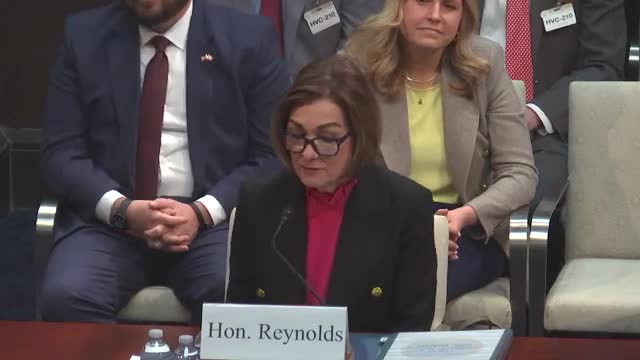
Iowa governor tells Oversight Committee her state 'did DOGE before DOGE' and saved $217 million
Get AI-powered insights, summaries, and transcripts
SubscribeSummary
Iowa Gov. Kim Reynolds testified to the House Oversight Committee about a multi-year state reorganization that consolidated agencies, reduced regulations and produced $217 million in savings in 18 months, which she presented as a model for federal reform.
Governor Kim Reynolds told the House Committee on Oversight and Reform that her statewide reorganization cut duplication, reduced the number of executive cabinet-level departments and sped the delivery of services — and urged federal lawmakers to consider similar reforms.
"Iowa was doing Doge before Doge was a thing," Reynolds told the committee in opening testimony, using the hearing's shorthand for the White House Department of Government Efficiency effort. Reynolds said that when she took office the state's tax and administrative structures were complex and "we were too big, too fragmented, and too inefficient."
Reynolds detailed steps taken in Iowa: - Consolidation: She said her administration reduced the governor's cabinet from 37 members to 16. - Agency alignment: She described merging public health and human services into a single Department of Health and Human Services and consolidating workforce and licensing functions that had been spread across multiple agencies. - Regulatory reduction: Reynolds said her administration removed 1,200 regulations in year one and enacted a moratorium on new rulemaking while reviewing administrative code. - Personnel and asset actions: The governor said the state eliminated 600 open positions (positions that had been vacant) and identified state-owned farmland for sale. - Reported savings: Reynolds told the committee her reforms have saved "$217,000,000 in just 18 months, surpassing our initial projections for the first four years." She said customer-service metrics also improved — for example, medical-license processing times dropped from about 65 days to 3 and unemployment case rulings moved from months to about 11 days.
How Reynolds framed the model: She said the reforms were a mix of executive actions and legislative cooperation. "We brought our agencies in and their team and had them do an overall review of their operation asking the tough questions that really leads to accountability and change," Reynolds said. She told the panel she used an outside consultant for benchmarking and worked closely with the state legislature when statutory changes were required.
Witness context and exchange: Committee members from both parties questioned Reynolds about process and outcomes; Democrats pressed on potential impacts to services and on personnel actions, while Republicans cited Iowa as a playbook for federal reorganization. Reynolds repeatedly said her changes did not rely on large layoffs and that many changes were implemented without terminating current employees.
Why it matters: The governor's testimony provided a concrete state-level case study of reorganizing government operations to reduce duplication and administrative costs. Members supporting aggressive federal reform pointed to Iowa as a model to export; critics said state-level authority and conditions differ from federal law and stressed the need for congressional processes when agencies created by statute are changed at the national level.