Get Full Government Meeting Transcripts, Videos, & Alerts Forever!
Get email alerts on the Labor Police Contracts topic
No spam. Unsubscribe anytime.
Pembroke Park, FOP report broad progress in police contract talks; key items remain unresolved
Summary
Town of Pembroke Park officials and Fraternal Order of Police representatives said they reached tentative agreements on a large portion of a draft police collective bargaining agreement and set dates for further review and possible ratification.
Town of Pembroke Park officials and Fraternal Order of Police (FOP) representatives said they reached tentative agreements on a large portion of a draft police collective bargaining agreement and set dates for further review and possible ratification.
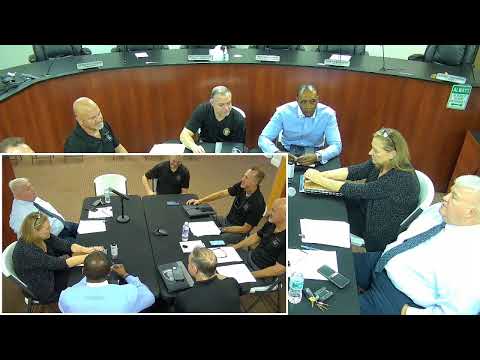
Town Manager Dan Blanchard opened the session by saying, “We are convening this additional session of the collective bargaining session of the new local police review here in Pembroke Park.” The parties then reviewed articles of the draft contract one by one and recorded multiple tentative agreements (TAs), holds for legal review and several items that require further negotiation.
Why it matters: The talks will shape pay, scheduling, discipline, and working conditions for the Town of Pembroke Park’s police officers. Tentative agreements must be converted into a clean contract and presented to officers and the town commission for final approval; the parties set an aggressive calendar aimed at a commission meeting on Feb. 26 for final action.
What the parties agreed and what remains
- The parties reported tentative agreements on a large number of individual contract articles, including the preamble and early articles (articles 1–3), management rights (article 5), bulletin board (article 8), dues deductions (article 9), assigned‑vehicle program (article 13), informational requests (article 16), court appearances (article 18), education (article 28), promotions, personnel records, probation, insurance and wages (article 37). Negotiators repeatedly said they would “TA” or “we TA’d that” as they confirmed language.
- Several items were explicitly held for further review by legal counsel or otherwise tabled. Those include: legal/indemnification language (article 14), certain disciplinary and arbitration provisions, drugs and alcohol testing language, and some grievance/arbitration wording that the town said it needs general counsel to review.
- On several operational points the parties either reached compromise language or agreed to return with clarifications: off‑duty employment will not be implemented immediately and the parties agreed to the concept that “when we institute off duty employment, we will sit down with the union and negotiate the process and procedure.” Use‑of‑force policy language will not be embedded verbatim in the CBA (the parties discussed treating the policy as a separate department policy/SOP rather than contract text).
- The union and town resolved some housekeeping and numbering issues (moving certain impact‑bargaining language into the management rights article, renumbering after deletions and correcting typographical inconsistencies in numeric limits called out during the session).
Key outstanding substantive issues called out during the session
- Indemnification/legal benefits: Town counsel and negotiators repeatedly noted that indemnification is governed by Florida law and that the town must follow applicable Florida statutes; the union pressed to include stronger contractual language. The town said it is prepared to draft contract language consistent with Florida statutes but would not commit to language that exceeds statutory limits.
- Holidays and pay on 12‑hour schedules: Officers on a 12‑hour shift asked that holiday pay be provided as 12 hours per holiday (which would raise the total hours of holiday leave discussed from 96 to 144 in the draft). Town representatives said this raises equity questions (an eight‑hour employee would receive fewer holiday hours) and that they would continue to negotiate.
- Overtime threshold and FLSA 7(k): Negotiators discussed how overtime is triggered for officers on 12‑hour schedules. Counsel referenced FLSA 7(k) provisions and related charts that define the applicable work period, and participants noted confusion in the draft over numeric thresholds (references to 84, 86 and, in other places, 120 or 240) that need correction and alignment with federal rules.
- Arbitration and “loser pays”: The parties discussed language about the arbitrator’s fee allocation. Town counsel said the town’s position is that each party bears its own costs (no “loser pays” rule), and negotiators agreed to adjust the language accordingly but held some arbitration details for further counsel review.
- Drug and alcohol testing: The town and union agreed to hold the current language for general counsel review; the union said it previously proposed specific language and will re‑send its proposal to town counsel.
Schedule and next steps
- The parties set an executive session for Feb. 10 at noon for internal review with the commission, a working session on Feb. 13 at 10 a.m. to try to iron out outstanding issues, and the town indicated a goal of presenting a clean contract for commission consideration at a special commission meeting on Feb. 26.
- Negotiators said once the parties produce a clean copy the town’s clerical staff will prepare a final formatted contract and table of contents for legal review and for presentation to officers for ratification. The union noted it will need a separate read‑and‑vote process for bargaining unit members.
What was not decided
Several specific changes were deferred to general counsel or future negotiation, including: the precise indemnification/defense language to be placed in the CBA, final holiday language for 12‑hour schedules, detailed arbitration procedures, and certain drug‑testing provisions.
Ending note
Negotiators described the session as productive and said they will exchange a clean draft after correcting typographical and numbering inconsistencies. Both sides signaled that they expect to complete internal reviews and member ratification steps before the Feb. 26 special commission meeting if the remaining issues can be resolved on the Feb. 13 working session.