Get Full Government Meeting Transcripts, Videos, & Alerts Forever!
Get email alerts on the Domestic Violence Protection Orders topic
No spam. Unsubscribe anytime.
Committee hears bill to allow sheriffs rapid access to court protection orders
Summary
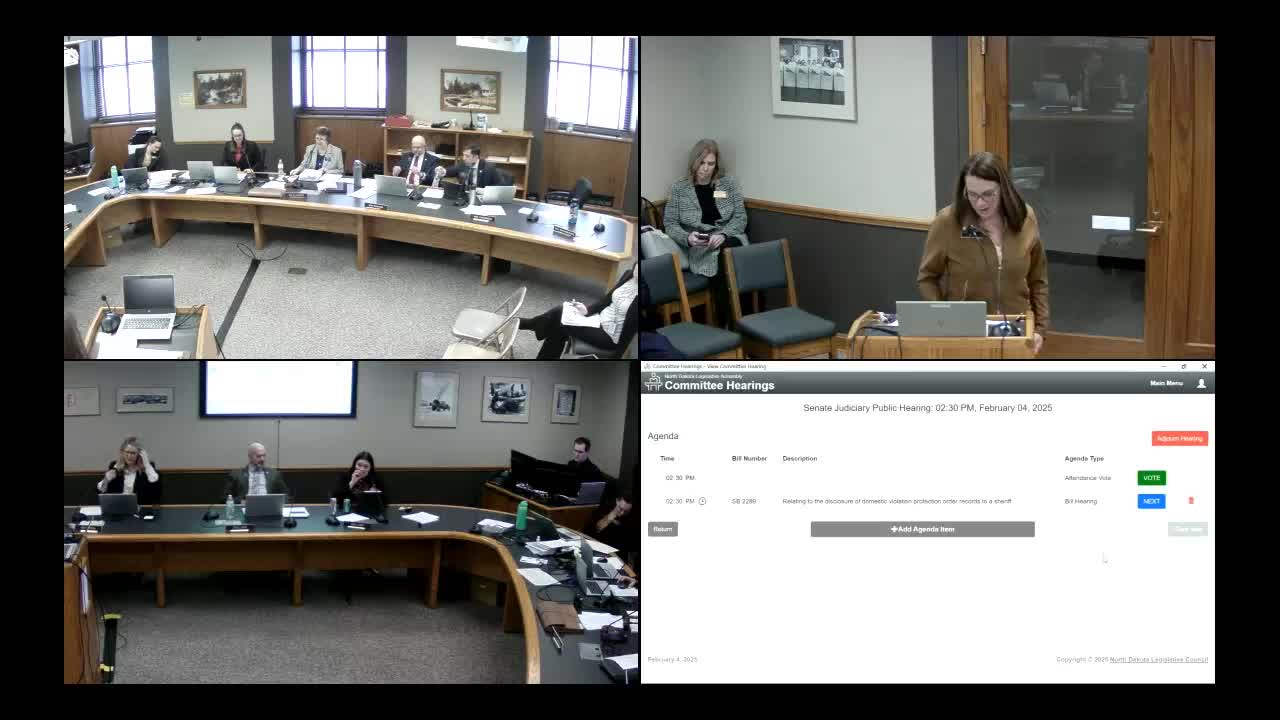
Senate Bill 2289, introduced by Senator Kristen Rohrs (District 27, South Fargo), would permit sheriffs to view recently issued domestic-violence and sexual-assault protection orders in the court case system (Odyssey) so officers arriving at 911 calls can verify and act on orders quickly.
Senate Bill 2289, introduced to the Senate Judiciary Committee by Senator Kristen Rohrs, would permit sheriffs to directly access protection-order records in the court case management system (Odyssey) so they can confirm and act on recently issued domestic-violence and sexual-assault protection orders.
The bill was introduced by Senator Kristen Rohrs, District 27 of South Fargo, who said the change responded to sheriff requests after officers arriving at 911 calls could not always find newly issued protection orders in NCIC. "We know that that first 24 hours after someone seeks help is the most dangerous 24 hours," Rohrs said, describing the bill as a tool for law enforcement to verify temporary or recently issued orders and, when appropriate, serve or remove people from a scene.
Supporters and witnesses said they backed the bill’s purpose but recommended technical changes. Seth O'Neil of the North Dakota Domestic and Sexual Violence Coalition urged including sexual-assault restraining orders (cited in the hearing as 12.1-31-1.2) and suggested lawmakers consider placing any access rule in the chapter that governs protection orders rather than the state's general open-records statute (Chapter 44-04). Danelle Presque, who represented the North Dakota Association of Counties and serves as executive director for the North Dakota Sheriffs and Deputies Association, spoke for sheriffs and said the change would help them provide safety to victims.
Court staff told the committee that law enforcement already has levels of Odyssey access but that some parts of domestic-protection-order files—particularly temporary or confidential petition files—may not be available through the access levels officers currently use. Sarah Behrens, a staff attorney with the State Court Administrator’s Office, explained that "law enforcement does have Odyssey access already" but that temporary petition files can be confidential while permanent orders become public records. She and other court staff suggested the bill's language and placement in the code be reviewed; they noted House Bill 1489 (referenced in committee testimony) is intended to consolidate various protection-order statutes and could change how access is organized.
Committee members asked whether the bill should be limited to sheriffs or extend to all law enforcement because 911 calls are sometimes routed to city police rather than county sheriffs. Witnesses and senators recommended clarifying which law-enforcement roles and which Odyssey security levels the bill would authorize. The committee agreed to staff work: legislative staff/interns will draft revised language (changing the reference from "sheriffs" to a broader or otherwise clarified class of law enforcement, and moving the provision out of Chapter 44-04 if appropriate) and to confirm who currently has Odyssey access and to what parts of a protection-order file.
The committee closed the hearing on SB 2289 with no vote and directed follow-up work. Members asked staff to prepare a revised bill and to report back with answers on current Odyssey access levels, the distinction between temporary and permanent orders, and whether the provision should be placed in the protection-order statutes rather than the open-records chapter.
The bill’s supporters emphasized its narrow aim: to give officers a fast, narrowly scoped way to verify a protection order in situations where immediate knowledge of an order would affect officer response. Court staff emphasized privacy and technical limits of access and suggested statutory placement and system-security details be resolved before the bill is advanced.
No formal committee vote on SB 2289 was recorded during the hearing; members agreed to further drafting and information gathering before taking action.