Get Full Government Meeting Transcripts, Videos, & Alerts Forever!
Get email alerts on the Juvenile Justice Minimum Age topic
No spam. Unsubscribe anytime.
Subcommittee backs raising minimum age for delinquency adjudication to 11; bill reported 5-3
Summary
Senate Bill 7-78 would prohibit adjudicating children under 11 as delinquent and direct cases to services and supervision; the committee reported the bill 5-3 after advocates and juvenile-justice officials testified for and against it.
Richmond — The subcommittee voted to report Senate Bill 7-78, which sets a minimum age of 11 for adjudicating children as delinquent and emphasizes community-based, trauma-informed services for younger children.
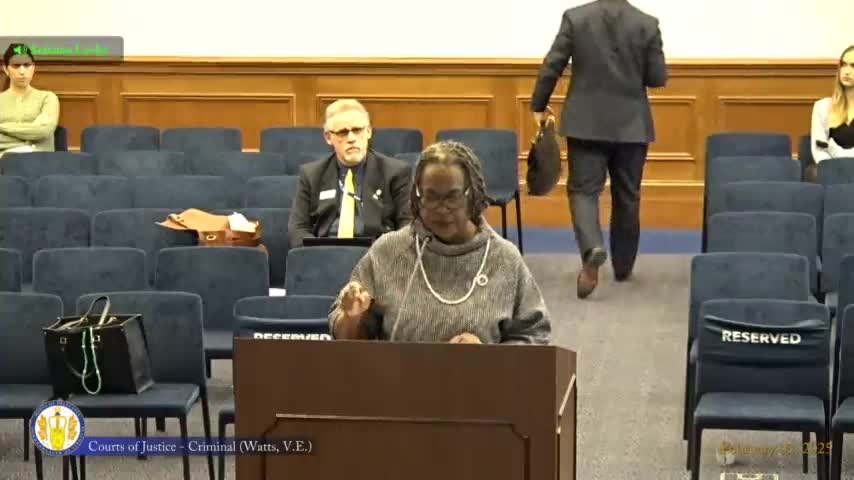
Senator Locke, sponsor of SB 7-78, told the panel that Virginia currently has no statutory minimum age for delinquency and that brain-science research supports preventing criminal adjudication of elementary-age children. "This bill protects our youngest and most vulnerable citizens from being prosecuted in a justice system that was not built with them in mind," Locke said.
Supporters — including youth-advocacy groups, legal-aid attorneys and faith leaders — testified the measure reduces long-term harm from early involvement in the justice system. Valerie Slater of Rise for Youth read testimony from a 10-year-old who urged lawmakers not to criminalize elementary-school children. Maisie Osteen of the Legal Aid Justice Center and other advocates said children under 11 lack the developmental capacity for criminal intent and should receive supportive interventions instead.
The Department of Juvenile Justice strongly opposed the bill, saying the common law presumptions against criminal responsibility for young children are working and that judges currently exercise discretion. James Tuohy of DJJ said the number of petitions for children aged 11 and younger is small and the number adjudicated delinquent averages fewer than two per year over the past five fiscal years. He warned that a statutory floor could remove judicial discretion in rare but serious cases.
Committee members debated potential loopholes and interactions with gang-recruitment statutes and penalties; members discussed enhancing penalties for those who recruit children younger than 11 rather than criminally processing the child. After discussion, the subcommittee reported SB 7-78 by a vote of 5-3.