Get Full Government Meeting Transcripts, Videos, & Alerts Forever!
Get email alerts on the Education Savings Accounts topic
No spam. Unsubscribe anytime.
North Dakota Senate Committee Hears Hours of Testimony on Education Savings Account Bill
Summary
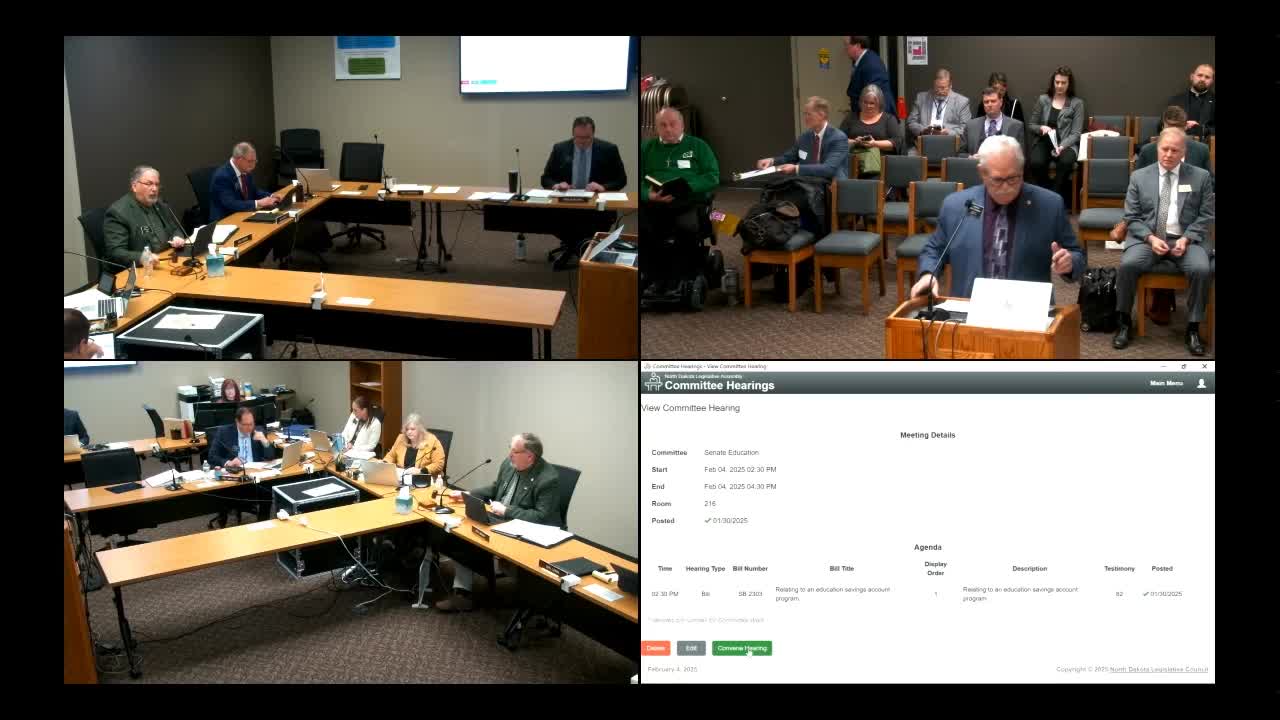
The Senate Education Committee on Monday heard more than 90 minutes of testimony on Senate Bill 2,303, a measure that would create an education savings account program to let state K–12 funding follow students to nonpublic schools or preapproved educational services.
The Senate Education Committee on Monday heard more than 90 minutes of testimony on Senate Bill 2,303, a measure that would create an education savings account program to let state K–12 funding follow students to nonpublic schools or preapproved educational services.
Senator Mike Wabamah, sponsor of SB 2,303, told the committee the program would split state funding so that school districts keep 20% for fixed costs while roughly 80% of a per‑pupil allocation would be paid into an ESA for participating students. “Taxpayer dollars should be used for taxpayers students,” Wabamah said, describing the Bank of North Dakota as the proposed account administrator and the Department of Public Instruction as the agency that would handle applications and prioritization.
Supporters from religious and school‑choice organizations argued the plan would expand options for families. David Tamasia, executive director of the North Dakota Catholic Conference, told the committee SB 2,303 “respects both the right of the child to a state supported education and the right of the parent to choose the form of education best suited to their child,” and cited recent U.S. Supreme Court rulings and a state attorney general opinion as legal support for using public funds in this way. Representatives of the State Association of Nonpublic Schools and the advocacy group American Experiment — North Dakota reiterated that nonpublic schools in the state already meet state approval and teacher‑certification requirements.
Opponents, including public‑school officials and education associations, raised questions about accountability and cost. Mike Biff, superintendent of Manette Public Schools, said the bill “appropriates $243,000,000 to private schools without private schools have to account for a nickel of how the appropriation is spent” and urged added fiscal guardrails. Amy DeCook, executive director of the North Dakota School Boards Association, called the proposed auditing language inadequate, saying the bill relies on “self report[ing]” and unspecified thresholds for investigations.
Witnesses on both sides described program mechanics that appear in the bill or in the sponsor’s amendment: a per‑pupil allocation with 80% directed into the ESA, 20% retained by the pupil’s resident district for fixed overhead, and a provision in the sponsor’s amendment limiting how much may be carried forward in an account (the sponsor described a 25% carryover cap). The sponsor also said the fiscal note’s cost estimate is based on current counts of private‑school and reported homeschooled students and acknowledged actual participation rates are uncertain.
Department of Public Instruction school finance officer Adam Tesher said he helped align enrollment counts used in the fiscal note and confirmed the department did not assume a specific take‑up rate beyond using available enrollment data. Tesher also noted the bill, as presented by the sponsor, would leave districts with the 20% fixed‑cost share in addition to their existing formula funding.
Testimony also included legal and philosophical arguments. Supporters cited the U.S. Supreme Court decisions referenced in testimony and a written opinion by Attorney General Drew Wrigley concluding that North Dakota’s Blaine‑style provision in Article VIII, Section 5, of the state constitution cannot be enforced to bar neutral funding that benefits religious schools. Opponents urged caution, noting other states that have experienced large cost increases after creating ESAs, and some commenters urged putting the constitutional issue to a public vote.
The committee did not take a vote on SB 2,303 at the hearing. Members asked technical and policy questions about auditing, administrative staffing, and whether the program would create inequities between public and nonpublic students. Committee staff closed the hearing after receiving both in‑person and online testimony.
The bill will return to committee work and possible amendment. The hearing record includes written testimony and a fiscal note that, as presented during testimony, estimates a multi‑hundred‑million‑dollar biennial fiscal impact under high‑takeup assumptions; proponents and the department said actual participation is uncertain and could be lower.
No formal committee action or vote was recorded during the hearing.