Get Full Government Meeting Transcripts, Videos, & Alerts Forever!
Get email alerts on the Ai In Courts topic
No spam. Unsubscribe anytime.
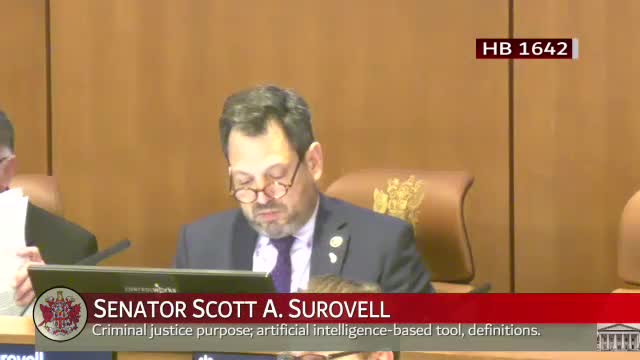
Senate committee pauses bill that would authorize AI use in judicial settings; members call for tighter guardrails
Summary
Delegate Doug Hayes, sponsor of HB 1642, told the Senate Courts and Justice Committee that the bill would make clear that artificial-intelligence-based tools may be used in criminal justice processes so long as a qualified human decision-maker reviews and documents their use.
Delegate Doug Hayes, sponsor of HB 1642, told the Senate Courts and Justice Committee that the bill would make clear that artificial-intelligence-based tools may be used in criminal justice processes so long as a qualified human decision-maker reviews and documents their use. He said the measure is intended to prevent automated systems from making final decisions in matters such as diversion, sentencing or release.
The proposal drew prolonged questioning from several senators who said the draft language is too broad and could have unintended consequences. Senators pressed on whether longstanding tools such as pretrial risk-assessment software or sentencing guidelines would fall under the bill’s definition of “AI-based tools,” whether the bill would require documentation of the data and rationale used by such tools, and whether a legislative authorization could undercut existing court challenges under the Constitution or evidentiary rules.
Why it matters: The measure addresses a growing use of algorithmic and statistical tools in criminal justice. Committee members said they generally support the goal of ensuring human oversight of decisions that affect liberty but worried the bill in its current form would explicitly authorize use without sufficient transparency or audit rights, and that it could cut across existing common-law and evidentiary safeguards.
During the hearing, senators and counsel identified several specific concerns: the bill’s definition of “artificial intelligence–based tools” may sweep in basic software long used in jails and courts; the phrase preventing the use of AI as the “sole basis” for a decision was discussed but left ambiguous; the bill currently would answer judges’ question about authority to consider AI by authorizing its use, which some witnesses said could discourage adversarial challenges; and there are no explicit requirements that model data, training sources or code be producible for review.
Legislative counselors noted there are currently no explicit statutory “guardrails” in Virginia code addressing AI; counsel said the bill’s language on authorization could be interpreted by a court as legislative approval of particular technologies. Senators pointed to prior statutory treatment of technologies such as DNA or facial recognition evidence as examples where statutory language followed rigorous validation and clear limits.
Quotes: "The bill just simply says that, under no circumstances will these decisions be made with AI tools without human intervention," Delegate Doug Hayes said, arguing the bill would protect human decision-making in justice settings. "The language is overly broad," Senator Perry said, describing how many long-standing tools—such as release-date calculators or pretrial assessment software—would meet the draft definition and raising questions about what documentation of oversight would practically look like. "There are no statutory guardrails," counsel Matt Benjamin said. "The operative language...would expressly authorize the use of AI so long as at the end there's a human."
After extended questioning and several offers to draft amendments, the committee and the bill sponsor agreed to pause the bill so the sponsor can work with senators and staff on narrower language and possible guardrails. Committee members asked the sponsor to consult with judicial, prosecution and defense stakeholders and return the bill after revisions.
Ending: The committee did not take a formal recorded vote on HB 1642. The sponsor agreed to take the measure back to interested members and staff for redrafting and to return it in a subsequent meeting.