Get Full Government Meeting Transcripts, Videos, & Alerts Forever!
Get email alerts on the Public Broadcasting Funding topic
No spam. Unsubscribe anytime.
North Dakota House passes bill limiting public funds for Prairie Public; re‑refers measure to appropriations
Summary
The House approved House Bill 12-55 on a 61-32 vote to restrict use of public funds to support public broadcasting, prompting extended floor debate about Prairie Public’s role and finances and immediate re-referral to the Appropriations Committee for funding review.
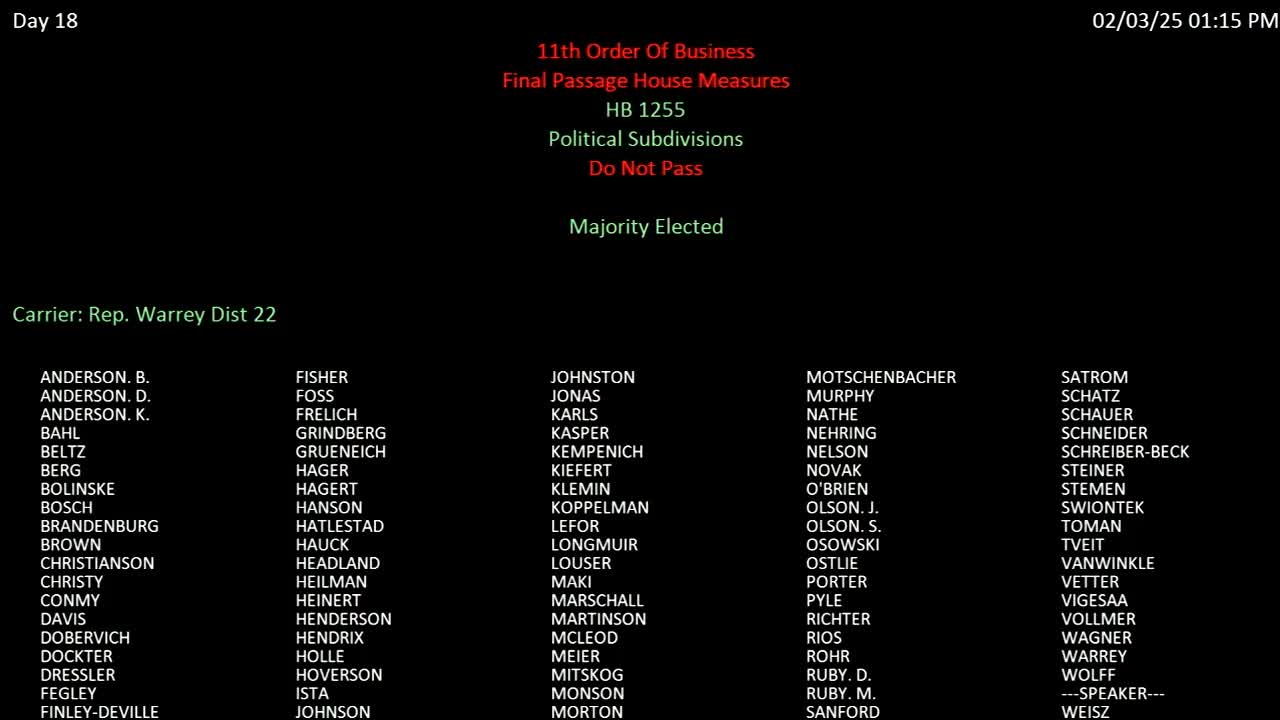
The North Dakota House of Representatives on Monday passed House Bill 12-55, a bill to restrict the use of public funds to directly or indirectly support public broadcasting, by a 61-32 margin and then re‑referred the measure to the Appropriations Committee.
The bill, introduced on the floor by Representative Jay Johnson, would create a new section of the North Dakota Century Code related to limits on public funding for public broadcasters. Representative Longmeer, chair of the House Political Subdivisions Committee, delivered the committee recommendation of “do not pass,” but the full House voted to pass the bill and send it to appropriations for further consideration of the funding implications.
Supporters argued HB 12-55 is a necessary reevaluation of state support for Prairie Public Broadcasting. Representative Jay Johnson said taxpayers should have a say in whether state dollars fund media outlets and highlighted recent reductions in the governor’s proposed appropriation. Representative Johnson cited the line-item history, saying the current appropriation flows through the Office of Management and Budget and noted the ongoing appropriation in the executive budget was $1,200,000.
Opponents argued Prairie Public provides educational, cultural and emergency services that small and rural households rely on. Representative Warrath, speaking for the Political Subdivisions Committee, warned that removing state funds could destabilize a broadcaster that provides “education and cultural programming” and serves as the emergency alert backbone. Representative Hager, who served on the committee, said many households cannot access streaming or pay for cable and would lose access to children’s programming and local reporting if funding were cut. Representative Hager asked colleagues to weigh Prairie Public’s role in serving rural and low‑income residents.
The debate included questions about reserve balances and charitable gaming revenue at Prairie Public. Representative Hedlund pressed whether the committee had inquired specifically about the broadcaster’s reserve account; Representative Longmeer said the committee did not discuss the reserve balance in detail, though charitable gaming was queried.
Representative Steiner framed the bill as a chance to demand “balanced editorial coverage” and asked whether Prairie Public provides equal airtime on controversial topics; Representative Longmeer responded that the committee did not discuss editorial balance. Representative Jay Johnson and other proponents contended Prairie Public can survive as a nonprofit through donations, sponsorships and other revenue streams.
After the floor vote, Representative Biggus moved that HB 12-55 be re‑referred to the Appropriations Committee under House Rule 3-29; the motion carried and the re‑referral was ordered.
Votes at a glance: HB 12-55 — final passage vote 61 yea, 32 nay; immediately re‑referred to Appropriations under Rule 3-29 for funding review.
The House calendar shows the matter will next receive fiscal scrutiny in Appropriations; no appropriation changes were enacted on the floor. The record does not include further details about any requested amendments to the bill’s text or an appropriations estimate attached to the re‑referral.
Ending: With the motion to re‑refer approved, the House left further funding decisions to the Appropriations Committee; members on both sides urged colleagues to review Prairie Public’s financial statements and sponsorship practices during that next-stage review.