Get Full Government Meeting Transcripts, Videos, & Alerts Forever!
Get email alerts on the Housing topic
No spam. Unsubscribe anytime.
HHS presents housing as a workforce and stability issue; requests eviction-prevention and rental-assistance funds
Summary
Health and Human Services told the appropriations panel housing affects workforce participation and service effectiveness, outlined a life-stage approach and requested $14.5 million for eviction prevention, targeted rental assistance and accessibility renovations.
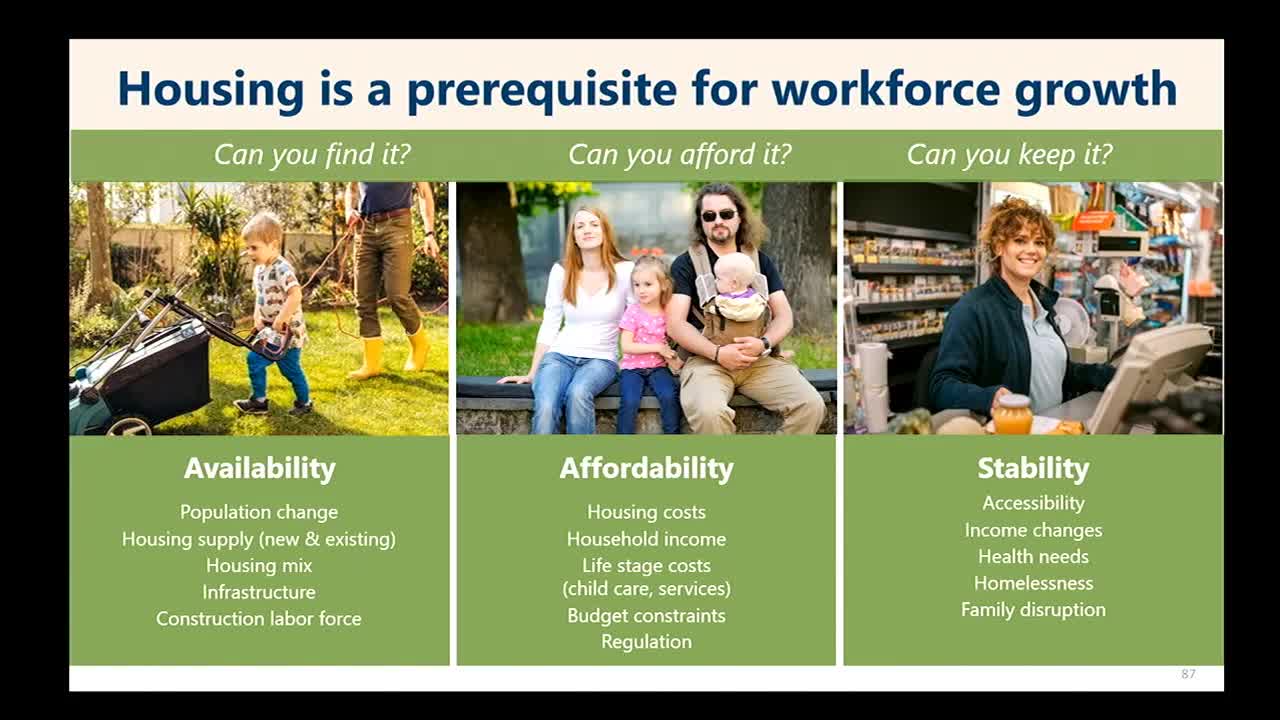
Jessica Thompson, Health and Human Services, told the Appropriations Committee's Human Services section that housing is "way more than HHS" but that stable, affordable housing intersects directly with workforce participation and with the department's service outcomes.
Thompson said housing questions fall into three simple problems: can someone find a place to live, can they afford it, and can they keep it. She told the committee the department participated in a statewide housing initiative with stakeholders and the Federal Reserve Bank of Minneapolis to analyze supply, affordability and stability across North Dakota.
Thompson summarized the department's findings and requests: the department argued a mixed strategy is required (new construction, preservation and targeted assistance) and presented a package in the governor's executive budget that included $14.5 million in the HHS request: $3.5 million for eviction prevention, $10 million for targeted rental assistance and $1 million for home renovation to improve accessibility for people with disabilities.
The department highlighted several programmatic points:
- Housing affordability metrics: Thompson described HUD and census measures showing high housing cost burden among low-income households (households earning less than 30% of state median income), and she said the cost burden has moved up the income ladder since 2012'2022.
- Market and place realities: the department said North Dakota's challenge is often a mismatch of unit type, price and location rather than an absolute statewide shortage of units; some regions lack builders and financing capacity, which limits options in rural areas.
- Stabilization and crisis response: Thompson reviewed the department's experience with emergency rental assistance and housing-stability work during the pandemic: the state's programs have received new applications (department cited roughly 250 new applications weekly at one point) and served several thousand households through rent assistance and coaching; the department said interventions can often move people from crisis back to stable with modest, targeted assistance.
- Life-stage approach: Thompson recommended adopting a life-stage lens (younger renters and buyers, families with young children, and older adults with accessibility needs) to align housing supply and services and noted that many housing solutions are private-market driven but benefit from targeted public supports.
Thompson emphasized that services without housing are less effective and that the department aims to connect people to private-market units where feasible, using targeted rental assistance to bridge affordability gaps and avoid deeper crisis.
Thompson concluded by noting the statewide housing initiative's public survey (about 1,900 respondents) and by reiterating the HHS portion of the governor's housing requests. Committee members asked about TANF flexibility, program exhaustion timing, housing insurance and how emergency programs could be integrated with local service providers.
Ending
Committee members thanked department staff; Thompson said HHS would provide additional detail on program pacing and answered questions about how eviction-prevention and stabilization supports would be coordinated with other agencies.