Get Full Government Meeting Transcripts, Videos, & Alerts Forever!
Get email alerts on the Childcare topic
No spam. Unsubscribe anytime.
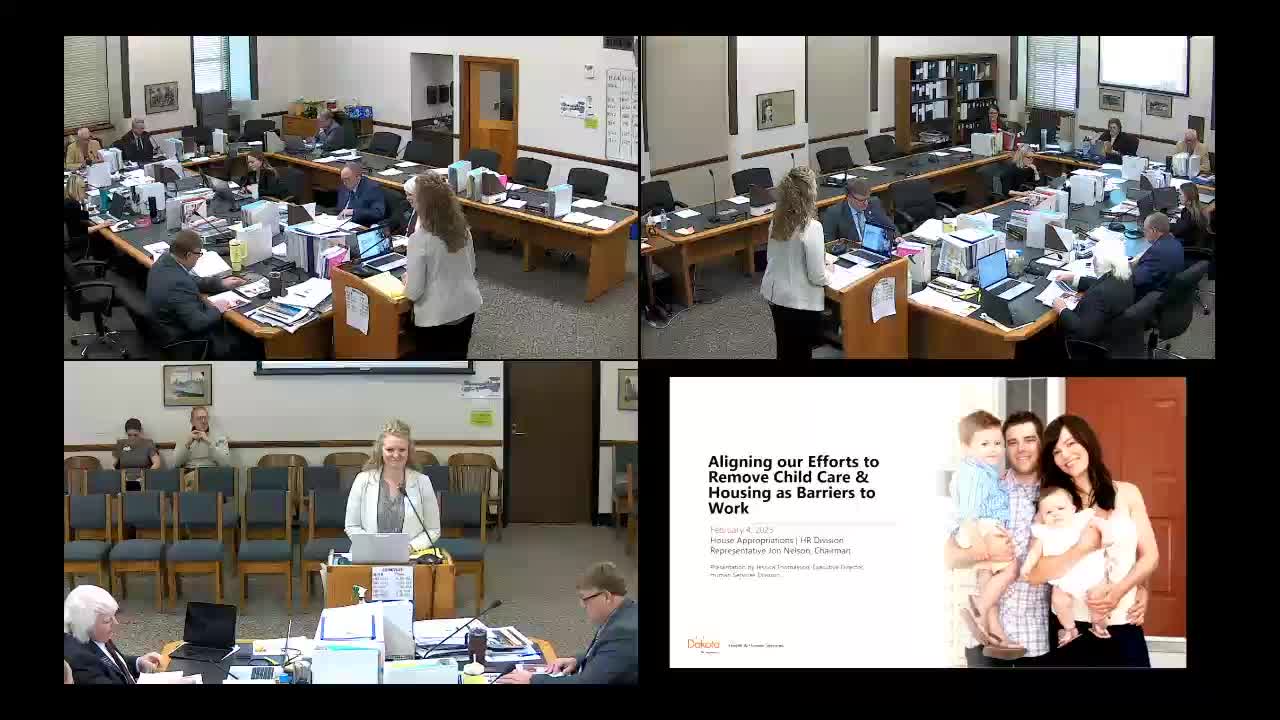
Health and Human Services briefs appropriations panel on childcare capacity, assistance and quality steps
Summary
Health and Human Services staff updated the Appropriations Committee's Human Services section on childcare capacity, the Child Care Assistance Program, recent grants and quality-rating progress, and flagged data limitations, tribal licensing gaps and outreach needs.
Jessica Thompson, Health and Human Services, told the Appropriations Committee's Human Services section that childcare and housing remain central to workforce stability and that the department intends to keep tracking both supply and demand as policy-makers weigh continued investments.
Thompson said, "childcare and housing are 2 things that thread their way through a lot of that conversation," and summarized recent state and federal investments, program uptake and remaining data gaps that affect policy design.
The update summarized three policy pillars the department uses to evaluate childcare: affordability, availability and quality. Thompson told the committee that licensed capacity remains the state's most reliable dataset but is an imperfect proxy for actual availability because providers often report lower "desired" capacity than their license allows and daily staffing shortages further reduce active capacity.
Thompson said North Dakota's licensed capacity by county is current to December 2024; the department found a roughly net gain of 49 licensed spaces statewide in 2024 even as the number of licensed providers fell by 47. She urged caution about interpreting county-level capacity as equivalent to family access because of cross-county movement, nonlicensed options (for example Head Start and school-based pre-K) and tribally licensed programs that the state licensing data does not include.
On wages and labor: Thompson cited Job Service data showing many open positions pay under $20 an hour and reiterated that childcare worker wages remain among the lowest-paid paraprofessional positions statewide. She presented the department's estimate that the Child Care Assistance Program (CCAP) benefit for a household averages about $1,400 per month, which the department said can be roughly equivalent to an $8-per-hour increase in household earnings for a full-time worker and has helped some providers recruit staff.
Program uptake and spending: Thompson said that from July 2023 through December 2024 roughly $72.8 million in CCAP payments (federal and state funds) flowed to providers on behalf of families. She gave utilization snapshots: about 5,500 children per month benefited from CCAP in a recent 12-month period; CCAP and other childcare supports have increased utilization of subsidies for children 0'to—2 since 2021. Thompson reported that administrative denials historically were a top cause of closed applications but that procedural changes (for example relaxing a 10-day documentation rule) reversed denial and approval trends starting in early 2024.
Grants, employer matches and quality supports: Thompson reviewed several targeted grant efforts and workforce-oriented programs. She said Commerce's RWIP program funded 21 projects with several large awards for facility-related needs during the previous biennium. The department reported smaller facility grants averaging about $7,700 (range up to about $20,000) to help providers make needed repairs or improvements. Thompson described the employer match program (49 participating employers as of the update) and said the largest participating employer is the State of North Dakota (as employer-match is budgeted in OMB).
Quality tiers: Thompson said North Dakota's voluntary quality improvement system has expanded since mid-2023: more programs moved from basic (step 1) into step 2, 3 and 4 ratings (environment, interactions and relationships). She noted quality-tiered payments increase CCAP rates for rated providers (step 2 = +5%, step 3 = +10%, step 4 = +15%) and that the department is requesting continued funding in the executive budget to sustain coaching, quality grants and the best-in-class expansion.
Data limits and outreach: Thompson repeatedly cautioned the committee that the state lacks integrated, day-to-day enrollment data: licensed slots do not equal active slots, desired capacity is self-reported and tribally licensed programs are not captured in the state's licensed dataset unless they opt into recognition through the childcare assistance program. She highlighted successful communications work (paid social posts generated 13,761 application actions during a campaign) and said the department is improving its self-service portal and administrative processes to reduce churn and denial rates.
The presentation closed with Thompson's note that the department expects to fully expend appropriations made under House Bill 1540 (the 1540 childcare package) and requested continued one-time and base funding items in the governor's executive budget for the next biennium.
Thompson and committee members discussed tribal licensing recognition, licensing application/transfer quirks, insurance requirements for providers, and the limits of the state's provider and utilization data.
Ending
Thompson told the panel she would provide follow-ups (including quarterly projections of CCAP spending and more detail on denial reasons) and paused before moving on to the housing portion of the presentation.