Get Full Government Meeting Transcripts, Videos, & Alerts Forever!
Get email alerts on the Older Individuals Who Are Blind topic
No spam. Unsubscribe anytime.
Blind-services advocate urges increased state support for Older Individuals Who Are Blind program
Summary
An advocate for blind and vision-impaired North Dakotans told the Human Services Policy and Appropriations Committee that the Older Individuals Who Are Blind (OIB) program needs additional state funding to provide assistive devices and home adaptations so older people can stay in their homes.
Alan Peterson, representing himself and the North Dakota Association of the Blind, told the Human Services Policy and Appropriations Committee that the Older Individuals Who Are Blind (OIB) program serves hundreds of seniors statewide but lacks adequate state funding to meet demand.
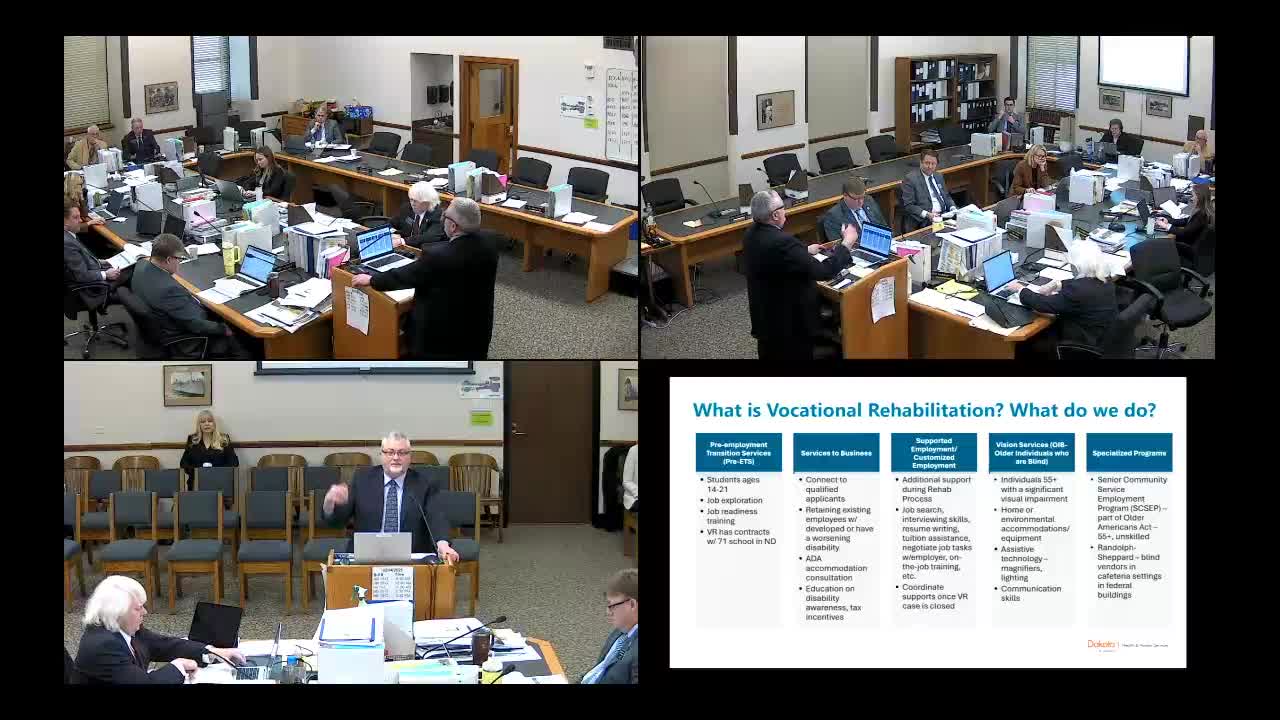
Peterson, who identified himself as blind and as a volunteer advocate with the association, said the OIB program is designed for people age 55 and older and focuses on independent-living skills, assistive-technology devices, home adaptations and training that allow people to remain in their homes rather than move to congregate care. He told the committee that about 700to750 unduplicated older individuals were served in the prior year and that the federal grant supports roughly 90 percent of OIB program funding while about 10 percent of costs fall to the state.
Peterson said the OIB state funding allocation has not been meaningfully increased in decades (he cited 1987 as the last significant state increase) and asked the committee to consider a state increase to cover adaptive devices and other services that federal grant dollars do not fully support.
Committee members asked whether additional state funding would jeopardize federal dollars; Peterson said increases in state funding for OIB would augment services and are not a matching requirement that would be matched by the federal grant in the way some other programs are accounted.
Ending: Committee members thanked Peterson and asked staff to review the program numbers; Peterson said he would be available to answer follow-up questions.