Get Full Government Meeting Transcripts, Videos, & Alerts Forever!
Get email alerts on the Vocational Rehabilitation topic
No spam. Unsubscribe anytime.
Interim VR director warns of flat federal grants, seeks $8 million technology appropriation and flexibility
Summary
Interim VR director Jim Fleming told lawmakers the state-run vocational rehabilitation program ranks among the nation—s best on several measures but faces strained capacity because federal grant funding has been flat while caseloads climbed; Fleming asked for an $8 million technology appropriation and urged lawmakers to consider mechanisms to stabilize grant funding.
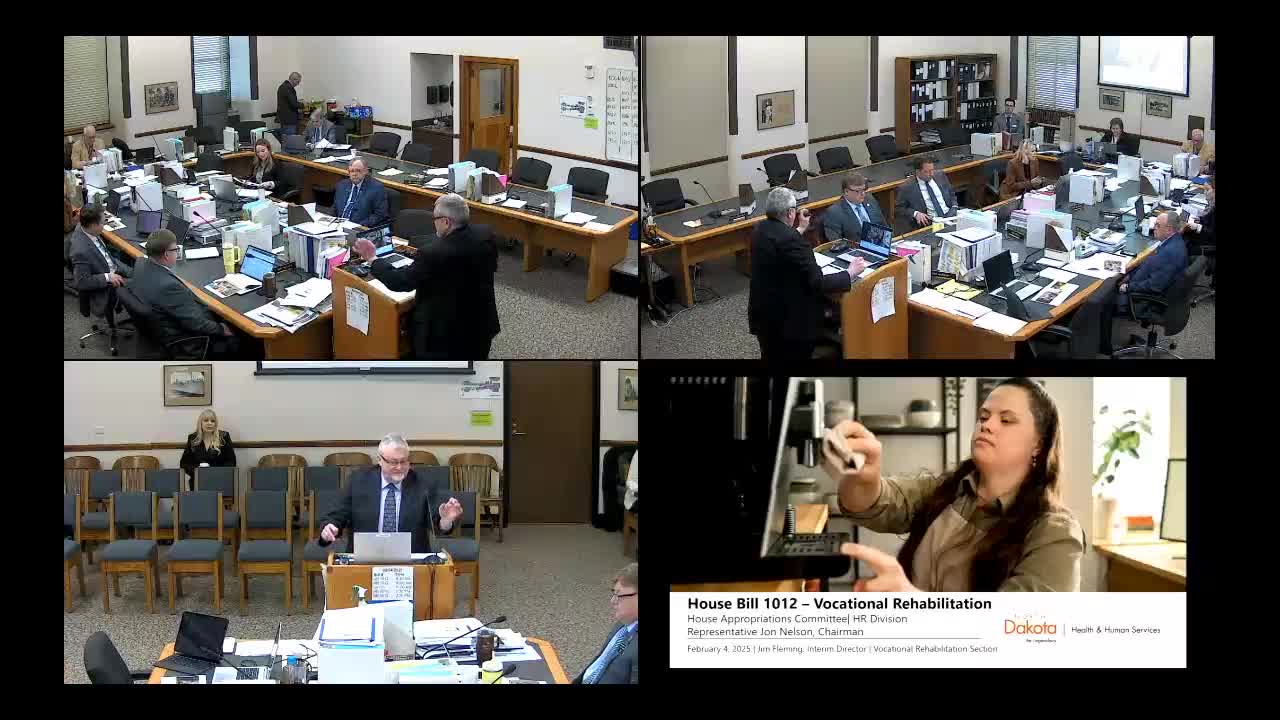
Interim Vocational Rehabilitation director Jim Fleming told the Human Services Policy and Appropriations Committee that North Dakota—s VR program ranks at or near the top nationally on several federal performance measures but faces growing caseload pressure and a federal grant structure that can leave the program constrained without legislative flexibility.
Fleming described VR—s mission and services: employer outreach and retention, supported and customized employment, pre-employment transition services (Pre-ETS) for students (services in 71 schools), older-individuals-who-are-blind (OIB) services, Randolph-Sheppard vending operations for blind vendor concessions, and community-based supports. He said North Dakota alternates with Utah among the highest employment rates for working-age people with disabilities and that the program has strong performance in credential attainment and post-exit employment.
Fleming emphasized funding constraints. The primary VR grant functions as a federal-state matching program (reported as roughly 78.7 percent federal / 21.3 percent state). Fleming said the federal minimum allotment is effectively consumed by regular operating expenditures; drawing additional reallotment federal dollars requires an appropriation vehicle. The governor—s budget includes $8 million for a VR technology system: Fleming said that money could be used for a major replacement or to expand the existing AWARE case-management system, and that vendors often require assurance of full funding before bidding on large contracts. He told the committee the department would likely phase a large project over several grant years to avoid maintenance-of-effort issues.
Fleming asked lawmakers to consider the volatility of federal funding under continuing resolutions and recommended exploring a state-level mechanism to stabilize VR funding over several years (a sinking/bridge fund) so the program could draw down federal reallotments when available without risking future state maintenance-of-effort obligations.
Staffing and workload: Fleming said VR had 87 authorized positions with 78 filled at the time of testimony and several vacancy and recruitment challenges. He said case counts have grown about 39 percent in three years while staffing did not increase, and the program has a significant number of employees near retirement. He described a push toward specialization (for example, statewide employer-relations specialists) and some remote or itinerant counselor models to improve reach.
Fleming described program-specific asks and items on the horizon: system modernization (the $8M request), use of Social Security reimbursements to offset some OIB costs, improving supported-employment capacity and employer relations, and a department-sponsored bill (House Bill 1066) to raise the wage rate for Community Service Employment Program (CSEP) participants assigned to the Department of Human Services. Fleming said HB1066 passed the policy committee on a 12-1 due-pass vote; the bill would set an interim higher rate (example number in bill text: $12/hour) for CSEP participants working for DHS and then allow the department to set a rate by rule.
Fleming and committee staff discussed the grant accounting mechanics, carryover rules, and timing. April Herring of the finance office clarified aspects of "other" funds in the budget presentation (fees, vending revenues, Randolph-Sheppard receipts).
Ending: Fleming said VR—s performance is strong but the combination of flat federal grants, rising caseloads and provider-price pressures creates the need for legislative discussion on the proposed technology appropriation and whether some form of state-level stabilization or targeted additional appropriations are needed.