Get Full Government Meeting Transcripts, Videos, & Alerts Forever!
Get email alerts on the Child Support topic
No spam. Unsubscribe anytime.
Child support officials cite improved collection rates, seek extension of IT appropriation
Summary
The Department of Human Services— child support section told lawmakers it has raised paternity and payment rates and will ask the legislature to extend a previously authorized IT appropriation while continuing operations funded largely through federal matching.
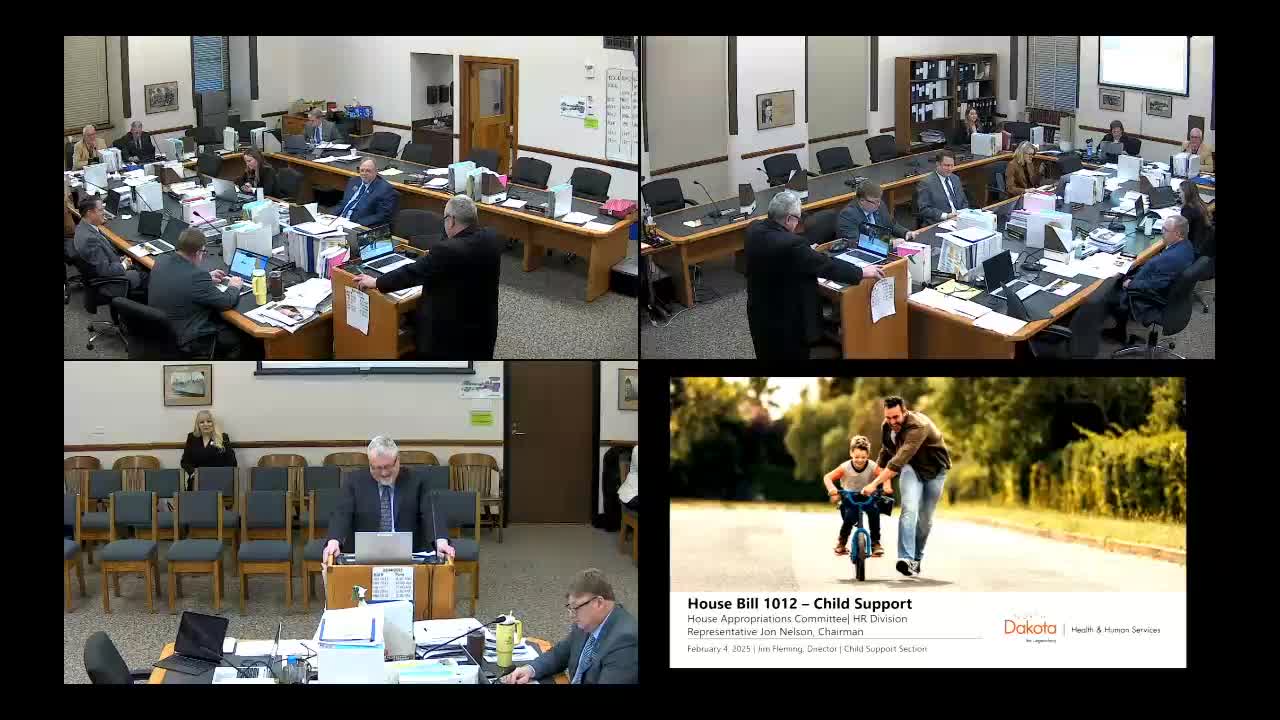
The Department of Human Serviceschild support section told the Human Services Policy and Appropriations Committee on [date not specified] that it has raised paternity and collection rates and is asking the legislature to extend an existing IT-system appropriation carried on the books from the prior biennium.
The department—s interim director of the child support section, Jim Fleming, told committee members the program now serves about 50,800 full-service child support cases and an additional roughly 20,000 limited-service cases. Fleming said the office has about 61.2 full-time equivalent staff and that collections in the most recent reporting year were in the neighborhood of $190 million. He said current-support compliance is ‘‘almost 80 percent’’ and that the state holds about $254 million in arrears.
Fleming described several policy and operational changes he credited for performance gains. The section moved periodic reviews from the federal minimum of every three years to every 18 months to keep orders aligned with pay changes; expanded partnerships with employers to increase new-hire reporting and the use of automatic withdrawals; and developed a program connecting payers to job services, a workforce program now recognized by federal child-support guidance for federal financial participation.
Fleming also described enforcement tools the section uses selectively: tax-refund intercepts, license suspensions (about 1,200 currently suspended) and involuntary payments from gaming and vehicle trade-ins when state checks or prize redemptions meet federal reporting thresholds. He said license suspensions are used to bring parents to the negotiating table and that the section offers arrears-interest suspension when a payer signs and maintains an agreed payment plan.
The section described new referral strategies with foster-care staff. Fleming said that when reunification is the goal, child-support referrals can be deferred so child-support actions do not undercut reunification efforts; if reunification fails, referrals may be reactivated. He said the change is guided by research (University of Wisconsin study cited) and recent federal guidance allowing certain TANF and foster-care referral exceptions.
On technology and budgeting, Fleming said planning is under way for a full replacement or major modernization of the child-support case-management system. He told the committee the project estimate from previous planning was about $60 million, with a 34 percent state share identified previously as coming from the Community Health Trust Fund; the department will ask the legislature to extend that authorization another biennium so the project can continue. Fleming said a planning contract is in place and an RFP for system modernization is possible this year, with vendor timelines ranging from two to four years.
Fleming said the section—s operating budget will be lower overall than in prior biennia due to reductions in rent and other space-related costs after increased use of telework and a remote call center; he also described using experienced retirees as temporary staff during critical IT modernization work. Fleming said the child-support program remains heavily federally matched (the program stated typical federal reimbursements around 66 percent) and that additional state general fund dollars yield a large federal match.
Committee members asked about evaluation of the foster-care referral strategy and about the proposed system modernization funding. Fleming said the foster-care referral approach is still ramping up and that effectiveness in North Dakota was guided by out-of-state study; he said the system modernization funding is in the existing appropriation and that the unspent Community Health Trust Fund dollars were identified earlier but not yet expended.
The section also described tribal partnerships, including work with three tribal programs and Standing Rock; a tribal offset consortium that had been briefly interrupted by an IRS decision this summer was restarted after congressional and press attention, Fleming said.
The presentation closed with Fleming acknowledging high program performance and asking the committee for continued legislative support for operating and IT modernization funds.
Ending: The committee recessed to floor session; no formal committee action or vote on the child-support operating budget or the IT appropriation extension was recorded during the portion of the transcript covering the child-support presentation.