Get Full Government Meeting Transcripts, Videos, & Alerts Forever!
Get email alerts on the Family Law Shared Parenting topic
No spam. Unsubscribe anytime.
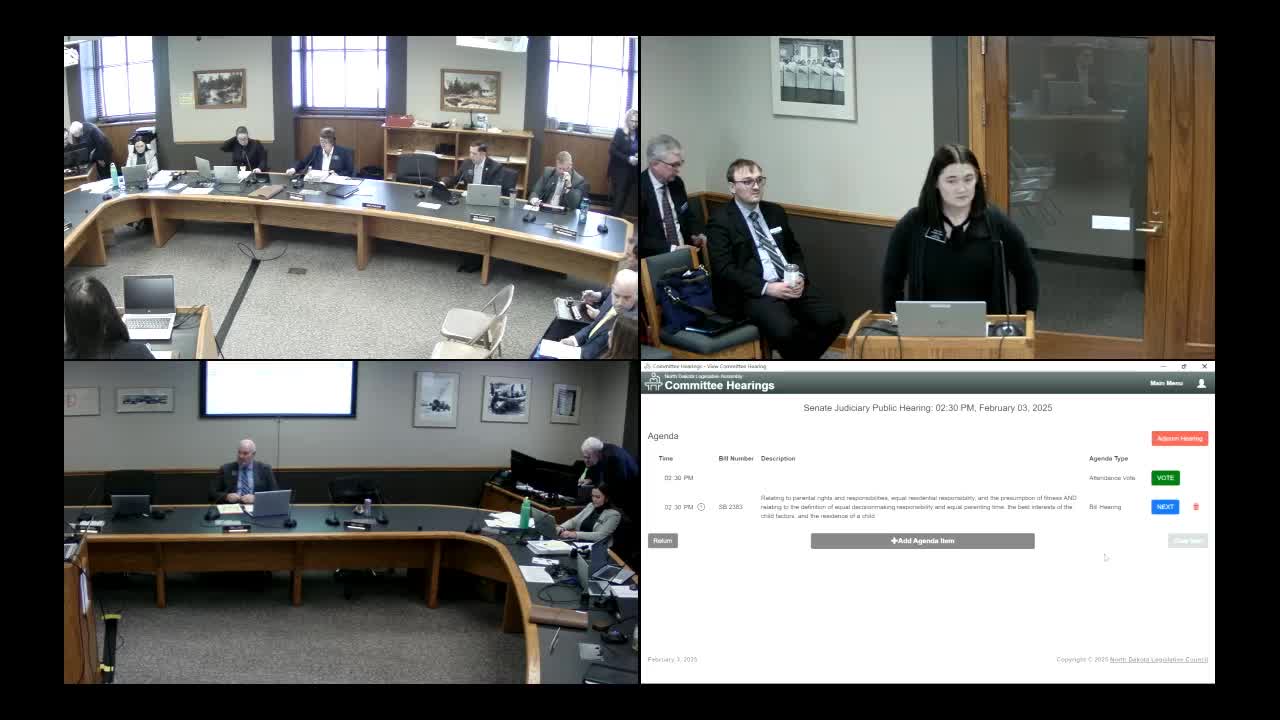
N.D. Senate Judiciary committee hears hours of testimony on Senate Bill 2383, action postponed
Summary
Senate Judiciary Committee members heard more than two hours of testimony Tuesday on Senate Bill 2383, a measure that would shift North Dakota family‑law rules toward a presumption that parents are fit and would create stronger baseline shared‑parenting provisions, then declined to take immediate action and postponed consideration.
Senate Judiciary Committee members heard more than two hours of testimony Tuesday on Senate Bill 2383, a measure that would shift North Dakota family‑law rules toward a presumption that parents are fit and would create stronger baseline shared‑parenting provisions, then declined to take immediate action and postponed consideration.
The bill’s sponsor, Senator Claire Corey, State Senator for District 42, introduced the measure as a response to constituent concerns and said hearings would include parents who brought the issue forward. "This topic obviously has been big topic for many years," Corey said in opening remarks, and she identified the measure as relating to parental rights and responsibilities.
Proponents told the committee the bill would reduce adversarial custody fights and ensure parents and children are treated equally under the law. Derek Sherwood, a witness testifying in support, argued the current standard forces parents into "a competition for custody for minor Children" and said the bill "mandat[es] that each parent is fit unless has been deemed unfit." Mark Ludwig, another supporter, described his personal experience being largely excluded from his child's life and said, "Based on the fact that you had a child, you should be presumed to be a good parent unless proven otherwise." Phyllis Lewis, who said she supported what she called the "orange effect"—children having both parents in their lives—said the bill would activate best‑interest factors only when there is "unmistakable evidence" such as convictions for domestic violence.
Supporters pointed to multiple specific provisions in the draft: removal of a vague "moral fitness" best‑interest factor, a Troxell v. Granville standard for parental rights references cited by witnesses, and a military provision that supporters said guarantees a minimum of 100 days of parenting time in certain cases (witnesses and a senator identified the provision as appearing in the bill at page 5, lines 19–24).
Opponents said those changes would weaken protections for domestic‑violence survivors, curtail courts’ fact‑finding tools, and create large new burdens on an already strained judiciary. Seth O'Neil, an attorney representing the North Dakota Domestic and Violence Coalition, said the bill "would change [the law] by presuming that equal decision making responsibility is in the best interest of all children" and highlighted language that would prevent courts from treating a domestic‑violence protection order as evidence of violence. Jason McLean, a family‑law attorney and mediator, warned the bill "will increase litigation and create the need for evidentiary hearings in nearly every case" and said that could overwhelm district courts and undermine the Family Law Mediation Program.
Other opponents with personal experience described case‑by‑case concerns. Jackie Hall, a Mandan resident who described her 2013 divorce, said her negotiated parenting arrangement took account of real‑world caregiving skills and housing availability and argued a statutory presumption would not fit every family. Hall said portions of the bill also conflict with existing provisions and with prior bills dealing with false claims and protection orders.
Committee members asked detailed questions about the bill text and consequences. Senators queried whether the bill’s language requires a criminal conviction to trigger domestic‑violence considerations, how the proposed 100‑day minimum would operate, and whether the presumption would increase motion practice and court filings. Witnesses gave differing answers: proponents emphasized fairness to deployed service members and presumed equality; opponents and family‑law practitioners emphasized the risk of limiting courts’ ability to consider protection orders and crafting individualized arrangements.
After hearing witnesses for and against the bill, Chairwoman Larson closed the testimony and told the committee they would not take action at that meeting. "We're going to just, hold off on taking any action on this particular bill until a later time," the chairwoman said, and recessed the hearing.
The record of the hearing includes direct appeals from parents, policy arguments from advocates on both sides, and repeated warnings from family‑law mediators and attorneys about increased litigation and the limits the bill would place on courts' current discretion. Committee members did not vote on the measure and no formal amendments were adopted during the hearing.
The Senate Judiciary Committee may schedule further consideration at a later date.