Get Full Government Meeting Transcripts, Videos, & Alerts Forever!
Get email alerts on the Developmental Disabilities topic
No spam. Unsubscribe anytime.
HHS outlines DD services growth, waiver changes and budget requests including host-home pilot
Summary
Department of Health and Human Services officials told the Appropriations committee the state's developmental-disability programs have grown in enrollment and scope, described recent waiver enhancements and pilots, and presented budget requests for assessment tools, a host-home service and cross-disability waiver work.
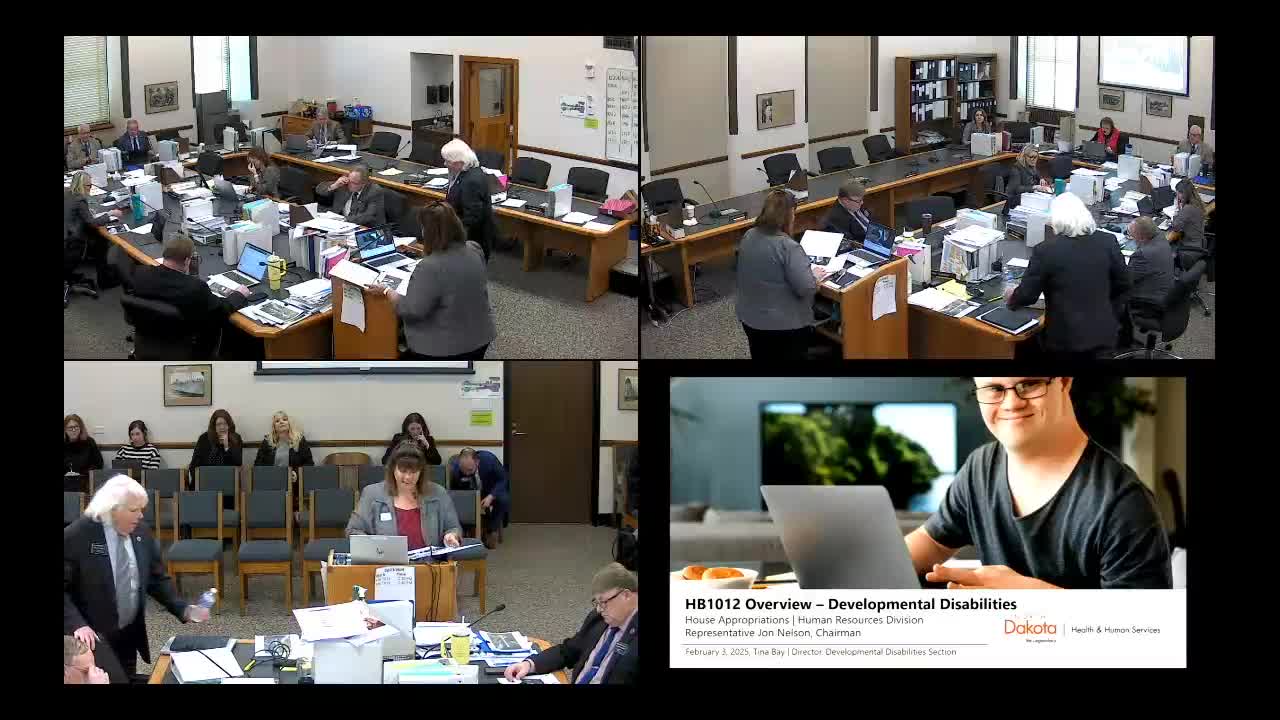
Tina Bay, director of the Developmental Disability Section at the Department of Health and Human Services, told the Appropriations committee the section serves about 8,410 people and operates a range of services including early intervention, program management, intermediate care facilities and a 1915(c) home- and community-based services (HCBS) waiver.
The department emphasized that eligibility and service delivery have shifted over time and requested funding in the executive budget for assessment-tool replacement, a host-home service for youth and planning for a cross-disability children's waiver.
Why it matters: Committee members were shown utilization trends and policy changes that affect how many people qualify for services, what services are available and how the state budgets for them. Several of the department's requests would change service access or payment arrangements and could increase ongoing costs if enacted.
Bay described the Developmental Disability (DD) Section's core functions: provider licensing and enrollment, waiver administration, service authorization, guardianship services and program-integrity work including quality reviews and provider audits. "The developmental disability section is dedicated to ensuring that individuals with developmental and intellectual disabilities have access to comprehensive person centered services that promote independence, inclusion and quality of life," Bay said.
Officials told the committee the DD program currently employs 117 program managers, conducts an average of 240 new referrals and 191 new eligibility determinations monthly, and serves about 8,410 people with DD case management supports. Bay showed a 7.8% increase in eligibility determinations since 2019 and said self-directed services and family-home supports are among the fastest-growing delivery modes.
Program and policy changes highlighted
- Waiver renewal changes effective April 2024: Bay said in-home supports may now be provided by a mix of provider-managed and self-directed services; allowable equipment-and-supplies limits increased from $4,000 to $5,000 per waiver year; environmental-modification limits increased from $20,000 to $40,000 (over five years) and may be used in rented homes; and a stand-alone respite service was created with up to 600 hours per year.
- Family caregiver pilot: Bay said the pilot established by 2023 legislation (Senate Bill 2276) launched April 1, 2024, with funding of $2,200,000 for direct services and $300,000 for an FTE and an IT portal. As of Dec. 3, 2024, the department had received 444 applications and approved 50; 62% of approvals were ages 0-17. Bay gave daily rates used in state reporting: $77.45 per day for ages 0-17 and $154.89 per day for ages 18 and older (the department reported an annual average figure of $40,271 for the adult rate).
- Guardianship establishment fund: a $3,000-per-request fund to cover petitioning costs; Bay said 112 requests had been approved.
Appeals, wait list and implementation costs
Bay described implementation tasks tied to the family caregiver pilot and other changes. She noted the law requires a 30-day appeal process when applications are denied and that the department temporarily holds funds while an appeal is pending. As of December the wait list totaled 182, Bay said. The department reported $35,000 in appeal-related costs paid to the attorney general and Office of Administrative Hearings, covered by HHS funding rather than the SB 2276 allocation.
Bay listed IT costs the department incurred for the pilot's portal (about $73,000) and stated the portal supports application submission, uploads of extraordinary-care assessments and a status view for applicants.
Policy and budget requests
Bay presented several requests in the executive package:
- Replace the ICAP child assessment with the child version of the Supports Intensity Scale (SIS-C) and fund testing and allocation consulting: one-time $400,000 (split general and federal) for assessment licensing and consultant work.
- Establish and fund a DD host-home service intended to replace and expand the existing family-care option by adding therapeutic wraparound supports for youth and their families. Bay said the request funds 20 operational host homes serving roughly 20 youth and is an ongoing request totaling $3,379,000 (split general and federal). She said the current family-care option is underused and the host-home model would support family reunification via therapeutic services and vendor-managed host-family recruitment and training.
- Provider inflation: 1.5% per year for agencies and self-directed providers, an ongoing request of $16,800,000 split general and federal.
- Cross-disability children's waiver design and implementation work to modernize eligibility and service arrays, with a three-year design timeline and an ongoing request of $4,900,000 (split general and federal). Bay said the anticipated service start date would be July 2028 and the work includes designing a new level-of-care approach and testing tools.
Changes to eligibility and level of care
Bay explained the department proposes to revise North Dakota's DD eligibility assessment approach so the state uses more modern standards to assess support needs. She described the shift from assessments focused mainly on intellectual deficits to tools that also capture social functioning alongside conceptual and practical adaptive domains. "We have to be very careful when we're implementing and looking at this level of care so that we don't have unintended consequences of people no longer qualifying for services," Bay said, adding the department will test tools, adjust allocation formulas and plan transitions to avoid sudden loss of services.
Licensure, accreditation and provider costs
Bay said the department expanded options for providers seeking accreditation and clarified that provider accreditation costs are the provider's responsibility. She told the committee that under previous payment methodologies accreditation had been reimbursable; after payment reforms the department's budget no longer covers accreditation costs. She cited Council on Quality and Leadership (CQL) person-centered accreditation averaging $20,000 to $30,000 for a four-year cycle, but said providers may now choose among accrediting entities.
Intermediate care facilities and bed use
Bay said North Dakota has 451 licensed ICF beds statewide, with an average monthly bed usage of 389 between July 2023 and June 2024 (86% utilization). She said the department wanted to explore whether some licensed beds could be repurposed for crisis needs while avoiding incentives to institutionalize people.
Outlier requests and assistive technology
Bay described the outlier staffing policy that allows additional Medicaid-funded staffing in extraordinary circumstances when other mitigation was pursued; she provided approval/denial counts for 2022-2024. She also summarized reimbursement pathways for assistive technology: Medicaid state plan coverage requires medical necessity and an enrolled vendor; 1915(c) waivers have caps and differing eligibility rules (for example DD waiver equipment-and-supplies $5,000 per year; environmental modifications $40,000 over five years). The department contracts with Viridian for intermediary services on environmental modifications for some waivers.
Budget and utilization overview
Bay presented DD program budget totals included in the executive request and highlighted that roughly 94% of the DD budget goes to private providers for direct services while about 4% is administration. The department reported a total DD funding figure in the presentation materials and identified the executive request changes for salaries, inflation, and program expansions.
What the committee asked and next steps
Committee members asked for more detail on several items, including cost estimates for repurposing ICF beds, the administrative share of host-home vendor contracts, and how many people might be affected by changing the level-of-care tool. Bay repeatedly said those numbers would require testing and that the cross-disability work is expected to be multi-year and to include careful testing to avoid unintended eligibility losses. She also noted appeals and administrative costs the department currently carries for denials.
Ending
Bay concluded by offering her contact information and appended consulting reports used in the department's planning. The committee did not take formal votes during the presentation; members indicated interest in follow-up details on cost estimates and on the level-of-care testing plan.