Get Full Government Meeting Transcripts, Videos, & Alerts Forever!
Get email alerts on the Behavioral Health Regionalization topic
No spam. Unsubscribe anytime.
Senate subcommittee holds SB2096 after debate over regional contracts and state hospital role
Summary
Senate Bill 2096, amended to remove references to the State Hospital, would authorize up to $64 million for contracts with private providers to expand regional inpatient and residential mental‑health care; the committee discussed staffing, existing regional contracts and possible adjustments and agreed to set the bill aside for further work.
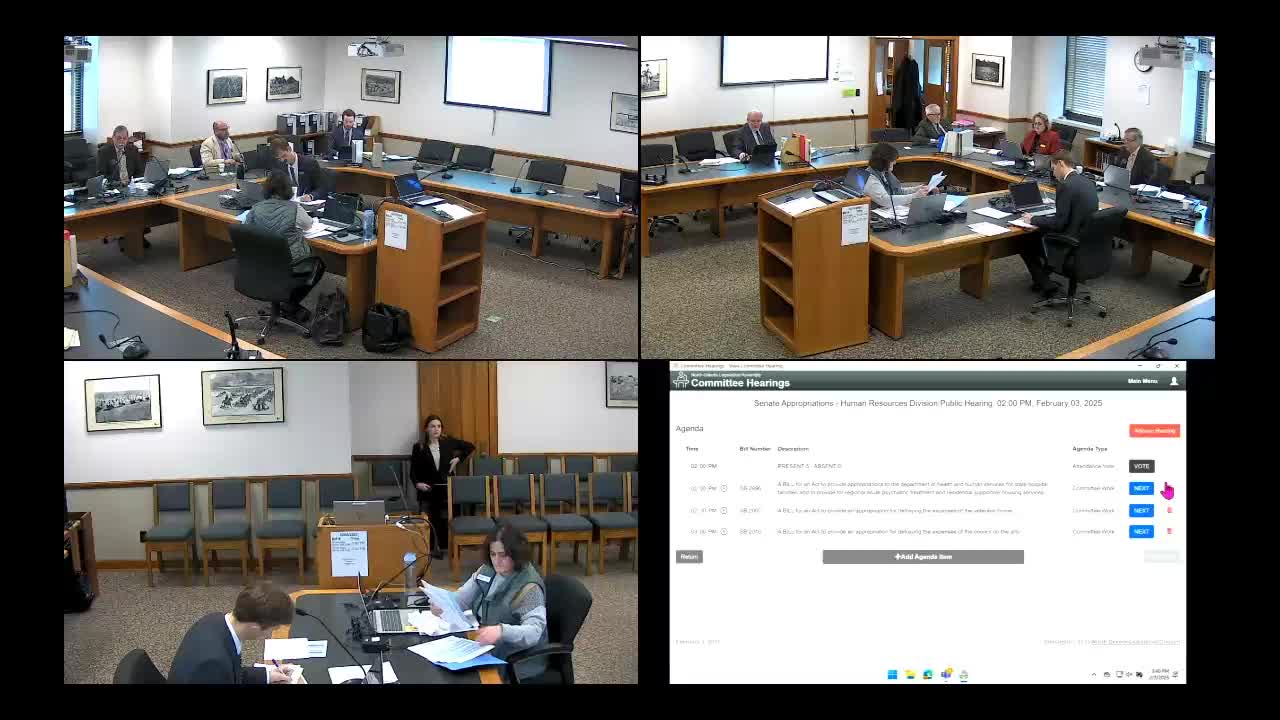
Senate Bill 2096, as presented to the Senate Appropriations — Human Resources Division, would authorize the North Dakota Department of Health and Human Services to contract with private providers across the state to provide acute and residential behavioral‑health services. Senator Matherin, the bill’s sponsor, said the amended bill removed any language about remodeling the State Hospital and reduced a previous contract authority figure to $64 million from $100 million.
Matherin described the bill’s intent as creating “more opportunities for people to get mental health treatment in our regions,” framing the program as contracting with providers in geographic areas — originally described as four quadrants — to ensure regional access. He said contracts would be at least 10 years long and that contracting would allow existing providers to expand services rather than creating entirely new state facilities.
Pam Segnus, Executive Director of Behavioral Health for the Department of Health and Human Services, told the committee the state already operates a regionalized acute psychiatric system through contracts with private hospitals and that some regions lack inpatient acute psychiatric capacity today. “We currently have a regional behavioral health system,” Segnus said, and she urged clarity in the bill about whether the $64 million would be one‑time capital investment, ongoing contract authority, or both. Segnus also recommended against limiting the effort to four regions, suggesting eight regions could better preserve existing coverage and expand services where needed.
Committee members raised operational concerns including workforce and forensic services. Several senators said staffing is a challenge but that distributing services across multiple population centers could be easier to staff than concentrating services in a single new facility. Segnus emphasized that competency restoration, forensic and civilly committed offender services remain specialized functions of the State Hospital and that private hospitals have not shown willingness to take on those services.
Members also noted that the House has a related proposal (House Bill 1468) that provides $16 million for a facility; Senator Davison and others said it may be prudent to coordinate with the House and the human services budget rather than advancing competing proposals now. After discussion the committee agreed to set SB2096 aside for further consideration and revisit it in about a week so members and staff can draft clarifying amendments and consider how the House proposals and the budget process should be coordinated.
Ending: The committee left the bill on the table to permit further work on language, funding structure (capital v. contract authority) and regional design before making a formal recommendation.