Get Full Government Meeting Transcripts, Videos, & Alerts Forever!
Get email alerts on the Ambulance Funding topic
No spam. Unsubscribe anytime.
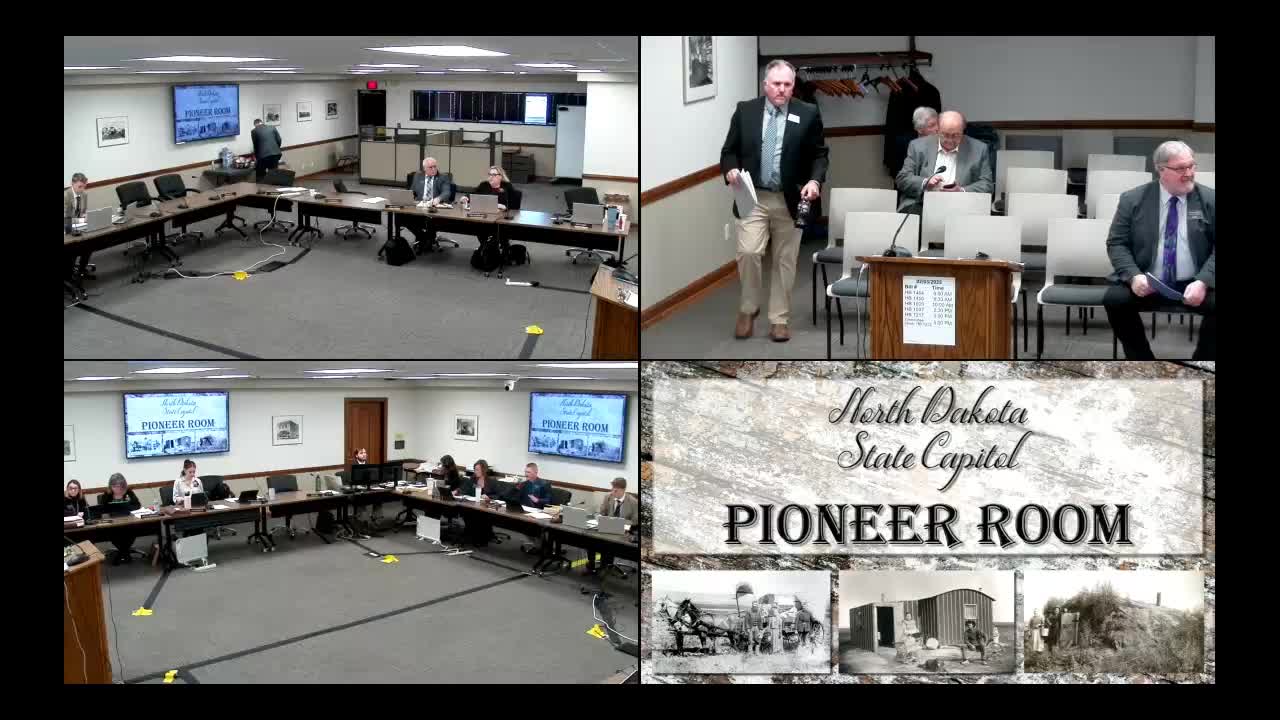
Committee hears testimony on HB 1597 to adjust rural ambulance grant formula
Summary
House Human Services Committee members heard testimony on House Bill 1597, which would revise the formula and eligibility for the state's rural ambulance assistance grant.
House Human Services Committee members heard testimony on House Bill 1597 on ambulance funding, a bill Representative Pat Heinert said would revise how the state's rural ambulance assistance grant is distributed.
The bill "is a ambulance bill to assist ambulances in some payment on a number of runs they make and other things," Representative Pat Heinert, District 32, said when introducing the measure (Rep. Heinert, testimony, 00:02:45). He told the committee an amendment was expected that would address concerns raised by some ambulance services.
Why it matters: The bill would change elements of the formula the Department of Health and Human Services uses to distribute a fixed appropriation for rural ambulance support. Witnesses said the appropriation itself does not change under the bill; the proposal changes who qualifies and how funds are split.
Bill Kalanick, representing the North Dakota EMS Association, described the bill as a periodic refinement to a formula that the legislature renews every two years. He said the average per-run figure used in the formula was updated in the draft to reflect current costs and that the proposal removes or changes eligibility language carried in previous session law. "This only substantive change in in subsection 1... the calculation of the average run, which went from... $17.50 to $20.23 as an average run," Kalanick said (Bill Kalanick, testimony, 00:04:02).
Kalanick and other supporters described two central changes in the draft amendment he submitted: deleting language that would have excluded operations owned and operated by cities, counties or rural ambulance service districts (a deletion that could allow privately owned ambulances to qualify in the future) and raising the threshold for runs-per-year used in eligibility calculations from 700 to 1,000 runs. Kalanick said the 1,000-run figure was selected because recent mergers and changing call volumes had left some districts just over the old 700-run cutoff and back under the cutoff at different points.
Committee members pressed for data. Representative Barr asked whether committee staff could get a list of ambulance services that currently would be eligible under the 700-run and 1,000-run thresholds; Kalanick said he could provide that report by email (Bill Kalanick, QA, 00:10:01). Representative Fegley asked how many services would be affected by distance and low-run counts; Kalanick said he did not have those numbers on hand but again offered to provide a calculation to the committee.
Tim Blaso, president of the North Dakota Hospital Association, testified the association supports HB 1597 as amended; he said some critical-access hospitals operate ambulance services with fewer than 1,000 runs and that the amendment would preserve support for those services (Tim Blaso, testimony, 00:11:40).
Key context and limits: Witnesses repeatedly said the bill changes distribution of an existing, fixed appropriation and does not increase the total appropriation. Kalanick said the appropriation was accounted for in the Human Services budget and that the change only alters how the money is distributed among eligible operations.
Discussion vs. decision: This hearing was for testimony and committee questions. The committee closed the hearing on HB 1597 with no formal committee vote recorded on the bill during this meeting.
Ending: Supporters offered to supply the committee with detailed eligibility lists and calculations; the committee did not vote on HB 1597 during this session and the bill will appear again in later work sessions where members can consider the staff reports and amendment language.