Get Full Government Meeting Transcripts, Videos, & Alerts Forever!
Get email alerts on the Medical Malpractice Cap topic
No spam. Unsubscribe anytime.
Committee raises non-economic malpractice cap to $1 million; several larger increases and no-cap proposals fail
Summary
After extended debate and multiple amendments, the House Judiciary Committee voted to advance a medical‑malpractice bill that raises the cap on non‑economic damages from $500,000 to $1,000,000 and retains limitations on future scheduled increases; proposals to raise the cap higher or remove caps failed.
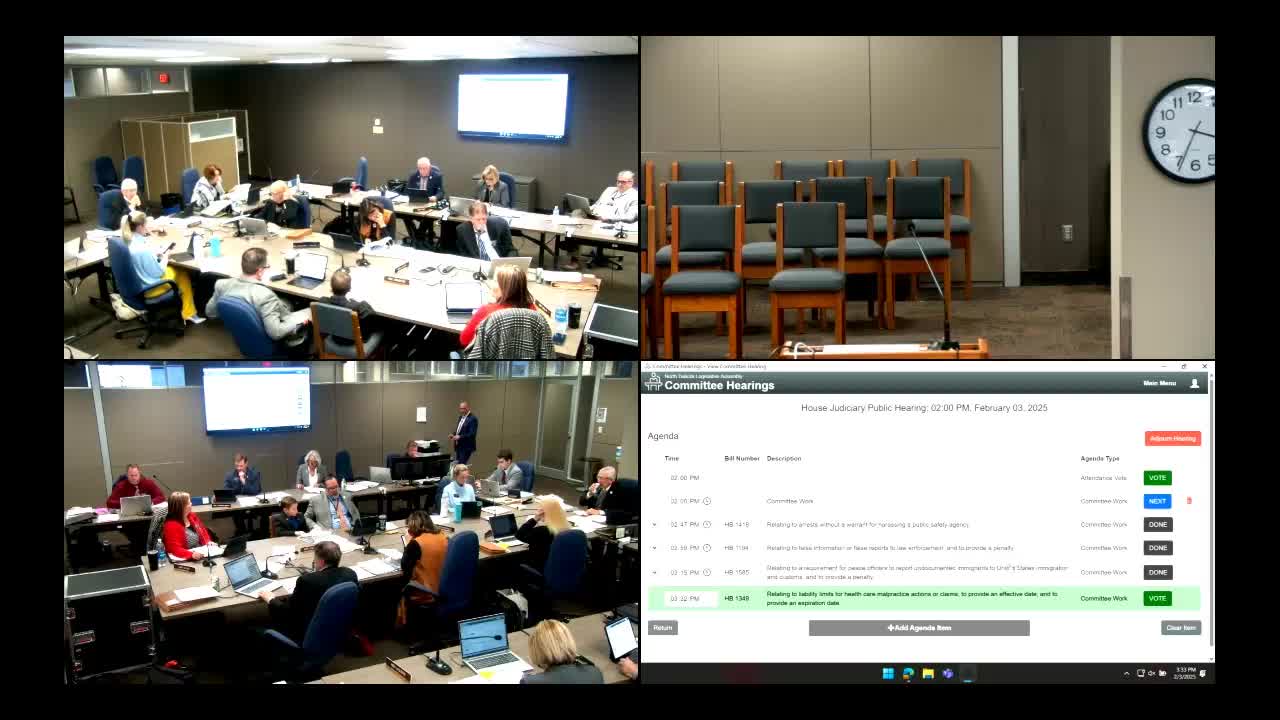
The House Judiciary Committee on Oct. not specified voted to advance a medical‑malpractice bill (House Bill 1349) amended to raise the cap on non‑economic damages from $500,000 to $1,000,000.
Committee debate lasted multiple rounds and considered amendments to raise the cap progressively to $2 million and to remove damage caps entirely. Representative Vetter proposed an amendment that would have increased the cap in stages up to $2 million; members who supported higher caps cited rising costs and testimony from claimants, while opponents warned of provider shortages and higher insurance costs in rural areas. That larger amendment failed on a recorded vote.
Several members said they would prefer no cap but worried about recruiting and retaining medical providers in rural parts of the state; others emphasized victims’ interests and recounted testimony from personal-injury claimants. Representative Satrim moved an amendment to set the cap at $1,000,000 and to restore language in the bill preventing multiple separate aggregate claims against multiple defendants; that amendment was adopted. A subsequent attempt to add language that would exempt unborn-fetus claims from the cap failed; a later motion to reinsert that exemption also failed.
After the amendments and additional debate, the committee voted to advance the bill as amended (do‑pass as amended); the committee reported the do‑pass vote as 10 yes, 3 no, with one member absent. Supporters said the $1,000,000 cap updated the prior $500,000 ceiling to reflect current circumstances; opponents maintained the cap should be lower or removed entirely. The committee identified a bill carrier to take the amended measure forward.
Committee discussion clarified that the bill’s non‑economic cap applies to damages such as pain and suffering, mental anguish and loss of consortium, while economic damages (medical bills, lost earnings) are not capped by the statutory change discussed at committee. Members asked legislative counsel and staff to verify statutory references and the bill’s cross‑references before floor action.