Get Full Government Meeting Transcripts, Videos, & Alerts Forever!
Get email alerts on the 24 7 Sobriety Program Funding topic
No spam. Unsubscribe anytime.
Committee hears bill on 24/7 sobriety program funding after judges waive participant fees
Summary
Senate Bill 23‑65 would shift responsibility for waived 24/7 program fees; sheriffs and county associations told the panel that waiver practices are creating unpredictable county costs and urged a state-level solution or prohibition on waivers.
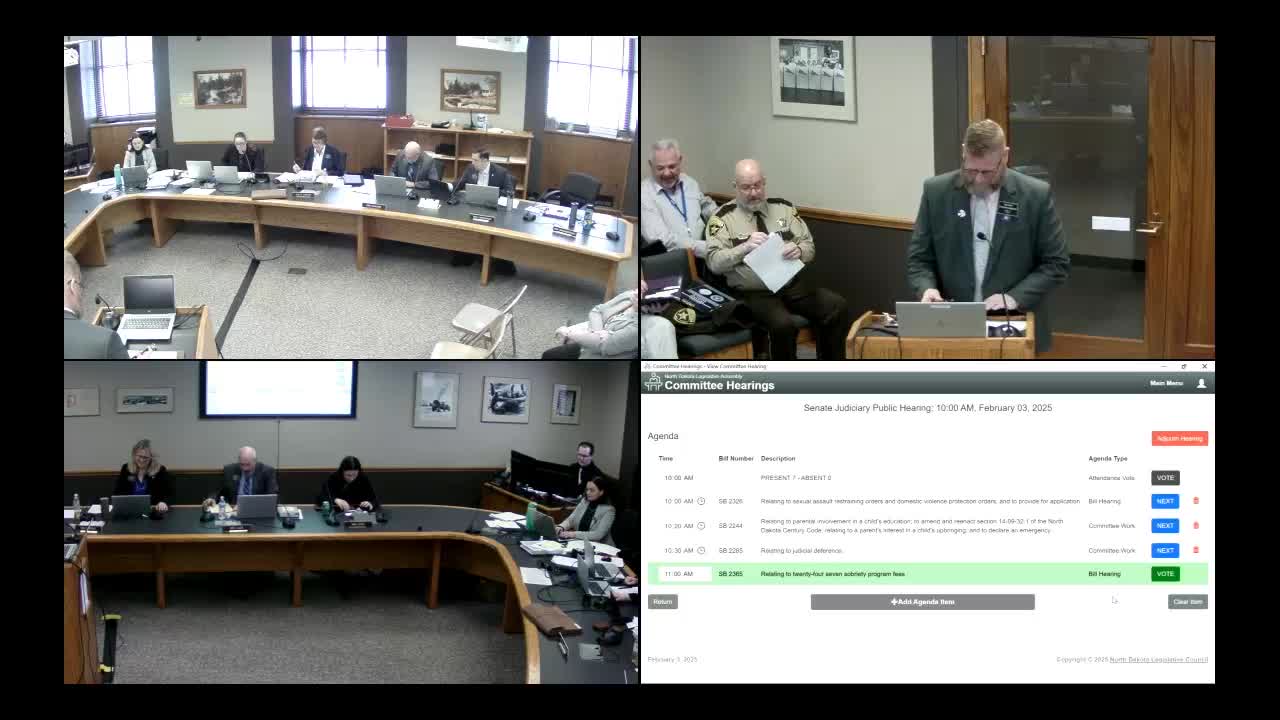
Senator Brownberger introduced Senate Bill 23‑65 to the Senate Judiciary Committee, saying the measure responds to county concerns about judges waiving participant fees for the 24/7 sobriety program and shifting costs to local governments.
"What this bill is proposing is that when a judge does waive those fees, the clerk of courts would be the ones that would pick up that difference," Brownberger said, and noted the Attorney General’s Office has recommended moving the funding mechanism into the AG’s statutory authority because clerks do not have discretionary funds to absorb those costs.
Danelle Presque, executive director for the North Dakota Sheriffs and Deputies Association (presenting through the North Dakota Association of Counties), said counties are experiencing budgetary pressure when courts waive fees and suggested alternatives including prohibiting fee waivers or routing waiver costs to a state fund.
Burleigh County Sheriff Kelly Lieben described how the 24/7 program is administered and provided several program-cost figures to the committee. He told senators the program can include twice‑daily breath tests ($2 per day), remote breath testing (startup $120 with a $50 activation fee and about $5 per test), SCRAM alcohol bracelets (approximately $84 per two‑week testing period plus a $140 startup cost), and drug patches (about $60 per day for a 7–14 day patch). He said Burleigh County’s recorded 2023 receipts from the program were $267,379, with roughly $128,089 retained by the county after costs and about $52,000 spent on supplies.
Lieben and Lieutenant Chad Violet (who ran Cass County’s program for 11 years) told the committee judges had begun waiving some drug-patch fees in certain counties, and that waivers can produce unpredictable costs for sheriff offices that administer the program. Violet said Cass County has seen waivers for drug-patch fees and provided an operational example: a participant on the drug patch who was on the program for four months generated roughly $800 in waived fees.
State Court Administrator Sally Halverson said she was neutral on the bill and offered an administrative view. She noted the 24/7 program is administered by the Attorney General's Office and that the AG’s guidelines allow fee waivers; because county clerks’ receipts are designated funds, she recommended any appropriation to reimburse waivers be placed in the AG’s fund that already exists to administer the program (ND Cent. Code § 54‑12‑29). Halverson said clerks do not have undedicated discretionary balances that could be repurposed to cover the waived fees.
Committee members asked practical and policy questions: whether waiver practice affects participation, whether indigent people should be held in custody instead of being placed on the program, and what statutory or budgetary vehicles are available to reimburse counties. Several senators observed that the program is participant-funded by design, but that statutes now mandate program participation in certain DUI scenarios (for example, repeat or felony DUI) and that the mix of voluntary and statutory participation complicates the funding question.
No committee vote was taken. The committee concluded the issue needs further study: options discussed included (1) prohibiting judges from waiving fees, (2) asking the Attorney General’s Office to change its waiver guidance, or (3) providing a state appropriation routed through the Attorney General’s 24/7 fund to reimburse counties when fees are waived.
The committee recessed after the hearing for additional scheduled business.
This record includes direct operational figures provided by sheriffs for testing types and approximate program costs, and multiple participants urged a consistent statewide policy to avoid shifting unpredictable costs to counties.