Get Full Government Meeting Transcripts, Videos, & Alerts Forever!
Get email alerts on the Education topic
No spam. Unsubscribe anytime.
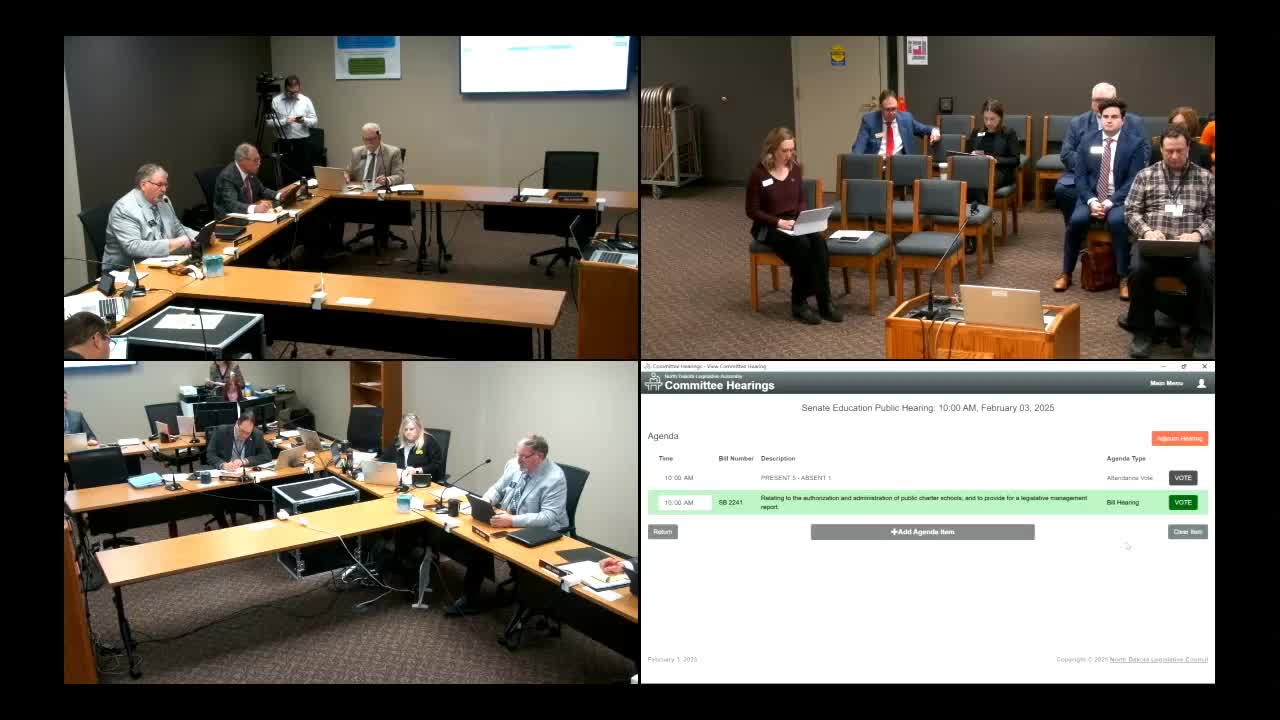
Senate committee hears hours of testimony on bill to allow public charter schools; amendment banning tuition approved
Summary
The Senate Education Committee heard extensive pro and con testimony on Senate Bill 22-41, which would authorize public charter schools in North Dakota; the committee approved an amendment clarifying charter schools may not charge tuition, 6-0, but took no final vote on the bill.
The Senate Education Committee heard testimony on Senate Bill 22-41 — legislation to authorize and regulate public charter schools in North Dakota — during a committee meeting. Sponsor Senator Michelle Axeman presented the measure and proponents and opponents from education organizations, parents and rural school leaders testified. The committee approved a technical amendment clarifying charter schools may not charge tuition; the amendment passed 6-0. The committee did not take a final vote on the bill.
Senator Michelle Axeman, who represents District 7, told the committee that the bill would create a “framework for the creation, governance and oversight of public charter schools in North Dakota,” stressing that charter schools are public, open and tuition-free. “What is a public charter school? Well, simply put, charter schools are public schools. There is no cost to attend,” Axeman said, and described the measure as combining flexibility for schools with “a higher level of accountability.” The bill would establish the state superintendent as the sole authorizer and require charter schools to meet state academic and graduation requirements, hire licensed teachers and comply with federal special education law and Section 504 plans.
The sponsor and witnesses described other provisions included in the draft: charter schools would receive the state per-pupil funding that follows students; they would undergo independent financial audits and report data to the superintendent; employees would be eligible for the state retirement plan if the charter elects to participate; and charter schools could not engage in religious instruction, be purely home-school or virtual providers, or charge tuition. Axeman noted applicants must also demonstrate local community support as part of the application.
Supporters highlighted experience from other states and rural examples. Lisa Grover, Senior Director of State Advocacy and Support at the National Alliance for Public Charter Schools, said the bill contains “lessons learned and best practices from all over the country” and that charter schools “are not in opposition to district schools. In fact, they can often be quite complimentary.” Maria Nessa, Chief of Staff to the lieutenant governor, testified the governor’s office supports the bill and listed expected benefits including tailored curriculum, specialized programming and increased parental involvement. Dr. Jacob Frankem, founding principal of North Idaho Classical Academy, described strong local interest in a rural charter school he helped start and said his school expects to serve students from surrounding communities and tribal families. He told the committee his start-up received federal charter-school program grants and private foundation funding.
Opponents raised concerns about funding, staffing, special education services and impacts on small and rural schools. Nick Archuleta, president of North Dakota United, urged a do-not-pass recommendation and cited national research on charter closures and mixed performance: “I rise today in opposition to Senate Bill 22 41,” he told the committee. Archuleta said national studies show substantial closure rates — 25% in the first five years and higher over longer periods — and warned that closures can leave communities without schools. He also questioned whether charter teachers would reliably participate in the state pension plan and asked how the bill would address charter staffing and turnover.
Representatives of local education groups and disability advocates asked for stronger, explicit protections. Anna Rackley of the North Dakota Protection & Advocacy Project urged the committee to require explicit compliance with IDEA and Section 504 and to describe how charter schools will provide specialized services such as speech and occupational therapy. Amy DeCook, executive director of the North Dakota School Boards Association, said she feared increased segregation and that enrollment preferences (for example, for children of charter employees) could undermine open access, and she urged more investment in existing public schools.
Public commenters who testified ranged from a rural charter school teacher who described positive professional experiences to parents and citizens who said charter schools would divert finite state dollars. One remote teacher testified that the charter environment provided professional opportunities she had not found in larger districts; a father testified he opposed the bill because it would “divert essential public funds away from our traditional public schools.”
Committee action: the committee considered an amendment submitted by the bill sponsor to correct a drafting error that would expressly prohibit charter schools from charging tuition. Senator Gearhart moved to approve the amendment; the motion was seconded and the amendment passed, 6 yays, 0 nays, 0 not voting. The committee closed testimony on SB 22-41 without taking a final vote on the underlying bill.
The hearing record shows divergent views about the bill’s likely impact in rural North Dakota, its effects on students with disabilities, and the adequacy of the state authorizing and oversight model. Supporters cited other rural charter examples and federal grants that helped startup costs; opponents cited national closure rates, staffing concerns, and the risk of diverting limited resources from existing districts. The committee will take further action on the bill at a later date.