Get Full Government Meeting Transcripts, Videos, & Alerts Forever!
Get email alerts on the False Reports Law Enforcement topic
No spam. Unsubscribe anytime.
Committee hears concerns about bill requiring officers to report false reports; police groups warn language too broad
Summary
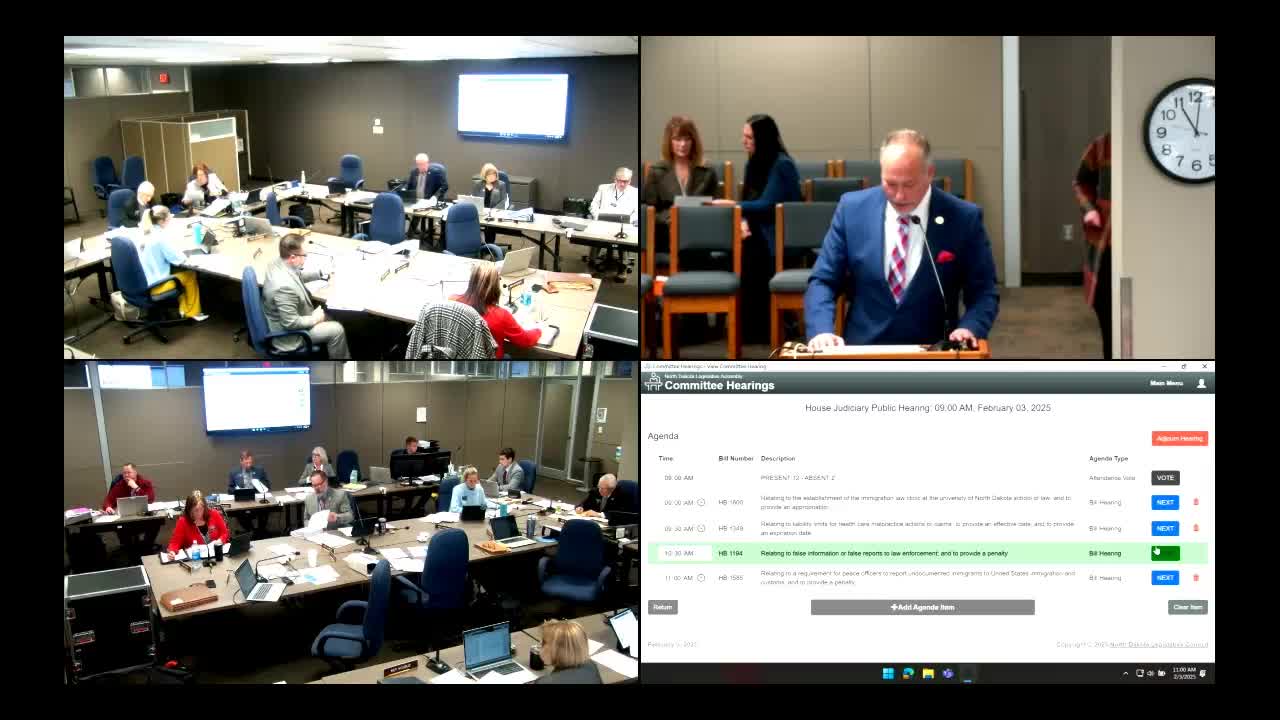
House Bill 1194 would require law enforcement officers to report false information or false reports to a state's attorney. Sponsors called the measure a modest step to ensure false accusers are reviewed by prosecutors; law‑enforcement groups opposed the bill as written, urging narrower language and preservation of officer discretion.
Representative Steve Vetter introduced House Bill 1194, a bill to amend Section 12.1‑11‑03 of the North Dakota Century Code to require reporting to a state's attorney when an individual provides false information or files a false report with law enforcement.
Representative Vetter told the committee he has seen “an increase in false accusations” and that the bill simply requires that peace officers forward suspected false‑report complaints to the state's attorney rather than leave that decision to a single officer’s discretion.
Nut graf: While the sponsor framed the bill as a limited procedural change, law‑enforcement organizations and prosecutors raised concerns that the bill’s current wording is overly broad, could create workflow burdens, and would remove important officer discretion in routine encounters where people provide misinformation.
Opposition and police concerns Lieutenant Dustin Olson of the Burleigh County Sheriff’s Department, speaking for his department and as president of the North Dakota Peace Officers Association, testified in opposition. Olson said officers receive false statements frequently and that the term “false information” covers many routine, noncriminal interactions (for example, a suspect giving a false name to avoid arrest). He warned the bill’s “shall report” requirement would force law enforcement to send many routine reports to prosecutors and remove needed discretion.
Stephanie Engerbretson, representing the Chiefs of Police Association, echoed concerns that the bill’s phrase “having knowledge of or reasonable cause to suspect” is broad and uncertain. Chiefs suggested narrowing the bill to require reporting when officers have knowledge a serious false report has been made (for example, a fabricated emergency report that triggers an emergency response).
Procedure and next steps Police witnesses said many jurisdictions already forward serious, proven false reports to prosecutors; they asked the committee to narrow language to focus on false emergency reports or to add culpability standards (for example “probable cause” or “knowingly”). The committee heard the concerns and closed the hearing without taking action.
Ending: No committee vote was taken; sponsors and stakeholders signaled they will work on drafting clearer, more narrowly tailored language if the committee wishes to pursue the issue.