Get Full Government Meeting Transcripts, Videos, & Alerts Forever!
Get email alerts on the Medical Malpractice Cap topic
No spam. Unsubscribe anytime.
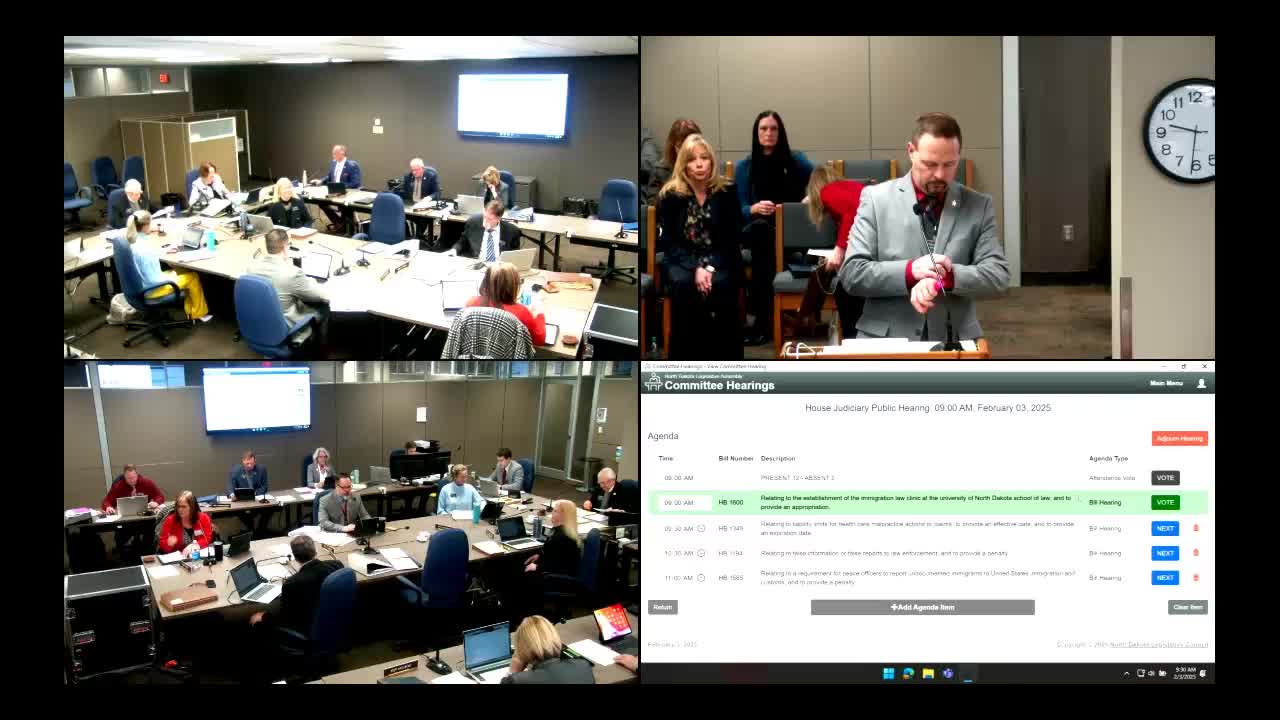
Heated committee hearing on raising North Dakota’s medical malpractice cap; proponents and health providers spar over effects
Summary
The House Judiciary Committee heard more than two hours of testimony on House Bill 1349, which would raise non‑economic damages caps in medical malpractice cases and phase in higher limits.
The House Judiciary Committee heard more than two hours of testimony on House Bill 1349, which would amend Section 32‑42‑02 of the North Dakota Century Code to raise limits on non‑economic damages in medical malpractice actions and to add a delayed effective date and expiration for phased increases.
Representative Ben Koppelman, the bill sponsor, told the committee the current cap — enacted in 1995 at $500,000 — has not been indexed to inflation. He said the legislature should consider whether a fixed cap remains fair and noted that the intent of any cap is to balance injured patients’ compensation against insurance and access concerns.
Nut graf: Victims’ advocates and plaintiffs’ attorneys urged substantial increases, arguing the present cap does not reflect inflation or families’ needs after catastrophic injuries; hospitals, insurers and medical groups warned that large increases or elimination would sharply increase malpractice costs, insurance premiums, and potentially affect access to care in rural areas.
What proponents said Jackie Hall, executive director of the North Dakota Association for Justice, asked the committee to raise the cap to reflect today’s dollars and offered an incremental path: raise the cap to $1,000,000 in the near term and increase by $250,000 annually to $2,000,000 by 2029. Hall said proponents initially sought $3,000,000 but negotiated down to $2,000,000 after talks with medical partners.
Two witnesses described personal harm in detail. Emily Cowan of Williston testified that a wrong‑site surgery led to complex regional pain syndrome and extensive ongoing treatment; she told the committee juries sometimes award substantially more than the cap and the statutory limit reduced her award. An online witness, Nashel (Michelle) Rick, said her family’s wrongful‑death claim was limited by the cap and that she struggled to find attorneys willing to take the case under the current limit.
What opponents said Melissa Howard, general counsel for the North Dakota Hospital Association, and representatives of insurer COPIC and the North Dakota Medical Association opposed the bill. They said increasing or eliminating the cap would make North Dakota an outlier, raise liability and insurance costs, and could discourage physicians from practicing in the state. COPIC’s Gerald Zarlengo testified that past liability crises forced doctors out of practice in other states and argued caps stabilize the market and access to care.
Defense attorney Tracy Kolb, who frequently represents physicians and hospitals, described how the cap currently applies “no matter how many defendants are sued,” and warned that the bill’s original language could multiply exposure by applying the cap per defendant and per claim. Kolb gave the committee background on a recent Williston verdict that exceeded the cap and explained that pretrial settlements can change how a verdict is reduced to judgment.
Committee discussion and tentative amendment proposals Committee members and witnesses discussed alternate schedules. Hall said proponents would accept an approach that establishes $1,000,000 sooner and steps up to $2,000,000 by 2029 (increments of roughly $250,000 per year). Opponents and insurers pressed for more study, warning of increased premium costs and possible workforce impacts. Hospital and business groups also testified in opposition, citing higher health‑care costs and employer premium increases.
Ending: The committee closed the hearing on House Bill 1349 without taking immediate action and will consider amendment language and additional written testimony; witnesses on both sides asked for more study and negotiation before a final committee decision.