Get Full Government Meeting Transcripts, Videos, & Alerts Forever!
Get email alerts on the Immigration Law Clinic topic
No spam. Unsubscribe anytime.
UND law dean urges funding, continuity for proposed immigration law clinic
Summary
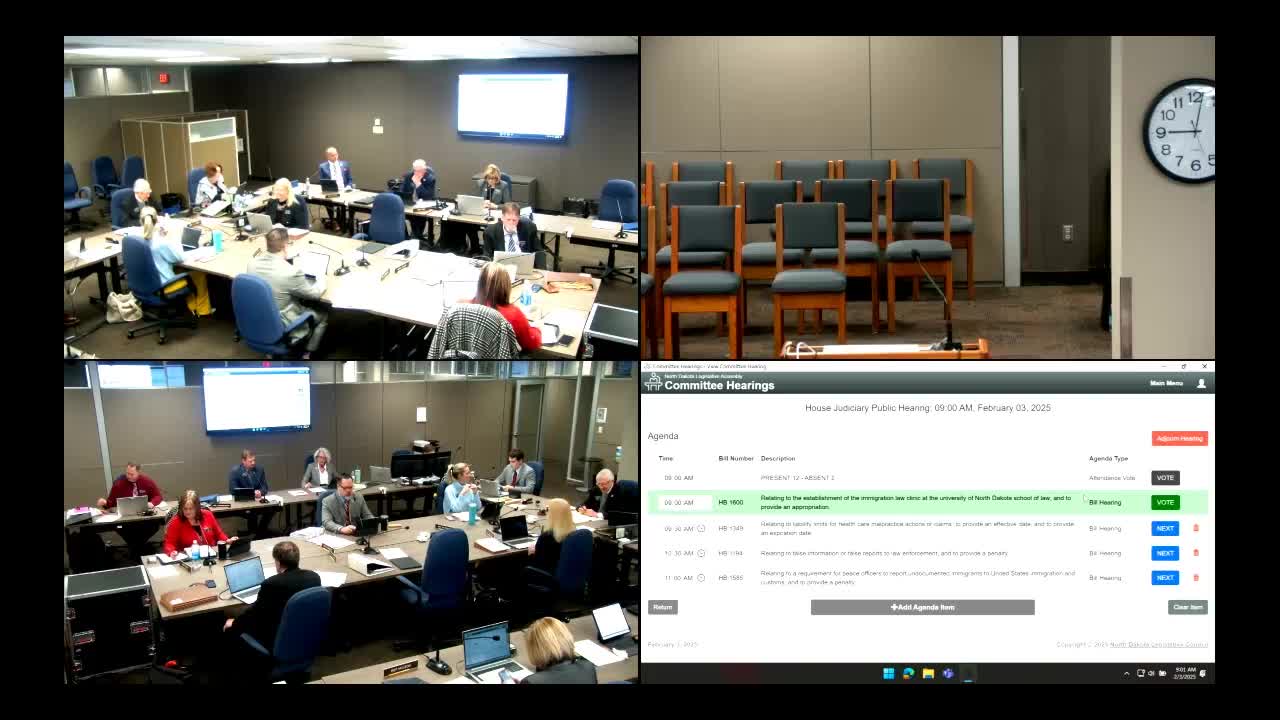
The House Judiciary Committee opened a hearing Tuesday on House Bill 1600, which would establish an immigration law clinic at the University of North Dakota School of Law and provide a state appropriation.
The House Judiciary Committee opened a hearing Tuesday on House Bill 1600, which would establish an immigration law clinic at the University of North Dakota School of Law and provide a state appropriation.
Dean Brian Pappas of the UND School of Law testified in favor of the bill, telling the committee, “immigration matters and attorney fees for those often cost high dollar amounts, commonly in the range of 15 to $20,000,” and saying the clinic would expand the state’s capacity to handle immigration work while providing low‑cost representation for employers and employees.
The bill’s sponsor, Representative Emily O’Brien of District 42, described the proposal as part of broader workforce development recommendations. O’Brien said the clinic would offer “free or low cost legal assistance” and provide training and practical experience for students.
Nut graf: Supporters said the clinic would fill a statewide shortage of immigration attorneys and train future lawyers for North Dakota, but witnesses and the sponsor asked the committee to fix technical language, clarify who must pay certain filing and relocation costs, and extend the proposed funding beyond two years to avoid disrupting multi‑year immigration cases.
Committee discussion and testimony Dean Pappas told the committee the law school estimates the clinic could train “anywhere from 5 to 20 students per year” but that operating an immigration clinic requires staff and infrastructure. He gave the committee a budget range for annual operating costs: “somewhere in the range of 150 to 200,000,” including a staff attorney at an estimated salary of “80 to 110” thousand dollars with benefits, $8,000–$10,000 in travel, about $10,000 for malpractice insurance and roughly $35,000 for association membership and training.
Both Pappas and Representative O’Brien emphasized that, under federal law, employers are required to pay certain filing fees and “the law clinic or anyone else cannot pay for them,” a point O’Brien asked be reflected in amended bill language. Pappas said the clinic would provide legal representation at low or no attorney cost to clients but would not be able to cover employer‑required filing fees or relocation expenses.
Pappas and O’Brien also raised concerns about the bill’s two‑year appropriation. Pappas noted that immigration matters can take “usually 5 years” in some visa categories, and said a two‑year funding window could force clients to change counsel midaction; O’Brien and Pappas both recommended extending funding to at least four years or structuring the appropriation as one‑time with a pathway for continuing funding.
Procedure and next steps Chairman Clameen (House Judiciary Committee) paused committee questions to allow the sponsor to work with counsel on technical corrections. The committee heard no further witnesses in opposition and closed the hearing without voting; Representative O’Brien told the committee she would return with draft amendments coordinated with the dean.
Ending: The committee took no action on House Bill 1600 and recessed pending the sponsor’s submission of amendments and additional drafting. If amended, the bill will return to a future committee meeting for further consideration.