Get Full Government Meeting Transcripts, Videos, & Alerts Forever!
Get email alerts on the Early Childhood Education topic
No spam. Unsubscribe anytime.
Montgomery County outlines five‑year early‑childhood plan, council presses to spend $350,000 left from $1M COA appropriation
Summary
County and partners presented a landscape update, a cross‑sector “common agenda” and several RFPs and studies to expand seats and strengthen the early care and education workforce. Council members pressed the executive branch to resolve a $350,000 unspent balance from a $1 million appropriation to the Children's Opportunity Alliance.
Montgomery County officials and community partners on Friday presented updated data and a draft five‑year “common agenda” for early care and education, and described several funding and procurement actions intended to increase the number of publicly funded seats, stabilize the workforce and launch infrastructure projects — even as council members pressed the executive branch to resolve a contract and spending dispute that left roughly $350,000 of a $1,000,000 council appropriation unspent.
The presentations sought to pull together separate strands of work that county staff, Montgomery College, Montgomery County Public Schools (MCPS) and nonprofit partners are pursuing to expand access, recruit and retain teachers, and build a more coordinated system for children birth through age 5.
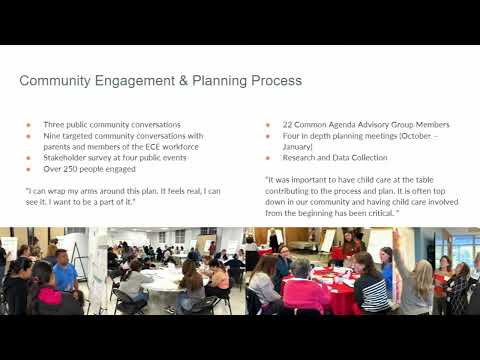
"It's that less than half of our children in our county enter kindergarten ready to learn and thrive," said Kimberly Resnick, executive director of the Children's Opportunity Alliance, summarizing the problem the common agenda aims to address. The alliance presented a slide pack showing about 72,000 children under 5 in Montgomery County, an estimated 33,600 licensed childcare seats and roughly 11,000 publicly funded seats in the county's current mix of programs.
The Children's Opportunity Alliance (COA) recommended targets intended to expand publicly funded seats and strengthen the workforce. "Our target will be to increase the number of children 0 to 5 in publicly subsidized seats ... to a goal of 18,000 in the next 5 years," Resnick told the joint Education and Culture and Health & Human Services committees. The COA also proposed workforce goals — including a 30 percent increase in the early‑care workforce, quantified in the presentation as 2,600 additional workers — and a campaign to pursue a dedicated local revenue stream to sustain the initiatives.
County staff and partner organizations outlined near‑term projects and timelines. Jennifer Arnaiz, senior administrator for early childhood services in the county's Department of Health and Human Services (DHHS), said the county has released two procurement solicitations and is moving on several grant and pilot efforts: a $4,000,000 childcare facilities fund (for forgivable and zero‑interest loans to expand or upgrade programs), an RFP for a shared services alliance to provide back‑office support to providers, and an EquiCare subsidy model that the county said added new infant/toddler seats on Jan. 1. Arnaiz said the workforce and compensation study vendor was selected and launched in January; the county expects data collection through February–March and initial findings in April with a final report later in the fiscal year.
Montgomery College reported growth in student participation tied to county scholarships. "Since FY23, we have seen a 57% growth in the number of approved scholarship recipients," said Lavina Nash Delarosa, department chair of education and psychology at Montgomery College, citing expanded scholarship eligibility and recruiting efforts.
MCPS described its early‑childhood portfolio and enrollment. "Our Head Start program ... is pretty much full at 633 students," said Michelle Owens, director for the division of early childhood and Title I programs at MCPS. Owens reported 2,182 children enrolled in pre‑K general education, about 2,001 enrolled in pre‑K special education, and about 137 children served through the county's Judy Centers, which pair family supports with child‑focused learning activities.
Office of Management and Budget director Deborah Lambert provided a mid‑year fiscal snapshot: about $7.2 million in early‑childhood spending or encumbrances in the first six months of fiscal year 2025, against a spending plan of $15.7 million (a roughly 46 percent spend/encumbrance rate). Lambert said the county expects to obligate or spend the remainder during the latter half of the fiscal year and noted specific encumbrances for the working parents assistance program, scholarship commitments and contracts tied to the EquiCare grants and shared‑services work.
Head Start reapplication, program structure and timing. County staff said DHHS submitted the county's Head Start grant application to the federal government; officials warned that recent federal performance‑standard changes (including limits on delegation authority and a broader birth‑to‑5 scope) create uncertainty and may reduce the number of children served in some configurations. Charlene Mohammed, program manager for the county's Head Start grant, explained that new national standards emphasize compensation parity with public education and give grantees flexibility to serve fewer children while improving staff compensation and benefits. The county applied for the full award and expects an award decision between March and April, but staff cautioned delays were possible.
Council scrutiny over $1M COA appropriation and an unspent $350,000 balance. Council members pressed COA and DHHS staff about a $1,000,000 appropriation the council made to COA in the prior budget cycle to expand community‑based pre‑K seats and capacity. COA said it had committed contracts and capacity‑building supports but that administrative questions and a prolonged contract amendment process left about $350,000 of that appropriation unspent. Council members said they expected the funds to be spent on seats and capacity building and urged faster resolution. Councilmember Gabe Alvernon (chair pro tempore) and others asked DHHS and the county attorney to help identify a path to allow COA to spend the remaining funds; one council member asked for a legal review to clarify whether contract language or council direction constrained use of the money. DHHS staff said they would work with counsel and the parties to resolve the issue but also noted procedural constraints about council involvement in executive‑branch contract negotiations.
What remains next. Officials emphasized continued coordination and follow‑through: COA plans a board discussion of the draft common agenda on Feb. 19; DHHS expects RFP awards and shared‑services contracts in early spring; the workforce compensation study will begin surveys, interviews and focus groups in February–March with interim findings in April and a final report targeted later in the fiscal year; and the county awaits a Head Start award decision in March–April. Council members asked county staff and partners to tighten outreach so families learn of available funded seats, and to provide clearer cross‑agency communications that align COA's common agenda with DHHS, MCPS and Montgomery College programming.
The committee hearing closed with council members urging quick follow‑up on the unspent appropriation and on the county's capacity to convert funded seats into enrolled children.