Get Full Government Meeting Transcripts, Videos, & Alerts Forever!
Get email alerts on the Unmanned Aerial Systems topic
No spam. Unsubscribe anytime.
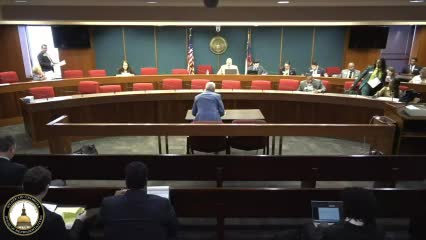
Committee holds drone bill after extended questioning on definitions, enforcement and FAA overlap
Summary
Representative Richardson presented a substitute to House Bill 58 (LC 39 45 75 S) to restrict unmanned aircraft over ticketed, gated mass gatherings. Committee members pressed the sponsor on definitions, enforcement, the 400-foot ceiling and FAA preemption; the bill was held for further stakeholder input.
Representative Richardson presented a substitute to House Bill 58 (LC 39 45 75 S), a measure aimed at restricting unmanned aircraft over ticketed, gated mass gatherings and giving law enforcement a path to act when unauthorized drones enter those event spaces.
"This will give a path for law enforcement to, to have a way forward," Representative Richardson said, describing the bill as a public-safety measure prompted by a rise in drone activity at outdoor events.
Committee members asked detailed questions about scope and enforcement. Several lawmakers noted the federal role in airspace regulation and asked how the bill would interact with FAA authority. The chair and other members repeatedly referenced the FAA’s operation specifications and temporary flight restrictions (TFRs) as an existing tool for event hosts. A committee member said that sections of the bill exempt FAA-authorized operations, and another observed that owners of a general aviation facility "get to determine what happens in its airspace."
Members raised specific concerns the sponsor agreed to address: whether the bill needs a size or weight threshold to avoid capturing children’s toy aircraft; whether to define a safety radius around events so windblown drones from private yards would not be criminalized; whether to include only drones with surveillance capability; and whether ticketed versus non-ticketed events should be distinguished more clearly. Representative Tran asked the sponsor to consider a safety radius around an event; Representative Beckles requested data on incidents and a surveillance definition.
A technical point discussed at length: the bill sets a 400-foot ceiling (described by the sponsor as a vertical limit) and refers to FAA-certified equipment and operators. The sponsor said the bill is intended to cover concentrated, ticketed, gated events rather than widely spread events such as marathons.
After extended discussion, the committee chair asked the sponsor to convene follow-up meetings with members who raised questions and to return with revisions or answers by Wednesday. The chair said the bill would be held for now.
Why it matters: The measure would create a state-level enforcement path aimed at public-safety concerns at large, ticketed gatherings, but it raises questions about federal preemption, enforceable definitions, and unintended coverage of benign small drones or toys.
Ending: The committee held the bill for further stakeholder consultation and possible amendment; no formal vote on the bill’s merits was taken at the hearing.