Get Full Government Meeting Transcripts, Videos, & Alerts Forever!
Get email alerts on the Immigration Sovereign Immunity topic
No spam. Unsubscribe anytime.
Senate committee advances bill stripping local sovereign immunity for failure to enforce state immigration laws
Summary
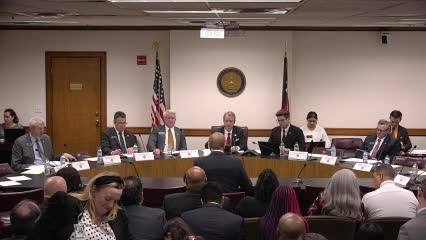
The Senate Public Safety Committee voted to give Senate Bill 21 a “do pass” recommendation after testimony from law enforcement groups, school and municipal associations, immigrant-rights advocates and legislative counsel over whether the measure would expose teachers and local officials to civil suits.
Senate members on the Public Safety Committee voted to advance Senate Bill 21, a substitute carried by Senator Blake Tillery that would allow civil suits against a local government or local government official that “does not enforce Georgia immigration law,” effectively waiving sovereign immunity in those circumstances.
The bill’s sponsor said the substitute mostly cleans up duplicative language passed last year in House Bill 1105 but does not change the substantive effect. "All that Senate Bill 21 says is if a local government or a local government official does not enforce Georgia immigration law, that they waive their sovereign immunity and are open to civil suit," Senator Tillery said during committee testimony.
Supporters and critics offered sharply different views of the bill’s scope. Mac Parnell of the Georgia Faith and Freedom Coalition described the measure as necessary to ensure compliance with state law and cited a high-profile campus murder as context for why immigration compliance matters. The Georgia Sheriffs’ Association took a neutral position, telling the committee many of the mandates appear similar to requirements the sheriffs already follow and report on. DJ Waller of the Georgia Municipal Association and Stephanie Tanner of the Georgia School Boards Association both asked for clearer language on what qualifies as a “violation” and whether liability would attach to a local government entity, an individual official, or both.
Megan Gordon of the Georgia chapter of the Council on American-Islamic Relations warned the committee about the breadth of the existing statutory definition of “sanctuary policy.” Quoting OCGA 36-80-23, she said the statutory definition includes "any regulation, rule, policy, or practice" that prohibits or restricts cooperation with federal immigration enforcement and argued that the word "practice" could capture informal or one-off behaviors by employees, including educators, and thereby expose teachers to penalties: "If even teachers or school counselors who are employees of the state or the local government adopt a simple practice of not volunteering the status of their undocumented students...they would be in violation of the existing sanctuary policy and therefore have this immunity waiver under 21," Gordon said.
Legislative counsel Kate Alexander told the committee that the statutory phrase Gordon cited includes a limiting clause: the sanctuary-policy definition applies to rules, policies or practices "adopted by a local governing body," clarifying that an isolated action by an individual employee corrected by district leadership would not necessarily create a waiver of sovereign immunity. Alexander also explained the timing for compliance with HB 1105, noting the governor signed that bill May 1, 2024, and the first 365-day compliance window runs to May 1, 2025 (with subsequent annual windows thereafter).
Committee members asked several clarifying questions about implementation and enforcement; the sponsor said civil claims would be handled under existing civil procedure (Title 9) standards that require duty, breach, causation and harm. The Association County Commissioners of Georgia recommended limiting the waiver to the specific official or local government entity that violated the law and suggested a 48-hour cap on holding detainees beyond scheduled release dates, citing federal practice concerns.
After discussion, Senator Bryan Robertson moved a "do pass" recommendation for LC 570224S and Senator Randy Bearden seconded. The committee recorded five members raising hands in favor and three opposed; the chair announced the bill "passed and moved forward" to the Senate Rules Committee.
The bill now moves to the Rules Committee; committee testimony showed continuing disagreement about statutory scope, practical enforcement and the potential for unintended consequences in schools and other local services.