Get Full Government Meeting Transcripts, Videos, & Alerts Forever!
Get email alerts on the Juvenile Justice Grants And Compliance topic
No spam. Unsubscribe anytime.
State juvenile advisory group details $18M in grants, compliance duties and local priorities
Summary
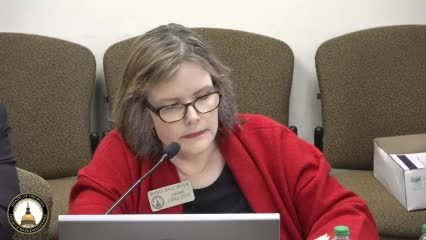
Stephanie Mickelson, juvenile justice program director at the Criminal Justice Coordinating Council, described the state advisory group’s membership, core JJDP compliance functions and the $18 million in grant funds the group oversees, and answered questions about program eligibility and federal funding risk.
Stephanie Mickelson, juvenile justice program director at the Criminal Justice Coordinating Council (CJCC), told the House Judiciary Juvenile Committee the juvenile justice state advisory group (SAG) oversees grant funding, JJDP compliance, technical assistance and strategic planning to support local juvenile-justice programming across Georgia.
Mickelson said the SAG is a 19-member, governor-appointed body required by federal and state statute; CJCC staff handle grant administration while the SAG provides advisory recommendations. "We have 19 members right now," she said, adding the panel includes mental-health representatives, DJJ officials, juvenile-court judges, locally elected officials and others including Chairwoman Ballenger as an appointed member.
She told the committee the advisory group oversees roughly $18,000,000 in grant funds (some multi-year, some federal) and that about 90% of available funds flow to subawards while roughly 6% covers CJCC staff and core monitoring costs. "Because about half of it is federal, it is not $18,000,000 every year. Some of it's open for over 3 to 5 years," she said.
Mickelson explained core federal requirements under the Juvenile Justice and Delinquency Prevention Act (JJDP Act), including DSO (deinstitutionalization/institutionalization of status offenders), jail removal (6-hour booking rule), sight-and-sound separation for youth in adult facilities, and disparity monitoring. She verified that Georgia has, during her tenure, not been out of compliance on JJDP core requirements.
The SAG manages four main open grant projects she described: a juvenile-justice incentive grant (serving high‑need and moderate‑risk youth across about 36 counties), two delinquency-prevention grants focused on status offenders/CHINS work and family-strengthening programming, and a juvenile prevention/intervention (JPI) program that prioritizes school-based violence-reduction and mental-health partnerships. Mickelson said the CJCC also recently closed a competitive School Safety grant that ran for four years and included partnerships with GEMA and the Department of Education.
Committee members asked whether federal policy or executive orders could put federal funding at risk. Mickelson said the CJCC follows current legislation and had not received federal direction to change funded projects; when asked for clarity on risk she said, "At this point, we we don't know. Right? We're waiting for more direction on it." She and members discussed that some grants are competitive and local agencies must apply; project eligibility and service populations are defined in each grant application so grantees identify which youth are "at risk" or appropriate for particular interventions.
Mickelson described technical-assistance supports CJCC provides to grantees: on-site model-fidelity coaching, statewide trainings (more than 500 people trained last year), a juvenile data clearinghouse managed with the Administrative Office of the Courts, evaluation partnerships (Carl Vinson) and local data assistance through a partnership with Georgia State University.
She said limited funding means not all eligible children can be served in every county; CJCC staff monitor spending and reallocate de-obligated funds to other grantees when possible. She invited committee members to contact CJCC with questions; the committee chair closed the meeting after the presentation.