Get Full Government Meeting Transcripts, Videos, & Alerts Forever!
Get email alerts on the Child Welfare Court Improvement topic
No spam. Unsubscribe anytime.
Supreme Court’s Justice for Children (Court Improvement Program) outlines data, reunification and attorney-performance projects
Summary
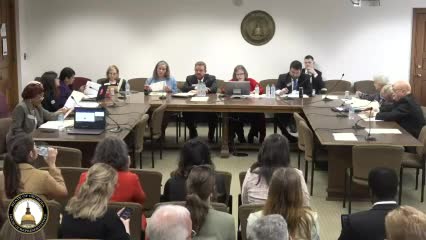
Diana Rude Johnson, Court Improvement Program director, briefed the House Judiciary Juvenile Committee on J4C/CIP projects including data collection (JCAMP), a Foster Care Cold Case Project, a DFACS joint project to shorten time to reunification, and uncertainty about federal reimbursement funding.
Diana Rude Johnson, Court Improvement Program director for the state of Georgia, told the House Judiciary Juvenile Committee that the Supreme Court’s Committee on Justice for Children (J4C) and the state Court Improvement Program (CIP) are running several projects aimed at improving outcomes for children in foster care.
Johnson said J4C — formed in 1995 and chaired currently by Justice Charlie Bethel — supports a range of activities including attorney and judicial performance data collection, trainings, the Foster Care Cold Case Project and a joint effort with the Division of Family and Children Services (DFACS) to shorten time from removal to reunification.
"We are collecting data on attorney performance, on judicial performance, on hearing timeliness, and most of all on the perceptions and the experiences of the families and children that we serve," Johnson said.
Johnson described JCAMP (Judicial Court and Attorney Measures of Performance) as an effort to illuminate the “black box” of juvenile-court activity by tracking attorney performance, hearing timeliness and related measures. She said CIP also administers the Foster Care Cold Case Project, offers parent-attorney training, and runs a real-time court process reporting system that exchanges data between DFACS and the courts.
On funding, Johnson said the CIP draws federal grant funds through the Children’s Bureau and that those funds are paid as reimbursements. "We generally draw — it's a reimbursement funding, so we send our expenses up to the Children's Bureau, generally quarterly, and then they refund that money," she said, adding that the program is planning conservatively because potential changes at the U.S. Department of Health and Human Services could affect future federal support.
Committee members pressed Johnson on staffing and placement issues. A former foster parent asked whether foster-home shortages had changed since COVID; Johnson said she does not have county-level placement counts and suggested DFACS as the direct source for current placement data. Representative Oliver asked about the number of children who are in DFACS custody and also under Department of Juvenile Justice (DJJ) jurisdiction; Johnson said she did not know that number but said SB 401’s diligent reporting requirements and a move toward unified case management should make that easier to identify.
Representative Oliver also relayed a figure from the Appropriations subcommittee when noting turnover in DFACS: "The turnover rate is 43.5%, which makes the vacancy rate even higher than that," he said. Johnson told the committee turnover shows up in court data (for example, through reasons for continuances) even if she could not provide a single statewide turnover percentage herself.
Johnson encouraged committee members to attend J4C meetings (hybrid, hosted at the Supreme Court) and to contact her for materials and meeting invitations.
The chair announced Commissioner Bross will testify to the committee on related issues at a later meeting.