Get Full Government Meeting Transcripts, Videos, & Alerts Forever!
Get email alerts on the Banking Housekeeping topic
No spam. Unsubscribe anytime.
House committee advances Department of Banking and Finance housekeeping bill
Summary
The Georgia House Banks and Banking Committee voted to move LC 620021, the Department of Banking and Finance's annual housekeeping bill, after discussion about foreign bank updates, merchant-acquirer limited-purpose banks and industry trends. The measure passed by voice vote with no recorded opposition.
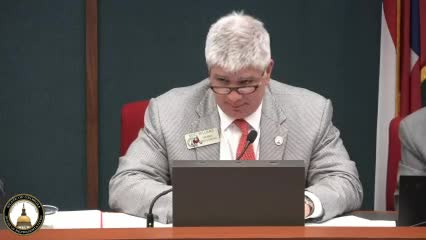
Chairman Williamson presented LC 620021, the Department of Banking and Finance's annual "housekeeping" bill, to the Georgia House Banks and Banking Committee and the committee voted to move the bill forward on a voice vote with no recorded opposition.
The bill, Williamson said, is the committee's yearly effort to modernize and clean up language across the state's banking code. "This is the annual housekeeping bill for the Department of Banking and Finance," Williamson said, noting the measure touches several regulated industries and has been developed with industry partners.
The measure updates multiple sections of state banking law to keep language current and streamline processes that affect bank holding companies, credit unions, merchant-acquirer limited-purpose banks (MALPBs), foreign bank offices, residential mortgage lenders and brokers, money transmitters and check cashers, among others. Williamson said the Georgia Installment Lenders Association and other stakeholder groups were consulted and that "there's no opposition to the bill."
Beau Fears, an attorney who leads drafting for the department, described two of the year's larger changes. He said the committee tightened parts of the foreign bank provisions after a recent modernization, including simplifying branch relocation filings from an application to a notice in some cases, and clarified name-change processes. On merchant-acquirer limited-purpose banks, Fears said the department adjusted language after experience with recent charters to ensure the state could place such entities into receivership if necessary. "We tightened that up," Fears said, and he added that one firm that obtained a charter has been scaling up: "We have an Fiserv processed in 2023 over $1,800,000,000,000 worth in transactions," a figure Fears cited when discussing why clarity around supervisory tools was needed.
Committee members asked department staff for context about recent banking activity. In response to a question about new bank charters last year, Fears said the state issued "0" new de novo charters in the prior year and noted that the last bank failure in Georgia occurred at the tail end of the Great Recession. He also said the department has approved five de novo charters since the Great Recession and that the typical capitalization for recently chartered banks ' in his estimate ' "is between, say, at around $20,000,000." He added the department had had "two conversations in the last 3 or 4 months" about possible new charters, saying one appeared more serious than the other.
Vice Chairman Lou Wade and other committee members discussed merger and acquisition trends. Department staff said M&A activity is likely to continue as succession planning and liquidity needs drive transactions, and that credit unions have shown interest in acquiring banks. Regarding fintech involvement, the department said federal policy changes may make fintech-bank partnerships or acquisitions more likely, but whether that change will fully materialize remains uncertain.
After discussion, a committee member moved to "so move" the bill and another member seconded. The committee chair called for the question; the bill was advanced on a voice vote. No roll-call tally was recorded in the transcript and no formal opposition was noted.
The committee next-business sequence ended after the vote; committee members thanked staff and the meeting was adjourned.