Get Full Government Meeting Transcripts, Videos, & Alerts Forever!
Get email alerts on the State Funds Gender Affirming Care topic
No spam. Unsubscribe anytime.
Committee advances bill barring state dollars for gender-affirming care in state plans; amendment sets Jan. 1, 2026 effective date
Summary
Senate Bill 39, carried by Chairman Tillery, would prohibit state general funds and the state health benefit plan from covering gender-affirming care and surgeries; the committee adopted amendments to clarify applicability and set the effective date to Jan. 1, 2026, and the measure passed the committee 6to3.
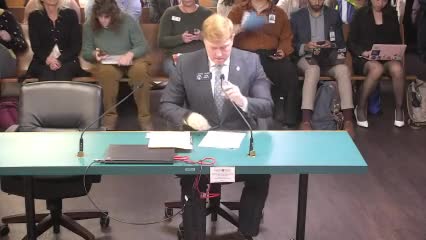
Chairman Tillery told the Senate Insurance and Labor Committee that Senate Bill 39 is intended to prevent state taxpayer dollars from being spent on gender-affirming care and surgeries that the legislature restricted for minors in last year's Senate Bill 140.
"We are not going to spend state taxpayer dollars on transgender surgeries in our state," Chairman Tillery said, describing the measure as a follow-on to SB 140 and saying it would apply to state health benefit plans, state hospitals and physicians employed by the state, and certain social-service expenditures.
The bill text, as discussed in committee, bars expenditure of state funds for health care coverage that includes gender-affirming care and defines terms including "gender affirming care" and "hormone therapy." Chairman Tillery proposed and the committee adopted an amendment changing the effective date to Jan. 1, 2026 and language clarifying applicability: the act would apply to state health benefit plans "issued, delivered, issued for delivery, or renewed in this state on or after such date." Legislative staff also offered a minor wording insertion for clarity.
Committee members asked whether the bill would conflict with ongoing litigation and federal law; Chairman Tillery replied that it is the legislature's duty to write state law and that courts will interpret enacted statutes. Senators asked about scope (state general funds only, not county funds) and treatment of current enrollees. Chairman Tillery said existing contractual obligations for current enrollees would remain until open enrollment; the Jan. 1, 2026 effective date gives notice before that change could take effect.
Public testimony was strongly divided. Amanda Kaseels, attorney for the plaintiffs in Rich v. Georgia, warned that attempting to undo promises made in that settlement would lead to litigation. "If you try to undo the promises made by the state of Georgia in the Rich versus Georgia settlement ... the state will find itself in court again," she said. Medical professionals and advocates testified that gender-affirming care is evidence-based and that restricting coverage would harm patients and public employees; speakers included physicians and representatives from Georgia Equality and the Human Rights Campaign. State employees and state beneficiaries described the care as essential to their well-being and compensation.
After debate and the amendments described above, the committee voted to recommend the bill pass, with a recorded outcome of "do pass" by a 6-to-3 margin.