
House Judiciary Committee advances tenant right-to-counsel, policing data reporting and other measures; several bills deferred
Get AI-powered insights, summaries, and transcripts
Subscribe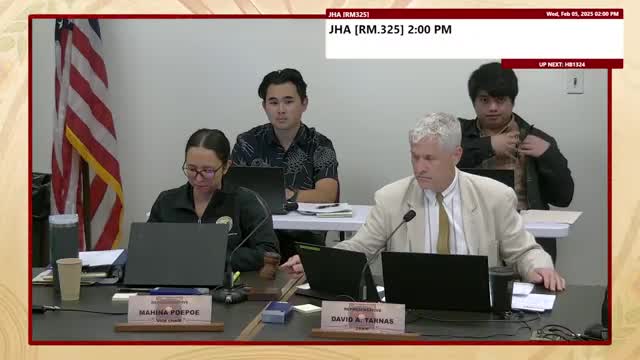
Summary
The House Committee on Judiciary & Hawaiian Affairs voted Feb. 5 to advance several bills — including tenant right-to-counsel, asset forfeiture transparency and a policing data-collection measure with amendments — while deferring other items for further work.
The House Committee on Judiciary & Hawaiian Affairs on Feb. 5 advanced several bills after public testimony and agency comments, voting to move measures on a tenant right-to-counsel program, civil asset forfeiture transparency, policing data collection, the community outreach court and increases to water-code penalties while deferring other items for additional work.
The committee, chaired by Representative David Tarnas, front-loaded decision making for the first bill on the agenda — House Bill 1324, a proposal to require the judiciary to contract for legal services for residential tenants in eviction cases — and took testimony from the attorney general, the judiciary, tenant advocates and several individual tenants before moving the bill with amendments.
Why it matters: The tenant-right-to-counsel proposal responded to repeated testimony that tenants face eviction hearings without legal representation. Susan Lake of Hawaii Appleseed told the committee that “studies show...tenants who are represented in eviction court have an 80 to 90 percent likelihood of staying in their units,” and later cited national trends where landlords are represented much more often than tenants. The committee adopted technical changes, accepted the attorney general’s recommendation to remove a reference to tenants in Hawaii Public Housing Authority proceedings, and approved an effective-date deferral and income-limit guidance to align providers’ contracts.
Key discussion and quotes Alyssa Kao, deputy attorney general, asked the committee to remove language referencing the Hawaii Public Housing Authority from the bill because HPHA evictions proceed through a different administrative process and, she said, “because the provisions would conflict we would recommend deleting that language.” Susan Lake, testifying for Hawaii Appleseed, urged the panel to adopt a program and suggested a formal notice requirement so tenants are informed of a right to counsel when rent increases or eviction notices are filed. Pro se litigant Celeste Gonsalves urged court-appointed attorneys rather than relying solely on paralegals or law students, saying she had been fighting wrongful evictions for years and describing the intimidation unrepresented tenants face in court.
Other major bills and committee decisions - HB 126 (civil asset forfeiture): After broad testimony from the attorney general, public defender’s office, police and reform advocates, the committee voted to move the bill forward with amendments. Deputy Attorney General Gurudev Allen and Haley Chang of the Office of the Public Defender both provided comments; Chang emphasized the need for transparency and noted concerns about people losing property without meaningful ability to challenge forfeiture.
- HB 278 (policing data collection): The committee adopted multiple amendments and moved HB 278 forward. Julie Ibato of the Department of the Attorney General told the panel the department lacks an existing electronic repository for the volume of stop/use-of-force/complaint data the bill would require and opposed a funding cut-off enforcement mechanism; members incorporated language removing a funding penalty and added clarifying reporting fields (including a change to require reporting for vehicle stops and pedestrian stops). The committee noted federal grant programs (including Section 1906) as potential funding sources for implementation.
- HB 280 (community outreach court): The Judiciary and participating agencies described the mobile community outreach court’s outreach work and the panel approved an amended HD1 that clarifies which prosecuting offices may refer cases and removes the Attorney General and deputy attorney general from the statutory definition of prosecuting attorney for this program after the offices coordinated their language.
- HB 306 (water-code penalties): The Commission on Water Resource Management supported raising penalties; the committee adopted amendments reflecting administration proposals to increase maximum penalties over time (listed for consideration by Finance) and moved the bill to the next stage.
Items deferred or sent back for more work - HB 301 (second/subsequent convictions for violating domestic abuse protective orders): The committee accepted a request to defer this bill for additional stakeholder work; the Public Defender and domestic-violence advocates asked for more data and a working group to resolve differences on scope, definitions and sentencing impact.
- HB 225 (squatting working group) and HB 1090 (Department of Hawaiian Homelands fee exemptions): Committee members accepted recommendations to defer these measures to allow for further study or alternate approaches (for example, a legislative study request rather than a large task force).
Votes at a glance (selection of committee actions) - HB 1324 (tenant right to counsel) — Approved (committee recommendation adopted with amendments; effective date deferred). Vote recorded: majority aye; several members excused; Representative Garcia registered reservations. Notes: adopted attorney general and judiciary suggested edits and judiciary-consistent income limits for contracting.
- HB 126 (property forfeiture reform) — Approved (with amendments). Vote recorded: committee recommendation adopted; members registered reservations.
- HB 166 (defense of licensed state employees) — Approved to Finance (with amendments to clarify withdrawal/transfer procedures and effective-date deferral).
- HB 278 (policing data collection) — Approved (with amendments). Committee removed enforcement funding cutoff language and added reporting clarifications; Representative Shimizu recorded a reservation and Representative Garcia recorded a no vote as noted in the minutes; the measure was nonetheless advanced with the adopted amendments.
- HB 280 (community outreach court) — Approved (HD 1 with amendments). Committee adopted coordinated language between the Judiciary, prosecutors and the Attorney General’s office clarifying scope and referral mechanics; funding language and administrative edits were streamlined.
- HB 306 (water-code penalties) — Approved (HD 1 with amendments). Committee asked Finance to consider staged penalty increases; the department requested higher minimums and staged increases through 2045 in its testimony.
- HB 301 (domestic abuse protective orders) — Deferred for stakeholder work, data review and consideration of alternative bills addressing sentencing and definitions.
What the committee asked stakeholders to do - Agencies and counties were asked to research federal funding programs (including Section 1906 and other grants) that could support statewide policing-data collection if the bill moves forward. - Participants on the outreach-court measure (Attorney General, prosecutors, Public Defender and Judiciary) reconciled statutory language during the hearing to allow the committee to advance an amended HD1. - Sponsors were encouraged to form working groups or submit concurrent resolutions where an administrative study would be more efficient than a new statutorily-created task force.
Looking ahead The committee adopted technical and content amendments across several bills and flagged items needing follow-up — particularly data/implementation plans and funding sources for policing data collection, and stakeholder working groups for domestic-violence sentencing and squatting issues. Lawmakers will carry amended language forward to Finance or the next committee as indicated by each bill’s referral.
Ending note: In several debates the committee emphasized implementation questions over policy intent — repeatedly asking departments to follow up with cost estimates, reporting templates and federal-grant options so that the measures, if enacted, are operable and fiscally feasible.