Get Full Government Meeting Transcripts, Videos, & Alerts Forever!
Get email alerts on the General Plan topic
No spam. Unsubscribe anytime.
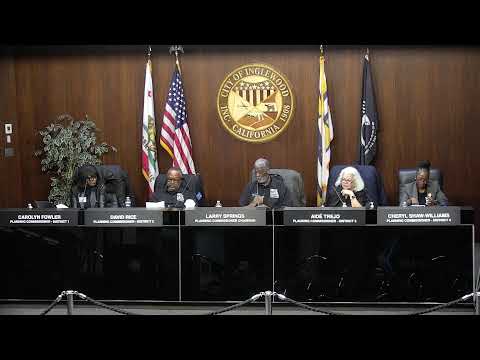
Planning commissioners review Phase 1 general plan report; postpone several development items to March 5
Summary
The Inglewood Planning Commission heard staff and consultant presentations on Phase 1 of a comprehensive general plan update — an existing-conditions report, community profile and draft vision statement — and voted to continue multiple agenda items, moving public hearings and tract-map considerations to the March 5, 2025 meeting.
The Inglewood Planning Commission on the evening of its meeting received staff and consultant presentations on Phase 1 of a comprehensive general plan update — the existing conditions report, community profile, and a draft vision statement and guiding principles — and voted to continue several agenda items to the commission’s March 5, 2025 meeting.
The Phase 1 materials summarize the city’s demographics, built environment, circulation, infrastructure and public services as a baseline for the next phase: preparing revised general plan elements and a programmatic environmental impact report. Director of Development Services Chris Jackson said the work will guide the city’s policy decisions for the next 25 years, and Planning Manager Bernard McCrumbie read the draft vision statement that staff and the consultant developed with public input.
Why it matters: Inglewood’s general plan has not been comprehensively updated since 1987; the Phase 1 products frame community priorities and will inform specific policy choices on housing, mobility, parks, utilities and economic development as the city proceeds to the formal element updates and an accompanying programmatic EIR.
Key findings from the Phase 1 report - Population and demographics: Staff reported Inglewood’s population around 106,000 residents as of 2023, with Black and Hispanic residents comprising roughly 90 percent of the city’s population. Educational attainment was reported at about 25 percent of residents holding a bachelor’s degree or higher. The city’s median/average household income was reported near $89,000, compared with about $121,000 for Los Angeles County.
- Housing and market trends: The market analysis projects modest demand for retail and office uses and stronger demand for multifamily residential and hospitality over the planning period. Staff noted the city is mostly built out, so future growth will be infill or replacement of existing uses.
- Schools and public services: The report documented a multi‑year decline in school enrollment: 10,959 students in the 2014–15 school year, 6,958 in 2023–24, and a projection of about 5,476 in 2029–30. Staff said that decline creates potential opportunities to repurpose school facilities but will require coordination with the Inglewood Unified School District. The report also noted public‑safety staffing gaps: the police department reported 29 sworn vacancies at the time the data were collected.
- Mobility and circulation: The existing conditions analysis shows the city remains automobile‑oriented: about 75 percent of commuters use cars (solo or carpool), roughly 5 percent use public transit, 2 percent walk and under 1 percent bike. The report recommends multimodal improvements, first/last‑mile solutions and planning around transit nodes.
- Parks and environment: Inglewood operates about 10 public parks totaling roughly 90 acres, just under the common planning target of one acre per 1,000 residents. The tree canopy was reported at approximately 14 percent; staff identified canopy expansion, air‑quality measures and green infrastructure as priorities.
Public engagement and the draft vision Consultant Jonathan Nettler of PlaceWorks described the outreach campaign: pop‑up events, an English/Spanish open house and targeted stakeholder interviews produced “more than 1,250 comments” from residents, businesses and other stakeholders that informed the draft vision and guiding principles. Common themes included pride in local community and new entertainment venues, concerns about rising housing costs and displacement, requests to support small and local businesses, and desire to revitalize downtown corridors such as Market Street, Imperial Highway, Century Boulevard and Prairie Avenue.
McCrumbie read the draft vision statement to the commission; one sentence from that text said, “Inglewood is an inclusive community where people walk, run, recreate, and actively participate in community events both large and small.” The guiding principles are organized under seven topics: community character, growth and development, community facilities and services, responsive governance, economy, mobility and environment.
Commission questions and staff responses Commissioners asked staff and the consultant to clarify specific data points and next steps. Commissioners pressed for clarity on school enrollment trends, rental vacancy (reported in the study at about 5.3 percent), police vacancies and how the general plan will account for changing transportation technologies. Staff and the consultant said the general plan will set a flexible policy framework rather than mandate specific technologies, and emphasized the need for interagency coordination (for example, with LA Metro and the school district) in implementing many measures.
Votes and items continued During the meeting the commission took several procedural votes and continuances. Notable actions (all motions and tallies were recorded in the meeting minutes):
Votes at a glance - Approval of minutes, Dec. 4, 2024: Approved. Record: Commissioners Fowler, Rice, Trejo, Shaw Williams and Chairman Springs — all Aye.
- Approval of minutes, Jan. 14, 2025: Approved with one abstention. Record: Commissioners Fowler — Aye; Rice — Aye; Trejo — Abstain (not in attendance); Shaw Williams — Aye; Chairman Springs — Aye.
- Item 6a (special use permit application by Gary Lee for a drive‑through and 30‑sq‑ft addition at 401 E. Manchester Blvd.): Continued to March 5, 2025. Motion passed unanimously.
- Item 6b (business operation details related to a separate applicant): Continued to March 5, 2025. Motion passed unanimously.
- Item 7a (Bridal Estate Development Services Group; final tract map No. 84423 — subdivision of air rights for five townhome‑style condominiums at 419 S. Eucalyptus Ave.): After the applicant did not arrive, the commission postponed questioning and later continued the matter to March 5, 2025. Motions to postpone and to continue were adopted by recorded vote.
What the commission will do next Staff said the general plan update will move into the next phase — drafting and revising specific plan elements and preparing a programmatic environmental impact report — and that work is expected to take about two years. The presentation materials (existing conditions report, community profile, draft vision and guiding principles) and an educational video are posted on the project website, which staff identified as www.nextlevelinglewood.com. Staff said they will take the materials to the City Council as a “receive and file” step and will continue community outreach — both online and in‑person — as the project advances.
The commission’s continuances mean the public hearings and tract map items mentioned above will be placed on the March 5, 2025 Planning Commission agenda for further consideration.
Ending Staff invited commissioners and members of the public to continue offering feedback through the project website and announced additional outreach and grant programs intended to support small businesses and downtown revitalization. The commission did not take final action on the general plan changes at this meeting; the Phase 1 documents are presented as the baseline to guide the formal plan updates to come.