Get Full Government Meeting Transcripts, Videos, & Alerts Forever!
Get email alerts on the Juvenile Justice Warrants topic
No spam. Unsubscribe anytime.
Committee hears DHS bill to clarify juvenile judges' authority to issue arrest warrants
Summary
Senate Bill 8, sponsored as a Department of Human Services bill, would align juvenile-court arrest-warrant authority in Title 15 with criminal-procedure provisions in Title 17; committee members and a juvenile court judge discussed practical effects and safeguards but took no formal vote.
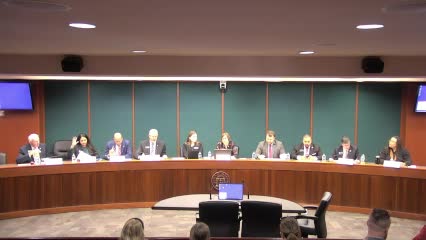
A departmental bill to clarify juvenile court judges' ability to issue arrest warrants drew focused questions but no formal vote at the Senate Children and Families Committee's first meeting. The bill, Senate Bill 8, was presented to the committee as an effort to align the juvenile code (Title 15 of the Official Code of Georgia Annotated) with the criminal procedure code (Title 17).
The presenting senator described SB 8 as "a department bill coming from DHS," saying the measure is meant "to clean up an inconsistency between Title 17, the criminal code, and Title 15, which includes the juvenile code relating to arrest warrants." The bill would explicitly recognize juvenile court judges in the statutory cross-references used for issuing arrest warrants and preserve the role of prosecuting attorneys in charging decisions.
The bill's sponsor and Regina Quick, general counsel for the Department of Human Services, told senators the key changes appear in section 3 (adding juvenile court judges to the list of courts referenced in Title 17) and section 2 (restating that district attorneys remain the ultimate decision-makers on whether charges will be brought). Quick noted the language mirrors existing Title 17 provisions, citing OCGA §17-4-404 as an example of the venue and execution language being imported into the juvenile code.
Committee members pressed concretely on protections and process. Senator Chuck Payne asked whether the change reflects a prior omission; Regina Quick and other presenters said the change resolves confusion that occasionally prevents clerks, sheriffs or others from treating juvenile-issued warrants the same as those issued by other courts. Senator Nabilah Islam Parks raised concerns about a child potentially incriminating themselves during dependency proceedings; presenters said nothing in the bill eliminates judicial discretion under existing juvenile-code safeguards (citing OCGA §15-11-7).
Judicial perspective came from Neil Bryant, juvenile court judge of Bartow County and president of the Council of Juvenile Court Judges, who told the committee the council did not oppose the bill and that the change "clarifies what the existing law is." Bryant said he personally is "not eager myself to issue warrants for adults," but that the clarification would give juvenile judges explicit authority to do so in appropriate cases and would still involve superior-court oversight and the district attorney's role.
No committee motion or recorded vote on SB 8 occurred during the session. Committee discussion emphasized that the bill is intended to remove ambiguity in practice — for example, where a juvenile court judge has issued a warrant but local law enforcement, unfamiliar with juvenile-court warrants, hesitates to execute it — while retaining existing prosecutorial safeguards.
If enacted, supporters said, the bill would make procedural cross-references explicit so juvenile-court warrants are processed and enforced on the same footing as warrants from other courts. Committee members asked staff and presenters to clarify drafting and the interplay with existing statutes; presenters repeatedly noted the measure is a statutory cleanup rather than an expansion of charging authority.
The committee did not establish next steps on the bill during the hearing; no amendment or vote was recorded.