Get Full Government Meeting Transcripts, Videos, & Alerts Forever!
Get email alerts on the Park Improvements topic
No spam. Unsubscribe anytime.
Sunbury committee backs Verdantus design contract for J.R. Smith Park improvements
Summary
The Sunbury Parks and Recreation Committee reviewed a not-to-exceed $315,000 design contract with Verdantus (formerly CT Consultants) to complete engineering and bidding documents for a multi‑phase J.R. Smith Park project; funding mix includes $1 million in grants/ARPA and a planned municipal bond to cover the remainder.
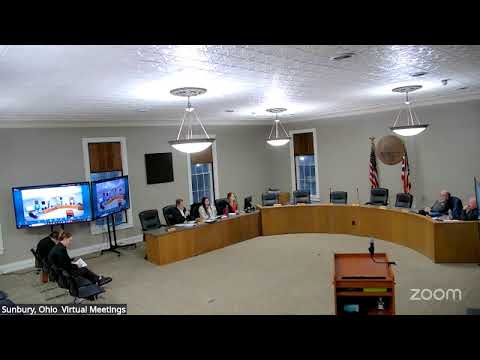
The Sunbury City Parks and Recreation Committee on Wednesday reviewed a not-to-exceed $315,000 contract proposal with Verdantus (the firm that acquired CT Consultants) to provide final design, bidding documents and construction administration for J.R. Smith Park improvements.
The proposal covers revision of the park master plan based on a completed survey and geotechnical review, detailed engineering, preparation of bidding documents, bidding services and construction administration; inspection services are not included in the contract and will incur separate costs. City Administrator Hennessy described the agreement as a “not to exceed $315,000 contract.”
Committee members said the design will include a flow‑through splash pad, an ADA‑accessible playground, a restroom configured as a three‑season heated facility that will be winterized, and site elements including a pavilion, walking trails, half‑court basketball/pickleball, landscaping, entry features and parking. “They propose the splash pad will be designed as a flow through system, not a recirculating system,” Hennessy said.
Committee staff said the city has secured roughly $1 million toward construction: $500,000 in ARPA funds and a $500,000 Land and Water Conservation Fund grant administered by the Ohio Department of Natural Resources. The remainder of the estimated construction cost — discussed in the meeting as about $3.5 million with contingency pushing a planning number toward $4 million — would be financed with a municipal bond. Hennessy said the bond is expected to run roughly 19 years. “Most of it will get picked up with the impact fees,” she said, referring to projected annual impact fees of roughly $100,000; the committee was told debt service was estimated in the “hundred and $40,000 range.”
Carla, a staff reviewer who examined the fee breakdown, told the committee the design fee percentage is consistent with industry norms. “From a planning perspective, anywhere from 7 to 10% is very common,” she said, and the presented line‑item breakdown made the fee acceptable to staff. The packet indicated roughly $270,000 of the not‑to‑exceed total is design services, with smaller percentages allocated to bidding and construction administration.
Hennessy said the design work would begin after council approval; the proposal estimates five months from contract execution to completion of design, with bids expected later in the year and most construction work occurring the following year. The contract will be introduced on the City Council agenda for first reading that evening, with staff anticipating possible council action in March.
Committee members asked staff to pursue several follow‑ups during design: confirm whether signage and associated costs are included in the construction estimate, re‑examine alternate park access locations near the old Lions building and Granville Street (noting grade and sight‑distance constraints), and continue a donation/sponsorship policy to offset costs.
No formal committee vote on the Verdantus contract was recorded in committee; staff indicated the item will go to City Council for formal action.
Background: the master plan in the packet shows phased amenities and an eventual connection to the Ohio Bicycle Trail; committee members noted portions of that trail and the park’s ultimate connection are not yet built and will require additional work and coordination. The packet also showed conceptual imagery for the amenities based on prior public comment and design input.
Next steps: staff will present the contract to City Council for first reading, confirm funding timelines for the Land and Water Conservation Fund grant and ARPA allocation, ask the design team to revisit access alternatives, and return to the committee with additional signage details and a donation/sponsorship plan.