Get Full Government Meeting Transcripts, Videos, & Alerts Forever!
Get email alerts on the Cybersecurity Procurement topic
No spam. Unsubscribe anytime.
Subcommittee approves bill directing Georgia Technology Authority to publish list of potentially risky vendors for state purchases
Summary
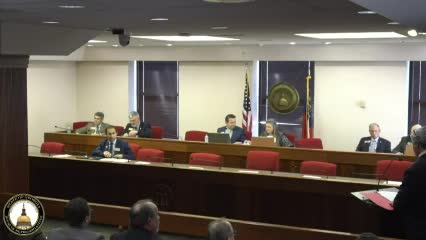
Representative Mark McDonald introduced House Bill 113 to the House Subcommittee on State and Local Governmental Affairs, telling members the bill would require the Georgia Technology Authority (GTA) to establish and maintain a public list of companies and products ‘‘produced or sold by entities linked to technology that poses potential threats.’’ The subcommittee approved the bill by voice vote.
Representative Mark McDonald introduced House Bill 113 to the House Subcommittee on State and Local Governmental Affairs, telling members the bill would require the Georgia Technology Authority (GTA) to establish and maintain a public list of companies and products ‘‘produced or sold by entities linked to technology that poses potential threats.’’ The subcommittee approved the bill by voice vote.
The bill, filed as LC442899-EC, directs GTA — described in the bill as the state’s designated cyber experts — to create a publicly available list intended to guide purchasing by the Department of Administrative Services and other state agencies to avoid introducing cybersecurity vulnerabilities into state systems.
‘‘House Bill 113 is a critical piece of legislation aimed at increasing the security of state purchasing processes,’’ Representative McDonald said in his presentation. He told the committee the authority already receives federal information about flagged technologies and that the list would ‘‘serve as a valuable tool’’ for state purchasing officials.
The bill sets a civil penalty for vendors found to be selling flagged goods to state entities: up to $250,000 or triple the total purchase value, whichever is greater, when sales involve foreign companies, third‑party vendors or resellers, McDonald told the panel. He said the text removes specific country names and instead uses the federal definition of ‘‘foreign adversaries.’’
GTA staff Cameron Fash told the committee the agency had no preselected goods it planned to ban immediately, and that the agency would take a broader approach as it develops the list. Chairman Anderson and members asked clarifying questions about how GTA would identify items; McDonald and Fash said GTA would rely on federal lists and ongoing federal information-sharing.
The bill explicitly states it applies only to future purchases and has no retroactive component, McDonald said.
The chairman opened the item for a motion; the committee made and seconded a motion, conducted a voice vote with no recorded opposition, and the motion passed.
The measure now moves from the subcommittee for further consideration in committee and possible floor action. The bill text clarifies roles between GTA for identification and the Department of Administrative Services for enforcement and imposes the stated civil penalties for covered sales.
Ending: The subcommittee approved the bill after the presentation and brief questioning; the sponsor will appear in full committee the following day, according to the hearing.