Get Full Government Meeting Transcripts, Videos, & Alerts Forever!
Get email alerts on the Criminal Justice Services Overview topic
No spam. Unsubscribe anytime.
Douglas County Commission receives briefing on criminal justice services, staffing and funding
Summary
County Department of Criminal Justice Services gave the Douglas County Commission an overview of pretrial supervision, electronic monitoring, community corrections, juvenile services, data gaps and grant funding at a 4:00 p.m. work session; no formal actions were taken.
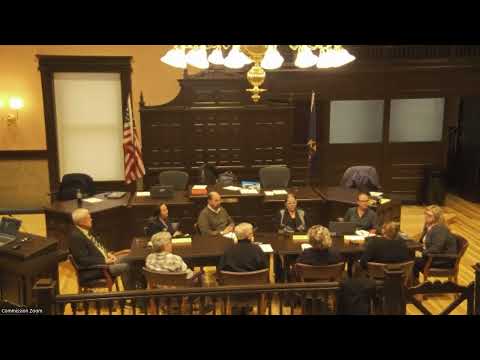
Douglas County Commissioners heard a detailed briefing from the county Department of Criminal Justice Services at a 4:00 p.m. work session on the department's programs for adults and juveniles, including pretrial supervision, electronic monitoring, community corrections, juvenile detention and day-school services, and grant-funded supports. The session was informational only and did not include public comment or formal votes.
Pam, director of the Department of Criminal Justice Services, told commissioners that the department employs about 55 professional staff and supervises several hundred people through a range of programs. "Everyone pretrial is presumed innocent," Pam said, describing the pretrial team's role in providing assessments and reports to the court so judges can set appropriate supervision levels. She said the pretrial unit typically supervises about 200 to 205 people on any given day and serves roughly "right under 500" individuals over the course of a year.
The department's pretrial staff interview clients at the jail, run background checks and assemble a written report for the court that includes criminal history and failure-to-appear records; the court, not the department, makes final detention and supervision decisions. Pam said the office follows a risk-needs approach and tries "not to over supervise people and make them higher risk." She added that prior to the county's pretrial program, cash bail was the primary way people left jail. The department also provides electronic monitoring and house-arrest equipment for district and municipal courts; the City of Lawrence reimburses the county for municipal monitoring hours.
Pam described specialty programs that aim to reduce jail stays and support behavioral-health needs. The county operates behavioral health court (in place since about 2017) and drug court (since 2020). She said the behavioral health court and drug court are intensive, team-driven programs, and the department is conducting a process evaluation of those specialty courts with a report expected to be returned to teams and then to commissioners in the spring time frame.
Adult community corrections is a long-standing program in Douglas County (staff noted it has existed locally since the late 1980s) that supervises people who otherwise might serve state prison time. Holly Myers, assistant director of adult programs, described four supervision levels for community corrections clients (level 1 highest risk through level 4 lowest), with corresponding face-to-face contact standards. The department reported about 220 active adult community corrections clients on any given day and said the program receives Kansas Department of Corrections (KDOC) grant funding.
On the juvenile side, the county operates a regional juvenile detention center (licensed for 18 youth ages 10–17) and a day-school program licensed for 40 youth; the day-school program had about 25 youth assigned at the time of the briefing. The detention center accepts referrals from many Kansas counties for short-term detention; officials said the center often houses non‑Douglas County youth and receives per‑diem payments from referring counties (the local per diem noted in the briefing was $150 per day). The department also runs an intake-and-assessment operation used by law enforcement across the county and a court‑linked diversion program. Pam said the county has offered 104 youth diversions since July 1 under the Immediate Intervention Program, and that the county partners with Building Peace and Bert Nash to provide restorative and behavioral-health services for youth.
Speakers described data and measurement challenges. Dr. Matt Cravens, the county data analyst referenced in the briefing, is working with the Criminal Justice Coordinating Council (CJCC) on a data strategy aimed at understanding outcomes such as failure-to-appear rates and recidivism; presenters said court management systems and jail records capture different pieces of those outcomes and that definitions (new arrest vs. new conviction, and time windows) vary across partners. Pam said the CJCC is finalizing a strategic plan and that the council will focus on data alignment and recidivism measurement if the plan is adopted.
Funding and grants were discussed in detail. Presenters said the county receives multiple state and regional grants to support adult and juvenile services, including an adult community corrections grant (noted as over $700,000), a juvenile block grant (around $600,000, including related allocations), a behavioral health grant (about $100,000), and a reinvestment grant (about $200,000) that funds mental‑health and community supports. The department also maintains barrier‑reduction funds (roughly $35,000–$40,000 annually, with an internal guideline of up to $600 per client) to pay client move‑in fees, rent deposits, clothing and other items meant to stabilize clients in the community.
Officials flagged several state-level developments to watch, including KDOC work on a funding formula for adult (and later juvenile) community corrections and periodic legislative discussion about consolidating probation, court services and community corrections at the state level. Pam said the county will monitor an ad hoc pretrial committee that includes Judge Henley for any requirements that might affect local pretrial programming.
Commissioners asked clarifying questions about program caseloads, the limits of county authority and how recidivism and failure-to-appear data are captured. Staff acknowledged limits in current data sources and said they will continue work through the CJCC to standardize definitions and improve measurement.
Because the session was a work session, no motions or votes were taken. Staff indicated several follow-ups: the CJCC strategic plan (pending adoption), a specialty‑court process evaluation expected back to teams in the spring, ongoing updates to pretrial data, and continued monitoring of KDOC and legislative activity that could change funding or supervision standards.
Douglas County Commissioners recessed the work session at about 5:00 p.m. for a 5:30 p.m. business meeting; the briefing did not include public comment and was presented as informational only.