Get Full Government Meeting Transcripts, Videos, & Alerts Forever!
Get email alerts on the Artificial Intelligence Criminal Law topic
No spam. Unsubscribe anytime.
Senate bill would criminalize AI-generated sexual images of children and add sentencing enhancements
Summary
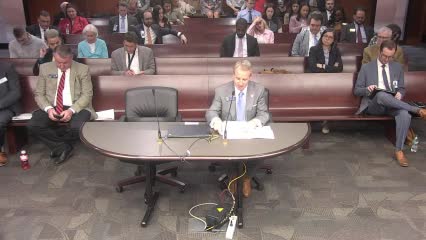
Sen. Albers, the bill’s sponsor, told the Senate Judiciary Committee that Senate Bill 9 would amend and repeal parts of Code section 16-12-80 to define artificial intelligence and make it a basis for criminal liability when someone knowingly distributes or possesses with intent to distribute obscene depictions of a child created using artificial intelligence.
Sen. Albers, the bill’s sponsor, told the Senate Judiciary Committee that Senate Bill 9 would amend and repeal parts of Code section 16-12-80 to define artificial intelligence and make it a basis for criminal liability when someone knowingly distributes or possesses with intent to distribute obscene depictions of a child created using artificial intelligence.
"We've seen young girls, particularly teenage girls, where somebody has used artificial intelligence to use, her face and then superimpose, ******** explicit photos of that person that while not real, they look about as real as could be," Albers said, framing the bill as a response to new methods of exploitation and fraud enabled by low-cost AI tools.
The bill, as described by Albers, would: define the term "artificial intelligence" within the statute; apply that definition to a list of designated offenses (including stalking, exploitation of a disabled adult or elder person, enticing a child for indecent purposes, theft-related offenses, forgery and election interference); and add sentencing enhancements tied to use of AI. Albers summarized the proposed penalties: for a designated misdemeanor, imprisonment of not less than six months and not more than 12 months and a fine up to $5,000; for a designated felony, imprisonment of not less than two years (with fines discussed in committee) and up to 15 years in the most serious formulations described by the sponsor.
Prosecutors' counsel Robert Smith told the committee the bill intends that the same jury hear the underlying guilt phase and then immediately reconvene for an evidentiary sentencing phase on whether the defendant knowingly and intentionally used an AI system. "My reading of this... is that the intent is that it's to be the same jury. It's not gonna be a case where you have to bring in a second jury," Smith said, citing the bill language that "the trial shall immediately be recommenced." Smith also warned the committee two passages (cited to lines 72–73 of the draft) replicate language a Georgia court found unconstitutional and must be struck; he gave the panel a case citation during questioning (Die v. Wallace, 274 Ga. 257 (2001)).
Defense attorneys and civil liberties commenters raised several recurring concerns. Ryan Brown and Maisie Lynn Guertin of the Georgia Association of Criminal Defense Lawyers warned that treating AI-generated images more harshly could produce anomalous outcomes compared with offenses involving real children, and that mandatory sentencing enhancements could raise rule-of-lenity and proportionality questions. Brown told the committee that mandatory bifurcated sentencing hearings could lengthen trials and require expert testimony: "…in his practice, he would expect this to like, if a trial and one of these charges would take him typically five days, this could be a seven day trial."
Private-citizen commentator Thomas Weaver, who formally registered opposition, said he supported the bill’s policy aim but was worried about unintended sentencing consequences and the novelty of the evidentiary issues, including how courts will reliably distinguish AI-generated material from non‑AI material in the near term.
Advocacy and industry witnesses expressed support. Mike Griffin of the Georgia Baptist Mission Board said his organization backed the bill as a measure to curb exploitation of children and to reduce access to sexual content by minors. Mason Rainey of the Technology Association of Georgia said his trade group also supported the measure and thanked the sponsor and the study committee for the draft language.
Committee members focused questions on three technical issues: (1) whether the enhancement will require a separate evidentiary proceeding and, if so, whether the same jury must decide both phases (prosecutors' counsel advised the sponsor's intent is the same jury will reconvene); (2) whether current "Romeo and Juliet"‑style defenses for certain teen-to-teen possession or exchange would apply when the image is AI-generated (the sponsor said he considered those issues but thought AI‑created images present different policy concerns); and (3) practical burden on prosecutors and defenders to hire experts to prove or rebut AI use and provenance, a point the sponsor and counsel acknowledged would increase costs and evidentiary complexity.
Albers acknowledged late-stage drafting fixes would be needed: he told the committee counsel had identified an unconstitutional passage to strike and an additional insertion to ensure the bill would not unintentionally lower mandatory minima in existing statutes (he referred to adding language at the draft's line 111 so enhancements do not replace existing mandatory minimums). Several committee members urged a substitute and redrafting to clarify whether the enhancement is treated as an element of the offense or as a separate sentencing factor, and whether existing bifurcation procedures (for example, those used in firearm-possession enhancements) offered an appropriate model.
The committee took no final vote on SB 9. Albers said he would work with staff and stakeholders on amendments and return the bill for further consideration: "We'll work on it and get it back to you, mister chairman."